Service / Innovation

Pirelli P Zero Cyber Tyre: we tested the tyres connected to the car

The system uses sensors to monitor key data relating to the tyres and driving conditions in order to optimise the operation of the electronic dynamic control systems. Here’s what it does and how it works.

5' min read

Translated by AI
Versione italiana

5' min read

Translated by AI
Versione italiana

The Pirelli P Zero range introduces Cyber Tyre technology, which can be fitted to all variants of the Milan-based company’s Ultra High Performance tyre range. The system, currently fitted to the Pagani Utopia Roadster hypercar but attracting interest from many brands – with Aston Martin leading the way to adopt it as soon as possible – transforms the tyres into active sensors to enhance drivability and, above all, safety. On Pirelli’s test track in Vizzola Ticino, we tested the Cyber Tyre system with super-high-performance cars.
Pirelli Cyber Tyre: everything under control, even when everything goes wrong

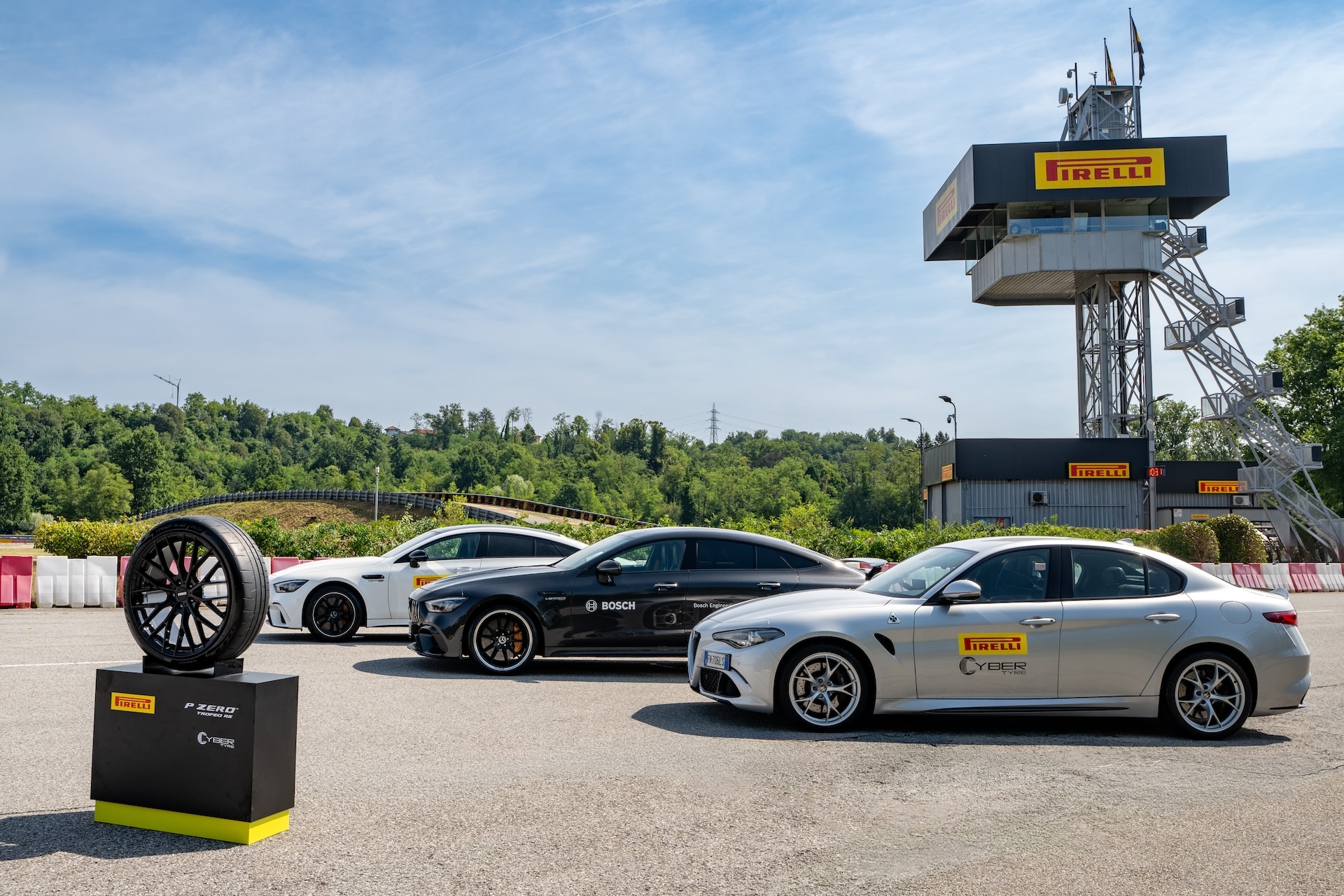
The tests were carried out using anrear-wheel-drive Alfa Romeo Giulia Quadrifoglio Verde with 520 cavalli and two Mercedes-AMG GT Coupé 4s with 530 cavalli and all-wheel drive, all fitted with P Zero tyres which were not ideal for the aquaplaning test conditions, traction control on very wet surfaces and emergency braking with ABS.

Loading...

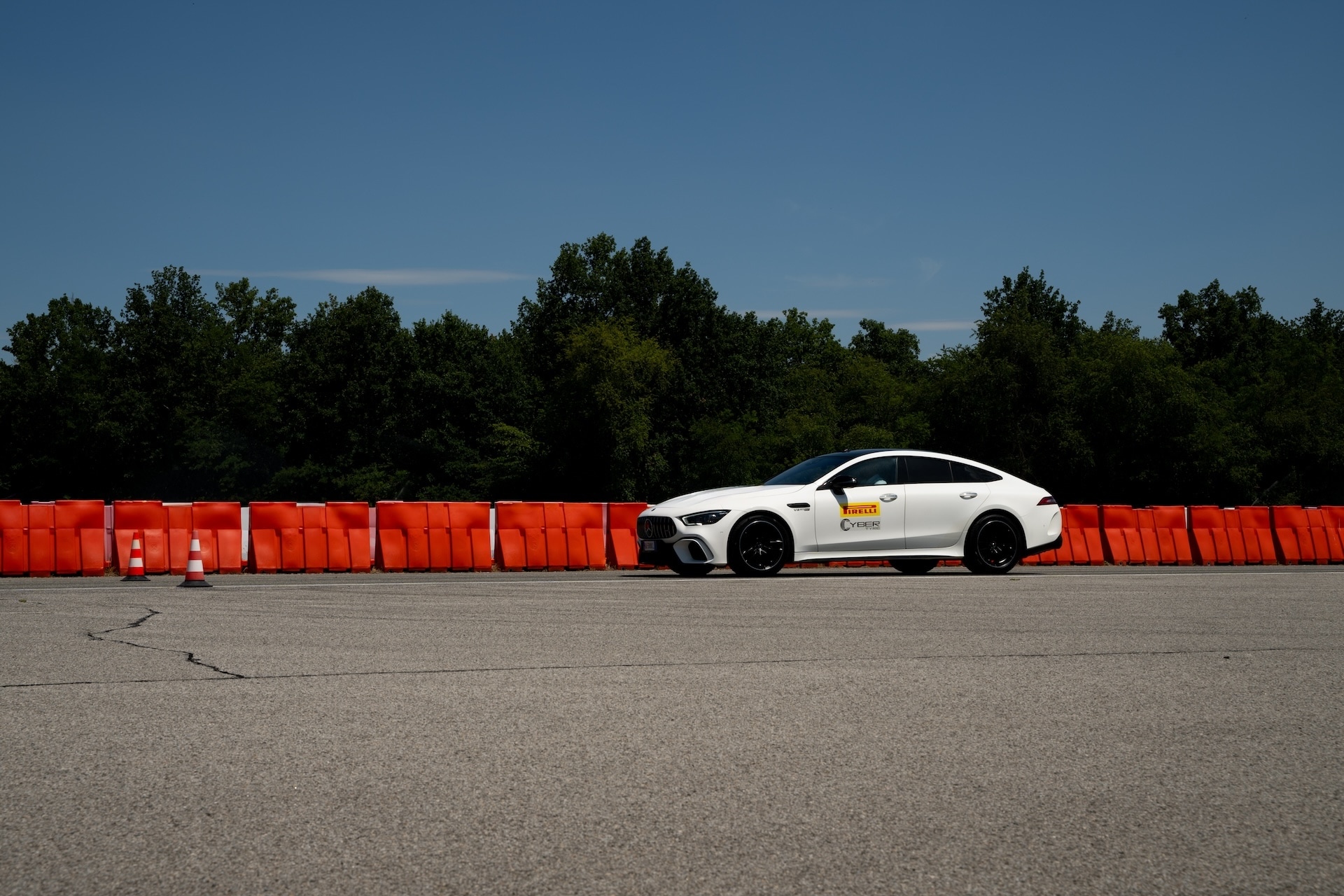
Let’s start this test with a GT Coupé 4 fitted with P Zero Winter tyres, which are perfectly suited to low ambient and road temperatures, but decidedly out of place on a day when the thermometer reads 38° and the road surface temperature is 61°. The car, which – like the others in these tests – serves as a test bed, offers the option to ‘switch’ the control unit’s standard function from standard mode to the mode defined for Cyber Tyre. An emergency braking manoeuvre in standard mode – involving a hard press on the brake pedal triggered by a sudden obstacle appearing in front of the car at 110 all’ora (represented by two cones on the track), resulted in the sensation of a prolonged skid before coming to a halt beyond the finish line. This effect was caused by the soft compound and the track temperatures. However, setting the control unit to Cyber Tyre mode immediately restored the sensation of the tyres gripping the tarmac as they should, bringing the car to a halt 5.4 metres earlier than in the previous situation. And that’s no small feat.

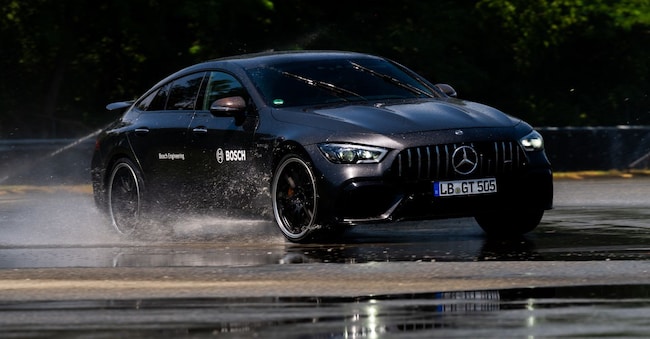
The other GT4, fitted with semi-slick tyres ideal for dry surfaces, was taken through a fairly fast corner on a water-logged surface at full throttle at around 100 orari. Without the aid of Cyber Tyre technology, it veered significantly off course, losing composure before the ESP and traction control intervened, and requiring significant steering corrections, whereas with Cyber Tyre active, it followed the set line perfectly, responding to the subtle corrections made by the dynamic control systems. In short, it felt very natural.

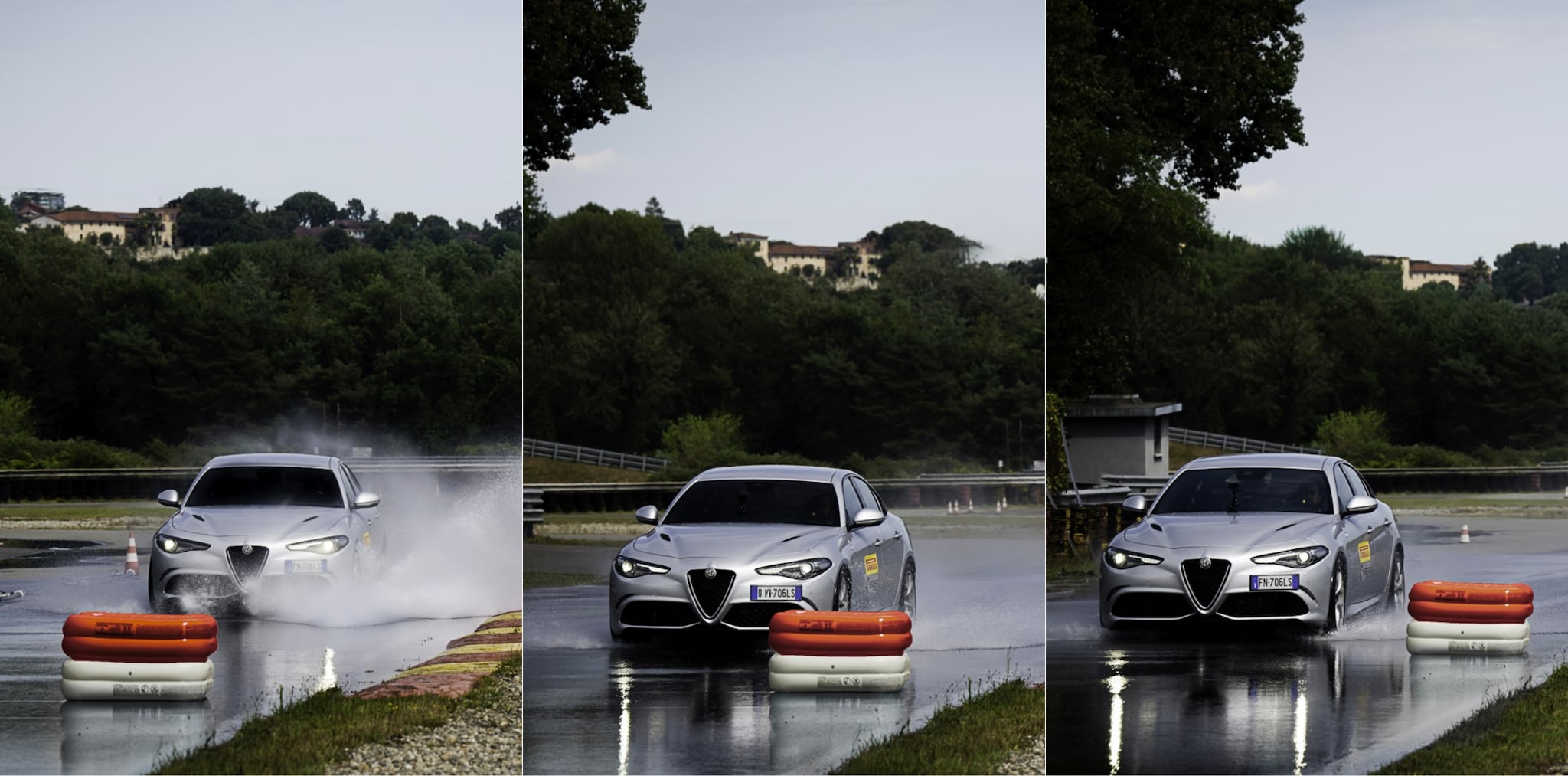
The Giulia Quadrifoglio Verde used for the aquaplaning test was also fitted with P Zero semi-slick tyres. In the first of the two tests in which we were passengers – both of which took place at speeds in the region of 100 per hour – it was only thanks to the great skill of the Pirelli engineer that we were able to counteract the loss of steering control that occurs when the car starts to aquaplane, and avoid hitting thefixed obstacle on the straight – for which we owe a debt of gratitude to those who would have had to reposition it for the subsequent tests. In short, it was quite noticeable that the car was ‘floating’ on the thin film of water. In the second run, however, it entered the long puddle without showing any sign of instability thanks to Cyber Tyre, remaining fully controllable by the driver.
Pirelli Cyber Tyre: how this cutting-edge technology works and what it does

The system establishes a continuous dialogue between the tyre and the car, radically transforming their interaction thanks to technology developed by Pirelli, which is the first in the world to integrate hardware and software. This dialogue is enabled by small, battery-powered sensors – with a battery life spanning the tyre’s entire lifespan – fitted inside the tyres. These sensors detect the type of P Zero fitted, as well as the temperature, pressure, wear and grip conditions of each wheel, whilst also taking into account longitudinal, lateral and vertical acceleration values. The data is transmitted in real time via Bluetooth to the on-board network through dedicated interfaces. A specific Pirelli library within the dynamic management systems control unit processes the information and makes it available fully automatically, providing continuously updated data and, where necessary, alerting the driver.

The central system is the result of a joint development project with Bosch Engineering, which ensures that the data processed by the Pirelli software enables the ABS, ESP and traction control systems to intervene more precisely, effectively and in real time, thereby allowing the full available grip to be utilised to the maximum, to the benefit of safety.

An important factor in the system’s operation is the recognition of the tyre type. Indeed, this avoids the inevitable compromises in the calibration of standard car control units – which arise because the settings must be suitable for every type of tyre – by allowing for bespoke calibration of the dynamic control systems’ performance, to achieve shorter braking distances and ensure smooth, reliable intervention by the ESP and traction control systems based on data received from the tyres. What’s more, this is achieved without affecting the linearity of the ride or the natural feel of the driving experience. But that’s not all, because Pirelli and Bosch Engineering are working on further developments for the application, including the prevention of aquaplaning.

Pirelli’s investment in RIDEsense – a spin-off from the University of Naples Federico II – also forms part of Cyber Tyre’s development process; Pirelli currently holds a 24.99 per cent stake, with an option to increase this to 100 per cent of the share capital. The collaboration aims to develop new software to be integrated into the Cyber Tyre ecosystem, combining the physical sensors of the Pirelli system with the virtual sensors developed by RIDEsense to further enhance the functionality of the car’s electronic safety systems: from the detection and prevention of aquaplaning to tyre and vehicle diagnostics, as well as strengthening Cyber Tyre’s role in the functionality of ADAS and autonomous driving systems. This technology also sees Pirelli’s investment in the start-up Niunlix – founded as a spin-off from the Politecnico di Milano – come to the fore, with a view to enhancing the Milan-based company’s role in the mobility ecosystem of the future.

Pirelli Cybre Tyre also helps improve safety by monitoring road conditions using AI

For some time now, the applications of this technology have also extended to road monitoring as part of specific projects launched in collaboration with Movyon, a company within the Autostrade per l’Italia group, and the Puglia Region, with the aim of identifying any issues and enabling prompt maintenance work.

To maximise the potential of Cyber Tyre, Pirelli has also launched a programme of targeted investments in technology companies and start-ups capable of enriching its ecosystem. Among these is the Swedish firm Univrses, which specialises in computer vision and artificial intelligence applied to road transport. This collaboration enables data from the tyres to be integrated with that collected by on-board cameras, which is then processed using AI-based algorithms to enhance the Cyber Tyre system’s ability to interpret its surroundings, detect issues with the road surface and road signs, and, more generally, assess the condition of the infrastructure.

Copyright reserved ©
Loading...

Brand connect

Loading...

Newsletter

Notizie e approfondimenti sugli avvenimenti politici, economici e finanziari.

Iscriviti