A world at risk

Pollution caused by war: the environment is suffering too

The impact on the natural world: 5.5 per cent of CO₂ emissions stem from conflicts. Pollution and direct damage are likely to persist for decades

7' min read

Translated by AI
Versione italiana

7' min read

Translated by AI
Versione italiana

Ukraine and Russia, Palestine and Israel, the ongoing tension between Iran and the US in the Strait of Hormuz, Iraq, the invasion of Kuwait and, going further back in time, the world wars. Conflicts which, in addition to the enormous human cost, have left behind several tonnes of rubble. Debris and devastated territories, some of which have never been fully restored. Who does not still have before their eyes the black smoke rising from the burning oil wells during the First Gulf War? Or, more recently, the drone footage of the ashes of Gaza. There is, however, a difference between these two examples: whilst we know little about the impact of that black smoke on the environment, we do have some indicators of the environmental damage caused in Gaza: 61 million tonnes of rubble, a scale comparable to around ten Great Pyramids of Giza. In fact, clearing all this rubble could cost around 1.9 billion dollars .

This means that, just as with human affairs, for the environment too, the end of wars does not coincide with the end of conflicts. There is a long-lasting wave of suffering for people, and there is a long-lasting wave of poison for the soil, water and the environment, the damage from which will continue even into future generations.

Loading...

L’ALLERTA NEL MONDO

Loading...

Arsenic in the Place à Gaz

The French know this only too well: in the forest of Verdun, where the Germans and the French fought one of the bloodiest battles of the First World War, there is a particularly toxic area called Place à Gaz, located precisely within the ‘forêt domaniale de Spincourt’, some twenty kilometres north of the battlefield. The findings, published in 2007, regarding the state of this area are among the most striking for a European site. In normal soil, arsenic is in fact present in trace amounts: five or six milligrams per kilo of soil. Arsenic is a naturally occurring poison that is generally harmless in these quantities. At Place à Gaz, levels of 175,907 milligrams were measured – 35,000 times the average for European soil. In fact, arsenic made up 17.5 per cent of the soil. Access to Place à Gaz was indeed prohibited, but only in 2012.

Uranium in Sarajevo

From arsenic to uranium : in Sarajevo between 1994 and 1995, NATO A-10 aircraft bombed the area around the city with nearly three thousand kilograms of depleted uranium munitions, which were concentrated mainly on Hadžići. Twenty years after the end of the war, soil analysis of playgrounds has revealed the continued presence of heavy metals, polycyclic aromatic hydrocarbons and polychlorinated biphenyls, including lead at levels of up to 48 milligrams per kilo.

CO2 emissions

From earth to sky: it is estimated that out of 53.2 billion tonnes (Gt) of CO₂ equivalent per year – that is, global greenhouse gas emissions – 5.5 per cent is attributable to the military sector. This means that if this were a country, it would rank among the world’s largest emitters, in fourth or fifth place, behind the EU (6 per cent) and ahead of Russia (5 per cent) (China, the United States and India lead the way, with 32 per cent, 12 per cent and 8 per cent, according to the EU Commission’s Edgar Report).

Damage to agriculture

On top of all this, there are other forms of environmental damage, such as that to agriculture, such as the approximately 2,000 agricultural sites destroyed in Gaza or the approximately 60 million litres of sewage which, every day in Gaza, have ended up untreated in the soil and groundwater.

The effects on the Amazon rainforest

And furthermore, in Colombia the Amazon rainforest has, paradoxically, been at greater risk under peace than when it was the scene of the FARC guerrilla conflict. The guerrillas had, in fact, forced farmers to leave at least a quarter of their land untouched, because the tree cover served them as a hiding place to defend themselves against aerial bombardments. Following the 2016 peace agreement and the guerrillas’ withdrawal, that ‘control’ ceased, so the following year, partly due to the expansion of livestock farming and the cultivation of coca, the country lost 219,973 hectares of tree cover, the equivalent of 35 football pitches every hour.

This has triggered a further long-term consequence: over the following decade, the Colombian Amazon lost around 1.2 million hectares. In 2024 alone, deforestation rose by 43 per cent. This map of devastation was compiled in the very year when, both in Italia and in many parts of Europe, the summer the heatwave officially broke the all-time record set in 2003, is the recently published essay entitled ‘War and Climate’ (Il Saggiatore) by Stefania Divertito, an essayist and investigative journalist specialising in environmental issues. “On 21 June 2026,” writes Divertito, “the European Copernicus programme recorded the all-time record for surface temperature of the world’s seas, and in the Mediterranean, the basin around which wars arise and never truly end, satellites detected waters up to six degrees warmer than the average over the last forty years’.

The offence of ecocide

A situation that would call for a strong punitive response, such as the introduction of the offence of ecocide as a standalone crime in the Rome Statute of the International Criminal Court – a proposal which, however, is still merely under discussion. In the meantime, however, an act of responsibility – albeit a theoretical one – towards future generations has materialised: ‘Since March 2022,’ writes Divertito, ‘the Italian Constitution has contained 12 words addressed to people who do not yet exist: the Republic ‘shall protect the environment, biodiversity and ecosystems, also in the interests of future generations...”, Germany had already assumed, in writing, through Article 20 of the Basic Law, responsibility towards future generations as early as 1994; France incorporated its Charte de l’environnement into the Constitution in 2005. And in 2008 Ecuador went further than anyone else, because its new Constitution, approved by referendum, recognises as a subject of rights nature itself, which it refers to by the name given to it by the Andean peoples, Pachamama, Mother Earth, and guarantees it the right to exist and to regenerate its own life cycles’.

Alerts around the world

Ukraine: The collapse of the Kakhovka dam

Loading...

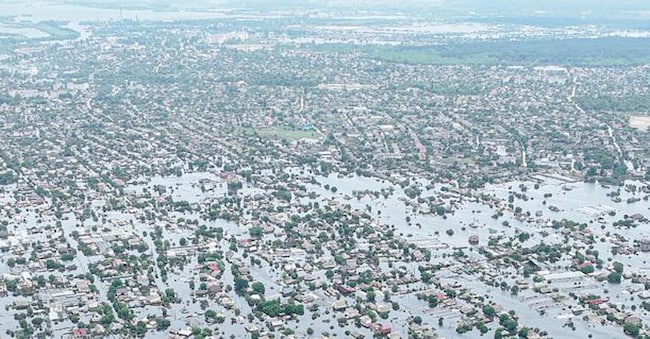
On 6 June 2023, the Kakhovka dam, on the River Dnieper, was destroyed during the Russian occupation, releasing 16.4 cubic kilometres of water in a matter of hours and draining a reservoir that covered 1,870 square kilometres, 90 per cent of its surface area. The study published in Science in 2025 by Oleksandra Shumilova and colleagues calculated that approximately 83,000 tonnes remain on the exposed riverbed of heavy metals, deposited by decades of industrial activity upstream: contamination that the researchers describe as a ticking time bomb, because rain and erosion could mobilise it towards the Black Sea.

Gaza: Rubble equivalent to ten Pyramids of Giza

In Gaza the water was already compromised before the war: in 2023, the WHO estimated that over 97 per cent of the coastal aquifer – the Strip’s only groundwater reserve – was unfit for consumption due to salinity and nitrates. The conflict destroyed 70 per cent of the sewage pumps and no treatment plants remain operational, meaning that around 60,000 cubic metres of sewage seep into the ground every day and from there into the aquifer. The second UNEP assessment, published in September 2025, estimated 61 million tonnes of rubble – equivalent to around ten Pyramids of Giza – 15 per cent of which poses a high risk due to asbestos and heavy metals.

Sarajevo: Uranium in the groundwater, lead in the parks 

In Sarajevo, the siege ended in 1995, but the ground continues to bear witness to it. Between 1994 and 1995, NATO A-10 aircraft struck the area around the city with nearly three thousand kilos of ammunition depleted uranium, concentrated mainly on Hadžići. In 2002, a UNEP mission confirmed, for the first time at a European site, that the uranium had reached the groundwater. In 2016, environmental chemist Aida Šapčanin analysed the soil of the city’s playgrounds for the first time and found heavy metals, polycyclic aromatic hydrocarbons and polychlorinated biphenyls, with lead levels of up to 48 milligrams per kilogram.

Sudan: Where gold is poisoning children

In Sudan, torn apart by the conflict between the army and the Rapid Support Forces that broke out in April 2023, the area most affected is not the one that has been bombed, but the one that has been dug up. Having lost access to two-thirds of its oil revenues following the secession of South Sudan in 2011, the country turned to gold, which in 2025 generated around 1.8 billion dollars, largely extracted from artisanal mines. To separate the metal from the rock, mercury is used, which is then burnt to make it evaporate: the substance settles in the soil, seeps into the water table and, following the floods of 2022 and 2023, has even reached the Nile, causing neurological damage among children exposed to the fumes from the burning.

Iraq: The surge in cancer cases 

In Falluja, the war has left a legacy that can be measured in terms of cancer. In 2004, the US deployed a high-explosive device followed by the dropping of white phosphorus, a substance that burns at 816 degrees. As the phosphorus settles into the ground, it transforms into phosphoric acid and phosphorus pentoxide, acidifying the soil and reducing fertility for years; to this was added depleted uranium, which had already been widespread in the region since 1991. A study published in 2012 in the International Journal of Environmental Research and Public Health recorded, in the years that followed, a four-fold increase in all cancers and a twelve-fold increase in childhood cancers.

Iran: Over 300 environmental incidents

Tehran is a city of nine million inhabitants nestled between the Alborz Mountains and a desert plain, a geographical formation that traps the air as if in a basin. On the night of 7–8 March 2026, air strikes hit four oil depots around the capital, including Shahran and Karaj: the smoke remained visible from satellites, and in the days that followed, what the media dubbed black rain fell – a mixture of particulate matter, nitrogen oxides, dioxins and polycyclic aromatic hydrocarbons. CEOBS has recorded over three hundred environmental incidents linked to the conflict. The destruction of the Rey and Kan depots released 19.5 million litres of fuel and 47,000 tonnes of greenhouse gases.

Copyright reserved ©
Loading...

Brand connect

Loading...

Newsletter

Notizie e approfondimenti sugli avvenimenti politici, economici e finanziari.

Iscriviti