
Porsche 911 GT3 S/C: behind the wheel of this thrilling but expensive new find with 510 cavalli
The range of the only 911 with a naturally aspirated engine – available exclusively with a manual gearbox and featuring numerous features derived from the world of motor racing – now includes, for the first time, a convertible version priced at 280,000 euros. It offers not only the pleasure of open-air driving, but also the joy of driving in all conditions.

Key points
- Porsche 911 GT3 S/C: plenty of power and a manual gearbox / the ultimate evolution of the flat-six is combined with plenty of carbon fibre and magnesium
- Porsche 911 GT3 S/C: a design that combines emotion and functionality
- Porsche 911 GT3 S/C, 2-seater interior with highly personalised details
- The Porsche 911 GT3 S/C offers the perfect connection between driver and car on the road
S/c, or ‘sport cabriolet’. An abbreviation that had never before featured in the Porsche 911 GT3 range and which can also be interpreted as ‘super engaging’. A definition that encapsulates the thrills evoked by the combination of the overwhelming performance of the flat-six engine – a rare example of pure engineering, being neither electrified nor supercharged, and available only with a manual gearbox – its weight, which is unusually close to that of the coupé versions to enhance dynamism and driveability, and the exhilarating symphony that fills the cabin, particularly with the top down when the rev counter needle approaches 9,000.
Based on the Touring version – that is, the GT3 coupé without the striking rear wing supported by the iconic swan-neck mounts – the S/C is on sale for 280,000 euros. That is, €60,000 more than the S/T coupé versions – in simpler terms, the sports tourers.
Porsche 911 GT3 S/C: plenty of power and a manual gearbox / the ultimate evolution of the flat-six is combined with plenty of carbon fibre and magnesium
In practice, it can be said that the GT3 S/C not only brings to the table the weight savings that many designs have achieved – compared to the extra weight that convertibles typically add over coupés – but also comes with a hefty price tag. This extra cost is not solely due, as in many other cases, to the presence of the electrically operated soft top and the structural reinforcements to the bodywork to compensate for the absence of a metal roof – which were not necessary for this GT3 – but to the measures taken to ensure that its inclusion did not cause its weight to deviate from that of the GT3 coupés (less than 1,500 kg), particularly those fitted with the optional dual-clutch gearbox. This objective was achieved both by offering the 911 exclusively with a manual gearbox – which is lighter than the automatic – and through an extensive quest to save every gram, achieved by incorporating a massive amount of composite materials and magnesium into its construction, even in the weave of the fabric and the structure of the soft top. Furthermore, this GT3 features many carbon-fibre body and interior components, similar to those in an optional package for the coupés, carbon-ceramic brakes, 20-inch magnesium wheels at the front and 21-inch at the rear, and a compact, lightweight 40 Ah lithium-ion battery.
Under the bonnet lies the 4-litre flat-six engine found in the other GT3s, producing 510 cavalli and 450 Nm of torque, developed to comply with current emissions regulations and featuring two particulate filters and four catalytic converters. Fortunately, the complex exhaust system does not alter the characteristic roar of this engine, thanks to meticulous work by Porsche’s ‘sound engineers’. The flat-six propels the GT3 S/C to 313 all’ora and to 100 orari in 3”9, just as it does with the coupés. From those versions, the Cabriolet inherits the direct steering ratio and a suspension set-up derived from the track-focused GT3 – featuring CFRP anti-roll bars – and, for the first time on a 911 Cabriolet, a double-wishbone front suspension.
Porsche 911 GT3 S/C: a design that combines emotion and functionality
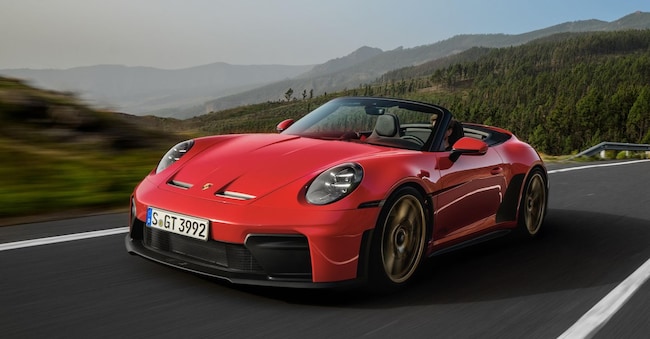
Aesthetically, the new convertible follows the design of the Touring coupé from which it is derived, sharing the entire lower section of the bodywork, which features design elements at the front and rear that optimise aerodynamics, including doors shaped to facilitate the flow of air coming from the vents in the front wheel arches. As on the rear of the Touring coupé, the cabriolet also features a Gurney flap – an extendable spoiler that ends in a suitably angled lip. This is a feature that no other 911 Cabriolet has ever had. The bonnet design mirrors that of the Touring and blends seamlessly with the soft-top housing; when raised, it creates a profile very similar to that of the 911 coupés. The ultra-light soft top can be lowered and raised electrically in 12” even whilst the car is moving at speeds of up to 50 all’ora.

