
Porsche presents the world's first wireless charging with the Cayenne electric concept
The innovative technology is a first in the automotive industry and will be available with the first series of the German manufacturer's largest full-electric suv.

3' min read
Key points
3' min read
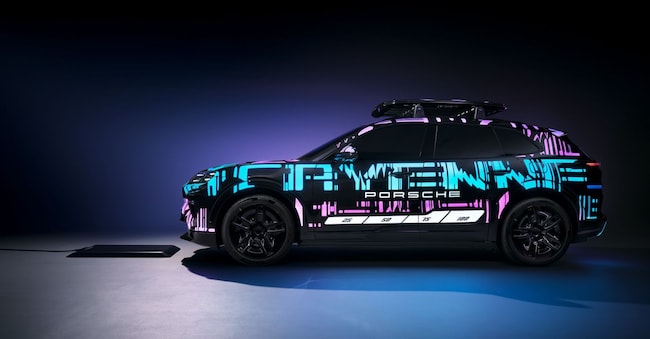
Displayed in Munich in fluorescent camouflage in concept configuration, the first electric Porsche Cayenne due to arrive at the end of the year is the 'godmother' of the world's first wireless charging system developed, produced and offered by a car manufacturer. The technology, which other manufacturers and many specialists are still developing, is undoubtedly a fundamental building block in simplifying the use of electric cars. Just as in the case of smartphones and some everyday electronic devices. This is how Porsche has developed this optional solution, which will, of course, also be available for its other electric models.
Porsche, this is what wireless charging looks like
.The system, which is called One Box, avoids the installation of a wallbox or control unit and can be installed in a garage, carport or outdoor parking space and connected directly to the mains, if desired, also with the support of Porsche Installation Service. With a maximum AC charging power of 11 kW, the system manages to reach the level of AC charging with a cable, as the energy transfer from the mains to the battery is up to 90 per cent. The plate, which is 1.17 metres long and 70 centimetres wide as well as 6 centimetres high, interacts with the car with specific hardware in the car and can be managed with the My Porsche app. The new electric generation of the Cayenne will be the first Porsche to be ordered with optional Porsche Wireless Charging and the Porsche Wireless plate on board. The plate is protected from stone chips and the elements, while the receiver unit is located in the underbody of the car between the front wheels.
Porsche, wireless charging is easy to use
.To start charging, simply park the Cayenne on top of the plate placed on the ground. The transfer of energy without any contact between the two charging units takes place at a distance of just a few centimetres, as the Cayenne lowers itself automatically. The floor plate has a motion sensor and a foreign body detection system. The charging process is automatically interrupted if a living thing, i.e. not only people but also animals, gets between the on-board plate and the floor plate or if a metal object is placed on the latter and becomes hot. A specific display within the Surround View parking function makes it easier to position the Cayenne at the optimal charging point. As soon as the car reaches the parking position above the plate and the parking brake is activated, charging begins. Induction charging developed by Porsche uses ultra-wideband technology to determine the car's position relative to the floor plate, then when the car reaches the optimum position the driver is alerted. In the on-board secondary coil, which acts as a receiver, the magnetic field generates alternating current that a rectifier converts into direct current, which can be stored in the high-voltage battery. During charging, the electromagnetic radiation remains confined to the underbody of the car. The floor plate, which weighs 50 kilograms, integrates an LTE and WLAN module to ensure remote software updates and infrastructure support.
Porsche, what does the fluorescent Cayenne concept look like
?The concept exhibited in Munich that anticipates the electric Cayenne, whose debut is set for later this year, and which of course can also be recharged like all other Porsche DC battery cars up to 400 kW in any Porsche Charging Lounge, has been finished with an innovative fluorescent paintwork that transforms the bodywork into a spectacular brightly-coloured surface that reproduces the dynamic camouflage pattern devised by the Porsche Style Centre when it is stressed by alternating current Some areas of the paintwork have been intentionally left out to create a dark effect, while five shades (from blue to violet) can be controlled in a targeted manner. The innovative coating consists of more than twenty-five layers of ultra-thin material including conductive primers, electrodes and insulators, as well as the actual electroluminescent material containing coloured pigments. To create the livery of this unique show prototype, more than fifteen layers of clear varnish were applied, more than thirty sanding passes were made and more than five hundred metres of cable were used.

