

Record transplant: heart travels 1,600 km from Athens to Turin without ever stopping beating
The recipient is a 65-year-old man suffering from severe post-infarct dilated cardiomyopathy who has been waiting for a transplant for about a year

Key points
For the first time, a heart from Athens was transplanted 1600 km away without ever stopping its beat, in the Molinette hospital in Turin. A heart for transplant that was kept beating not only during transport, but also during implantation in the patient. The case was handled in Turin by the Molinette hospital, whose managers speak of 'breaking a new frontier'. The organ, taken from a donor in Athens, was no longer stopped, for a total of eight hours between travel and operation. 'A revolution that makes it possible to overcome the barrier of time,' they say at the City of Health. The recipient is a 65-year-old man suffering from severe post-infarct dilated cardiomyopathy who has been waiting for a transplant for about a year. "Once again," commented Federico Riboldi, Piedmont Region's Health Councillor, "the Piedmont Region's Transplantation System confirms its position at the top in Italy and Europe with a heart transplant of exceptional technical and organisational difficulty.
A revolution that breaks the time barrier
This is an innovative type of transplant in which Italy has led the way: the world's first ever beating heart transplant, from harvesting to implantation, was in fact performed last year at the Padua hospital. But here there is the great news that the heart, which would later be transplanted in the operating theatres of the Cardiac Surgery (directed by Professor Mauro Rinaldi) of the Heart and Lung Transplant Centre of the Molinette Hospital of the City of Health and Science of Turin, started beating again 1600 km away, the distance separating Turin and Athens, and was no longer stopped even during its implantation in the recipient's chest, for a total of 8 hours. A 'revolution', it notes, that makes it possible to overcome the time barrier because the heart is artificially perfused during all the phases of the transplant (transport and implantation) without suffering from ischaemia linked to the lack of blood (usually the organ has a maximum ischaemia time of 4 hours to be transplanted).
How the withdrawal worked
A Greek donor in an Athens hospital is referred by the National Transplant Centre, directed by Giuseppe Feltrin, and the Piedmont Regional Transplant Centre, directed by Federico Genzano Besso, to the Heart Transplant Centre of the City of Health and Science of Turin, directed by Professor Mauro Rinaldi. A harvesting team from the Molinette Hospital, consisting of Erika Simonato, Matteo Marro, Professor Andrea Costamagna and Dr Domitilla Di Lorenzo, left Turin in the late afternoon and reached Greece by private jet. At midnight the sampling begins. The heart is removed and, after being placed in a machine that restores its perfusion during transport (Ocs Heart, Transmedics) is restarted. The heart starts beating again in the perfusion machine in Athens and is transported in this state (beating) to Turin. Meanwhile, a 65-year-old patient with severe post-infarct dilated cardiomyopathy, who had been waiting for a transplant for about a year, is brought into the cardiac surgery operating theatre and prepared to receive the transplant.
The transplant and the course
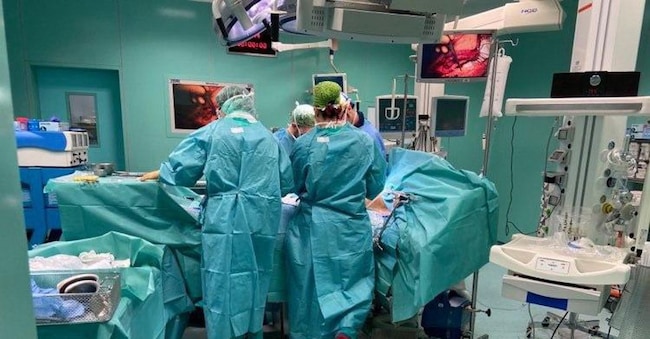
The heart arrives in the operating theatre beating in the perfusion machine for about six hours. The recipient is in extracorporeal circulation and his old bad heart has already been removed. Unlike the usual practice, the heart to be transplanted is not stopped, but is connected to the extracorporeal circulation that is keeping the patient alive. In this way, the new heart can be detached from the perfusion machine used for transport while maintaining perfusion itself and the heartbeat. The transplantation performed by Professor Massimo Boffini, Professor Antonino Loforte and Dr. Barbara Parrella, assisted by anaesthetist Dr. Rosetta Lobreglio, is carried out with the heart beating naturally, first supported by the surgeons' hands and finally in its natural position, i.e. in the patient's pericardial cavity. The post-transplant course went smoothly and the patient was transferred from the Intensive Care Unit (coordinated by Dr. Anna Trompeo) to the ordinary in-patient ward of Cardiac Surgery after a few days. "A story with a happy ending that once again becomes an example of the excellence of our City of Health and Science at a European level and of the value of our operators," pointed out the General Director of the Cdss Livio Tranchida.


