Astronomy

Red Moon eclipse visible from all over Italy: times not to miss Sunday's event

The spectacle is certainly worth the effort; it requires no equipment other than going to a comfortable place. We have not seen an eclipse like this for about six years

by Leopoldo Benacchio

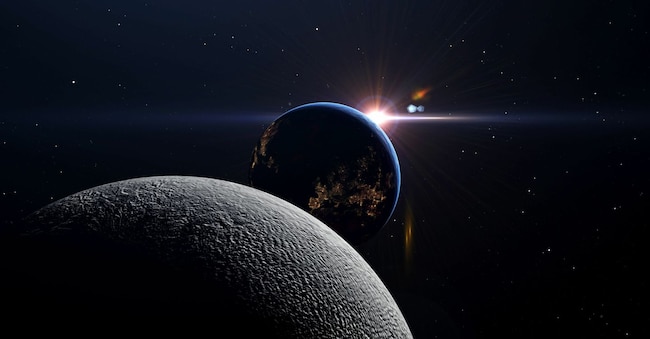
Eclissi lunare. (FreelanceImages/Universal Images Group/Science Photo Library / AGF)

3' min read

3' min read

Next Sunday, 7 September, big show in the skies: we will be able to see a moon eclipse for a few tens of minutes, from all over Italy.

The Moon will be very red in colour, and this is for two reasons: it already rises practically in eclipse, the phenomenon in fact beginning when it is not above the horizon from us; moreover, being very low on the horizon, it will be even more reddened by the atmosphere, as it already normally is, and it will also appear a little larger than usual.

Loading...

Because of its colour, an eclipse like this is also called by the unsympathetic appellation 'bloody'. We have not seen one for about six years.

So there are pros and cons: the spectacle is definitely worth it, it does not require any equipment, except to go at sunset to a comfortable place, with a clear horizon and possibly without too much light.

The cons are essentially that when the moon rises it will not yet be dark, in fact still quite light, but if we go a few minutes earlier to the chosen spot and do not look towards the setting sun, which is not very good for later viewing, we can rest assured that the spectacle will be assured. Slightly better will be the regions to the east in Italy, hence Puglia, but the difference is only a few minutes.

Let us now turn to the timetables, which, as mentioned, differ slightly between regions, from East to West.

Taking Central Italy at 19:30 the Moon will have just risen and already be in total eclipse, as mentioned. At 20:11 it will be the maximum of the eclipse, with the Moon at about 10 degrees above the horizon; if we want an empirical but realistic measure, we need only stretch out our arm and clench our fist: its size is a little less than 10 degrees. These are the best moments we should not miss, because at 8.52 p.m. the eclipse exit phase will begin and at 10.55 p.m. it will be over and we will return to seeing a beautiful, let's say, normal full Moon.

Those with binoculars can enjoy exploring some of the details of the lunar terrain, and those who wish can also easily photograph the eclipse exit phases.

It remains to be remembered why there are eclipses of the Moon: the Sun and Moon face each other but the Earth stands in the way, and we see them from there: that is why we go from full Moon to eclipse and then back to full Moon within a few tens of minutes. One may rightly ask: if this is so, how come we do not have an eclipse of the Moon every month? Simple: the Moon's orbit is tilted by about five degrees and the eclipse requires the three bodies to be perfectly aligned, which happens much less often than every month. If it is difficult for us to understand just put three fruits on the table, for example. one will be the Sun, another the Earth and the smallest the Moon. If the latter is not on the table, but below or above, no eclipse. That is why the phenomenon is not repeated 12 times in a year, but from zero to three times, and they can be total or partial eclipses or even just penumbra, depending on the position of the three bodies.

The second point to understand is why the Moon will remain visible, since the eclipse should obscure it, as the Sun does when it goes completely black in total eclipses.

The fault, so to speak, lies with our atmosphere: the Earth, which is located between the Sun and the Moon, filters the sunlight with its tenuous atmosphere and scatters it into space, favouring red wavelengths, which is why the Moon, even though it is in total eclipse and is some 400,000 kilometres away, remains dimly visible, illuminated by diffuse light.

It is worth following the phenomenon because at the beginning, as we have said, the sky will still be clear but it should darken in a few minutes and the red hue due also to the low altitude on the horizon should be better detected

The next total eclipse of the Moon will be on 31 December 2028, for New Year's Eve dinner.

Copyright reserved ©
Loading...

Brand connect

Loading...

Newsletter

Notizie e approfondimenti sugli avvenimenti politici, economici e finanziari.

Iscriviti