Cars

Renault 4 E-Tech Electric, the test. Here's what the reinvented icon looks like, how it goes and how much it costs

Aesthetically inspired by its famous and versatile ancestor, the French manufacturer's new battery-powered model launches itself into the future with an intriguing appearance, state-of-the-art technology and many practical solutions.
by Massimo Mambretti

6' min read

6' min read

From its ancestor it inherits the aesthetic layout, extremely versatile character and functionality, but then the new Renault 4 breaks away from the small car context where its progenitor reaped success everywhere and enters the urban suv context, adopting efficient electric powertrains and presenting itself with an eye-catching line and sophisticated technological equipment. In short, the new 4 follows in the footsteps of the reinvented 5 E-Tech Electric, paving the way for Renault's third battery retro-futurist: the 21st century Twingo that we will see next year.


Loading...

Renault 4 E-Tech Electric, le foto della prova dell’urban suv a batteria

Photogallery20 foto

Renault 4 E-Tech Electric, well-known powertrain but also technological innovations

.


To reinvent the charismatic 4 produced between the early 1960s and 1992 in twenty-eight parts of the world, Renault used the same recipe it used to revive the 5, so much so that the two cars share many components under the outfits. In fact, the new 4 is also based on the AmpR Small architecture developed by Renault's Ampere division and is offered with the same front-mounted powertrain and nickel-manganese-cobalt batteries as its sister car. At the base of the offering is the variant with the 120 horsepower engine and 225 Nm of torque powered by a 40 kWh battery promising range of up to 308 kilometres, while at the top of the range is the unit with 150 horsepower and 245 Nm of torque coupled with a 52 kWh battery that moves range up to 408 kilometres. In both cases, the equipment includes a heat pump, bi-directional recharging to transfer current to the external network and device, while recharging can be done either with alternating current up to 11 kW or with direct current with systems of up to 80 kW in the case of the less powerful 4 and up to 100 kW in the case of the more powerful one, so as to always allow refuelling from 20 to 80 per cent in half an hour. With the new 4, the one-pedal function makes its Renault electric debut. This model also offers the option of opting for the Extended Grip traction control system, which adds snow and off-road configurations and brings M+S tyres. The equipment together with a ground clearance of more than 18 centimetres makes it possible to tackle low-grip surfaces and unpaved roads without too many worries, just like the R4 of the past, which was so popular with country dwellers thanks to this option.


Renault 4 E-Tech Electric, past and present styling cues draw the urban suv line

.


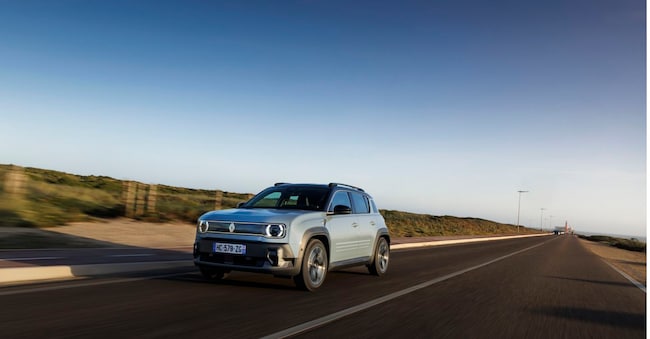
Having gone from hatchback to urban suv, the new 4 fits dimensionally between the 5 and the electric Mégane as well as the Captur, passing between the Renault Ice. In fact, it is 4.14 metres long, 1.80 metres wide, 1.57 metres high and has a wheelbase of 2.62 metres which, for the record, is 8 centimetres longer than that of the 5. Aesthetically, the new 4 is clearly related to that of the past with a silhouette in which the flat shape of the front end stands out, together with the vertical grille that is now obviously sealed, surrounded by a luminous frame and integrated by the full-LED headlights and the illuminated Renault logo, with the trapezoidal design of the third side window and that of the rear lights, as well as the slightly arched profile of the roof. To emphasise the SUV personality, the body is surrounded by plastic side and lower guards, as well as roof rails and muscular wheel arches.


Renault 4 E-Tech Electric, stylish, practical and well-digitalised interior

.


The rational intertwining of body design and dimensions is positively reflected in the interior of the 4, as even those sitting in the rear have a good amount of space in both length and height, but of course only two people can travel very comfortably in this area. The dimensions of the passenger compartment do not limit the width of the load area, which offers a volume ranging from 420 to 1,405 litres similar to that of larger cars. Functionality is benefited by the low loading sill, the compartment under the load floor for storing charging cables, the large gap that opens the tailgate (electric on request) and the backrest of the front right seat that can be folded forward to create a 2.20-metre storage space.

The décor is identical to that of the 5 and thus combines modern elements with nostalgic details. The pleasant-looking dashboard supports two unconnected screens enclosed in a frame. In the entry-level trim the cockpit is 7" in the others 10.3", while the infotainment display slightly oriented towards the driver is always 10.2". However, in the two higher trim levels it makes use of the OpenR Link operating system that integrates Chat Gpt, navigation with route planning to facilitate recharging on the road, wireless integration for smartphones, the Reno avatar and Google services, and offers up to a hundred apps. Digitisation rationally leaves the climate controls and some vehicle services out of sight. Instead, it is just as convincing as on other recent Renaults to place the gear lever to the right of the steering wheel along with the windscreen wiper and audio controls satellite because it is easy to confuse one with the other. The regenerative braking paddle can also be added to the confusion. On the other hand, the refined presentation of the ambience is very convincing, especially in the higher trim levels that feature the dashboard and headlining covered in quilted recycled fabric, blue denim effect inserts on the doors if on the seats that, in the end, camouflage well the presence of even hard plastic components.


Renault 4 E-Tech Electric, behind the wheel of the 150 hp version

.


On the road with the 4 of the electric era it immediately reveals itself to be confident, because from the very first metres it exhibits a healthy and fun character. The version with 150 horsepower and a 52 kWh battery, which reaches a self-limited 150 km/h and tops 100 km/h in 8"2 against a declared average consumption of 15.1 kWh/100 km, moves with ease through bends, while in traffic it proves manoeuvrable thanks also to the reduced turning radius that facilitates manoeuvres and only at motorway speeds is the constitutional silence of electric cars broken by aerodynamic hiss. In general, however, comfort is always appreciable thanks also to the set-up that although rather rigid, to contain the roll in curves that can trigger ground clearance, proves to be a good compromise to absorb most of the road's irregularities. The powertrain always responds with good responsiveness and linearity regardless of the driving mode set and becomes very responsive in Sport. Thus, especially by customising the steering response in driving mode to make it more ready, the 4 becomes fun to drive. The general pleasantness of the drive does not diminish even when using the regenerative braking steps, among which the most incisive One Pedal comes to a complete stop but never abruptly. As far as consumption is concerned, at the end of our test essentially on extra-urban roads around Lisbon at a leisurely pace the on-board computer recorded an average of 14.1 kWh/100 km, but on the short motorway stretches we tackled the bar rose to 24 kWh/100 km.


Renault 4 E-Tech Electric, versions and prices

.


The range is made up of five versions that originate from the intertwining of the Evolution, Techno and Iconic trims and the two powertrains. The first is the only one that offers a choice between the 120-horsepower one that generates the Urban Range variant and the 150-horsepower one that originates the Comfort Range. This powertrain is the only one available with the other two trims, whose equipment, however, also implies higher masses than those of the Evolution version and, therefore, reshapes the range from 408 to 399 kilometres in the case of the Techno and to 397 kilometres in that of the Iconic. The price list ranges from just under 30,000 euros to just under 37,000 euros. On the Techno trim the standard equipment also includes Adas for semi-assisted driving level 2, a smartphone charging plate, four car configurations, steering wheel paddles to set regenerative braking steps and 18-inch alloy wheels instead of steel. Also in the family in a few months is a variant with a long canvas sunroof, inspired by an R4 of the past.

Copyright reserved ©
Loading...

Brand connect

Loading...

Newsletter

Notizie e approfondimenti sugli avvenimenti politici, economici e finanziari.

Iscriviti