
Renewables, solar installed capacity in Italy to grow by 92% in 2023
Growth in clean systems continues, but not enough to reach the 2030 targets. Node for storage systems: too few in operation

3' min read
Key points
3' min read
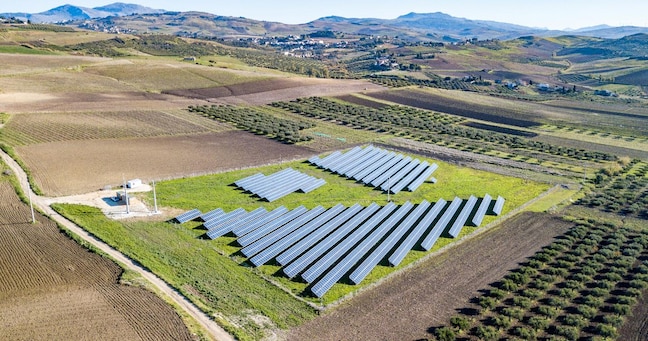
Renewable energy continues to grow in Italy: in 2023, at an all-time high +87% compared to the previous year, with the contribution of +345% of upgrades on existing plants and +77% of new installations. Photovoltaics is the driving force, with 92% more installed power, but very limited growth in utility-scale plants. These are some of the data released by the Fer (Renewable Energy Sources) Observatory, produced by Anie Rinnovabili, an association of Anie Confindustria, on the basis of Terna's Gaudì data, which also show that in the last calendar year, renewable sources were installed for a total of 5,677 MW, of which 5,234 MW for photovoltaics, 487 MW for wind power, and 41 MW for bioenergy, while hydroelectric power went against the trend with -85 MW (116 MW decommissioned against 31 MW of new installations).
Targets to 2030
.Despite the excellent result achieved in 2023 and the consolidated growth trend in the three-year period 2021-2023, Italy is however far from the target of 9 GW per year of new renewable power to be installed, a growth rate that would allow it to reach the 140 GW of total installed capacity by 2030 required for the emission cuts required by Europe. Even further away from the commitment, signed at the last Environment G7, to triple its capacity to around 200 GW by 2030, .
Delays
."The sector is also not supported by an adequate regulatory framework," writes Anie Rinnovabili in a note: out of 39 implementing measures, 17 have yet to be issued, and among these are some of the most relevant measures: these are the decrees concerning the identification of onshore and offshore eligible areas, the burden sharing decree, the Fer X decree, the Fer 2 decree, the decree that will abolish on-site exchange, to which are added the platform of eligible areas and that of the authorisation procedures. Measures that have accumulated a delay of about two years. Added to these are further measures awaited by the sector, such as: the Gse operating rules and the Crea-Gse guidelines on agri-voltaics, the Industria 5.0 decree together with the Enea register for the registration of the efficiencies of modules and cells from European manufacturers, and Terna's platform for decongesting the grid from requests for obsolete or dormant connections.
Autorizzazioni
'It does not get any better for the simplification of the authorisation process for utility scale plants: expectations have been disappointed,' the association adds. Although the Ministry of the Environment has authorised the plants, they have not received clearance from the Ministry of Culture. The panorama is further darkened by the position of some regions that have issued their own measures, in some cases in opposition to the suitable areas established by national legislation such as Legislative Decree 199/2021 implementing the European directive on renewable energy sources. An action put in place by the Regions while waiting for the decree containing the criteria for identifying onshore and offshore suitable areas and the allocation of the 2030 targets among the Regions and Autonomous Provinces, which is late in arriving. Last but not least, the difficulties in coordinating and governing the energy transition; the explosion of connection requests and authorisation procedures that would require strategic planning that would give strong and clear signals to the market. The hope of Anie Rinnovabili is therefore that elements of greater clarity and certainty can be acquired, so that the renewable energy chain can continue on its path of solid growth and contribute to achieving the decarbonisation that the country needs.
Accumulation systems
.With regard to storage systems, which are necessary and connected to renewables, in 2023 all regions consolidated a positive sign compared to 2022 in terms of number of installations, amounting to 287,707 units for a power of 2,022 MW and a capacity of 3,836 MWh. In line with the growth of Fer, there is an increase in PV installations with a capacity of more than 1 MW that are being equipped with storage systems, with 17 installations in 2023, or 750% over 2022. Installations with a capacity greater than 1 MWh are also on the rise (+75%), with 11 installations, including 2 units each with a capacity of 67 MWh and a duration of 2.5 hours.

