
Robert Nozick and the right to self ownership: why welfare is 'a robbery'
In general terms, philosophical reflection on politics can be seen as an analysis of the nature of those values that are most relevant to our life together: freedom, well-being, equality, happiness, power

9' min read
Key points
9' min read
Robert Nozick and his departmental colleague John Rawls constitute, as we saw last week, the two extreme poles of the landscape of 20th century political philosophy. Both start from the same critique of utilitarianism and both propose to overcome this perspective by adopting the Kantian premise that each individual must be treated as an end in itself and never as a means. Individualised rights therefore cannot be exchanged or reduced even for greater social benefit. What is surprising is that despite the fact that the starting point is the same and the path proposed is the same, the outcomes reached by the two philosophers are so diametrically opposed: Rawls' egalitarianism on the one hand, Nozick's libertarianism on the other.
In general terms, philosophical reflection on politics can be seen as an analysis of the nature of those values that are most relevant to our life together: freedom, well-being, equality, happiness, power. How compatible are these values with each other? How much do they conflict? Which of these should we give pre-eminence to? The answers to these questions generally take three different forms. The first is typical of utilitarians, who hold that there is a single prevailing principle - the maximisation of social utility - to which all other principles must be subordinated because they are in some way derivatives of it. A second approach is the one that focuses on a plurality of values but still recognises a hierarchy of them. Rawls, for example, falls into this category. His 'principle of priority', in fact - we have spoken about it at length in recent weeks - states that between the principle of equality and that of freedom it is necessary to recognise a 'lexicographic' priority for freedom. Finally, there are others, such as Isaiah Berlin, who accept a form of radical pluralism whereby citizens can have, and very often do have, worldviews and values that are incompatible and irreducible with each other.
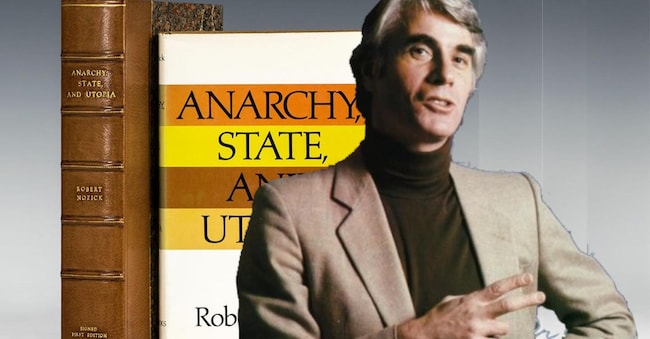
Cases in which it is necessary to find rules of coexistence that overcome this value incompatibility. It would be easy, almost taken for granted, to place the Nozick libertarian approach in the first category, the one centred on the role of a pre-eminent value, and to identify that value with that of freedom. It would be easy because indeed Nozick's approach falls into the single value category. It is less obvious to recognise that this unique value is not that of freedom but, rather, that of ownership, and in particular of 'self-ownership'. One of Nozick's most insightful interpreters, British philosopher Jonathan Wolff, explains this point as follows: 'No one has the right to interfere with your person or your property unless you have consented or you have forfeited your rights by violating the rights of others - this right to freedom is simply a consequence of this right to self-ownership' (Robert Nozick: Property, Justice and the Minimal State, Polity, 1991). It is therefore the idea of 'self-property', according to Nozick, that is placed at the foundation of all other rights from which they derive and that should be used as a decision-making compass in the face of every possible political problem. The political implications of such a view of freedom are analysed by Nozick in the first part of Anarchy, State and Utopia.
The starting point is the anarchist vision of freedom
.In this regard Benjamin Tucker writes: 'If the individual has the right to govern himself, all external forms of government are tyranny' ('State Socialism and Anarchy', in Woodcock, G., ed., The Anarchist Reader, Fontana, 1977, p.151). If we accept the absolute pre-eminence of the principle of freedom, we cannot consider any form of state power as legitimate, says Tucker. Nozick's task is to depart from this assumption, with which he is sympathetic, and demonstrate, instead, that an albeit minimal form of legitimate state can exist. A form of state that can be considered legitimate because it acts without violating the fundamental right of 'ownership of self' or the other rights that derive from this. Nozick's task, in other words, is to try to show that anarchy is not the only logical consequence of taking the inviolability of the right to individual freedom seriously. But let us return to the subject of 'self-ownership'. This is, in fact, the concept through which Nozick develops the Kantian idea of the 'separateness of persons'. We saw last week how the critique of utilitarianism, Rawls' as well as Nozick's, starts precisely from the Kantian assumption that others can never be considered as a means to my ends.
The eye lottery
.This means, for instance, that redistributive policies that limit the freedoms of a few in order to promote the welfare of the many - perfectly legitimate policies in a utilitarian framework - cannot be admissible neither for Kant, nor for Rawls or Nozick. To decline this Kantian idea of the 'separateness of persons' Nozick chooses the path of 'self-ownership', of self-ownership. This is the thesis according to which only the subject has the right to decide on what concerns him or her and therefore cannot be forced to sacrifice himself or herself for the sake of someone else. Although it is legitimate and even commendable to do so, this is only possible when this decision is an autonomous decision that does not result from external interference. The welfare state, for instance, violates in this sense the right to 'self-ownership'. Indeed, the welfare state, through taxation, provides for the provision of goods and services that benefit the most disadvantaged. Since this taxation is compulsory and not voluntary, the production of these goods and services is based on a form of violence, an outright robbery. In this regard, Nozick gives the example of the 'eye lottery'. Let us imagine that surgical technique has reached such a level as to allow perfectly safe eye transplants for both the donor and the recipient who, after the transplant, will be certain to regain full sight. In a world where there are unfortunately many who are born blind or who become blind as a result of disease or trauma, the redistribution of one eye from those who have two to those who do not even have one healthy eye would represent an increase in overall usefulness.


