Mind the Economy / Justice 79

Robert Nozick and the utopia of utopias

The ideal of a non-coercive society in which, through freedom and the right to self-ownership, the dignity of each individual is fully recognised

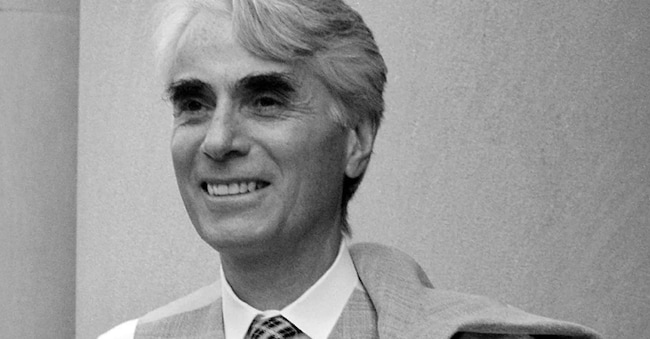
by Vittorio Pelligra

7' min read

7' min read

"Wittgenstein, Elizabeth Taylor, Bertrand Russell, Thomas Merton, Yogi Berra, Allen Ginsberg, Harry Wolfson, Thoreau, Casey Stengel, the Lubavitch rabbi, Picasso, Mose, Einstein, Hugh Heffner, Socrates, Henry Ford, Lenny Bruce, Baba Ram Dass, Gandhi, Sir Edmund Hillary, Raymond Lubitz, Buddha, Frank Sinatra, Columbus, Freud, Norman Mailer, Ayn Rand, Baron Rothschild, Ted Williams, Thomas Edison, H.L. Mencken, Thomas Jefferson, Ralph Ellison, Bobby Fischer, Emma Goldman, Piotr Kropotkin, you and your parents'. Consider all these people, Robert Nozick asks us, and then try to ask yourself whether there really can be a society, an ideal of life, a vision of what is right and what is wrong that can bring all these people together, capable of meeting all their aspirations, satisfying their desires, reflecting their preferences, nurturing their ideals.

Everyone has their own utopia

What characteristics would this utopia have? Would it live in the city or the countryside? Would it promote an opulent or austere lifestyle? Would marriage exist and how would relations between the sexes be conceived? Would private property be allowed, forbidden or tolerated only in some cases? How many religions would there be and what would their nature be? According to what values would children be educated and what place would technology have and how would people relate to death? These are just some of the questions that Nozick invites us to ponder before he sets out his position: 'The idea that there is a single best articulated answer to all these questions, a society that is best for everyone to live in, seems to me something incredible' (Anarchy, State and Utopia, Il Saggiatore, 1981, p. 316).

Loading...

Thus begins the third part of his most famous work, the one dedicated to utopia. A part that the British philosopher Alan Lacey calls 'surprising and original (...) the dessert that comes after the libertarian main courses'. A part, however, that is rarely discussed by commentators and continues to be unjustly underestimated.

Nozick's starting point is, we have seen, not only the diversity, but the incompatibility of the ideals of life - the utopias - of individuals. From the radical differences between us derive the differences between our ideals, and from these differences the impossibility of finding a community that can stand on unanimously shared principles and values. This is what Rawls called 'de facto pluralism' and which led him to the proposal of political liberalism based on 'consensus by intersection'.

The search for a possible balance

.

Nozick's answer is of course different, radically different. If such a community is unthinkable, the New York philosopher tells us, it is not, however, impossible to imagine a general framework, a 'structure' within which many different forms of society can be established and made to coexist. This structure, utopia, would thus be that free and open common ground where each citizen can choose to live according to rules and ideals freely adopted by some but not by all. In this utopian space, citizens form 'associations' and contribute to the creation of an equilibrium, similar to what game theorists call 'Nash equilibrium', in virtue of which no member of an association is willing to leave his community because any other possible community would guarantee him an inferior well-being, a worse ideal conformity, than what the association in which he currently finds himself guarantees him.

In this utopian structure all possible forms of association - libertarian or not - are allowed with the sole exception of the 'imperialistic' ones, that is, those that attempt to impose their principles and rules by force. The existence of different possible associations formed by different individuals who can decide which association to belong to or which association to abandon resembles, so Nozick tells us, a competitive market because the various communities compete with each other to attract new members capable of bringing positive contributions to the communities they choose to join. This parallel between 'structure' and market is welcome, Nozick says, because it allows us to use for the analysis of utopian structure, the powerful and sophisticated models and tools developed by economists for the analysis of market functioning.

A first model

.

The first step is therefore accomplished. We have imagined a model that considers ideal worlds in which everyone can realise their utopia together with other free and rational people. In this model, anyone can freely migrate from the community in which they find themselves to another community that is thought to be more consistent with the individual's ideal values, provided that this new community accepts them.

This structure - 'the utopia of utopias' - as Nozick calls it, has many merits and a few shortcomings. The latter begin to emerge the very moment we try to apply the ideal model to the real world. At this stage, in fact, at least four fundamental problems arise that Nozick identifies and tries to solve.

Four nodes

.

The first concerns the role of others. In the ideal model, others can be thought of in unlimited numbers and with ideal characteristics. In the real world, others are given and in finite numbers. This means, for example, that we may happen to desire and think of an association in which we would like to live but which does not attract the preferences of any other possible members. Such an association would be possible in the abstract but unfeasible in practice.

The second point concerns the interaction between the various associations, which in the ideal model do not influence each other, whereas in the real world they cannot but interfere with each other. This naturally gives rise to problems of coexistence that can generate conflicts and this determines the need for third parties capable and legitimised to resolve any disputes.

A third aspect refers to the existence of research and information costs to which members of the various associations are subject when deciding whether to remain in the current association or move to an association more in line with their ideals.

The fourth aspect concerns, finally, the possibility that in a certain community members may be kept in the dark about the existence of alternative communities out of fear that they may decide to leave. Parents, for instance, may keep their children in the dark about the existence of other and different communities for fear that they, once they grow up, may decide to adhere to alternative life models and leave their community of origin. A scenario explored by Indian director M. Night Shyamalan in his 2004 film The Village. This possibility confronts us with the need to imagine institutions capable of preserving freedom of access to information and freedom of movement.

The evolution that Nozick calls "filter-method"

.

Reasoning in this way on the concrete application of the ideal structure to the real world, Nozick comes to the conclusion that this would involve the emergence of institutions very similar to those envisaged in the minimal state. Institutions, that is, primarily aimed at protecting the rights and freedoms of individuals whenever these might be threatened in the process of forming and changing associations. This evolution, which Nozick calls the 'filtering method' (filtering method) occurs through trial and error, conjecture and refutation, following a logic similar to that which Karl Popper associates with the process of scientific discovery.

Similarly, possible communities will form and life will present them with obstacles and difficulties, some will pass the tests and some will not. The former will continue to exist and will be put to the test again, as Popper explains, in a continuous process of asymptotically approaching the 'ultimate goal' of maximum association with the individual utopias of individuals. For, as Nozick writes, 'the ultimate goal of utopian construction is to achieve communities in which people want to live and which they would voluntarily choose to live in' (p. 322).

Three types of utopia

.

Through the Nozickian framework such a result is at least logically possible because it is an inclusive model capable of accommodating different visions of life and even different ideas of utopia. Nozick distinguishes between three, in particular: 'imperialist utopianism, which authorises the coercion of everyone into a single model of community; missionary utopianism, which hopes to persuade or convince everyone to live in only one particular kind of community, but will never force anyone to do so; and existential utopianism, which hopes that a particular model of community will eventually exist, though not necessarily in a universal form'. Existential utopians are naturally attracted to the existence of the structure they choose to adhere to without reservation. Even missionary utopians are likely to join existential utopians in adhering to the structure, considering that it allows them to freely and voluntarily adhere to their preferred utopia even if it is not universally accepted. Only the imperialist utopians will oppose the emergence of the structure at least as long as there are those who do not want to espouse their personal worldview.

As we have seen in last weeks Mind the Economy, Anarchy, State and Utopia opens with a discussion of the reasons that make the minimal state desirable. Today we see how the same book closes by acknowledging the necessity of its existence within the framework of a structure capable of guaranteeing the coexistence of free and voluntary utopian communities. In this configuration, the minimal state is not founded on the basis of what it does, but rather in virtue of what it enables, on the basis of the freedom of the lives it enables. Thus, as British philosopher Ralf Bader points out, the minimal state 'does not specify a model to which society must conform, but allows individuals to live their lives as they see fit' (Robert Nozick, Continuum, 2010, p. 68).

Here we can find the constituent core of the libertarian ideal that inspired Nozick's political work, the ideal of a non-coercive society in which, through freedom and the right to self-ownership, the dignity of each individual is fully recognised, respected and protected from all forms of external interference and covert or overt paternalism.

Copyright reserved ©
Loading...

Brand connect

Loading...

Newsletter

Notizie e approfondimenti sugli avvenimenti politici, economici e finanziari.

Iscriviti