Mind the economy / Justice 76

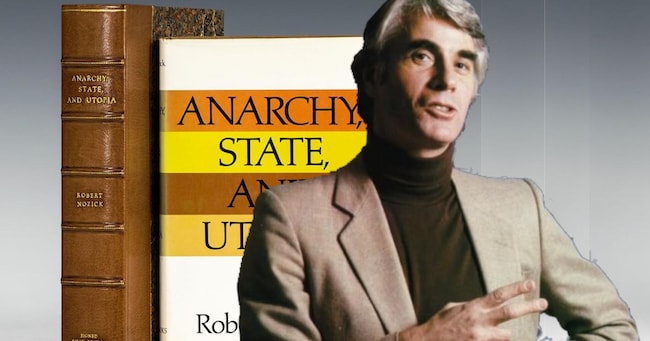
Robert Nozick, the invisible hand and the birth of the 'minimal state'

Nozick's argument goes on to demonstrate the rationality of the minimal state as opposed to pure anarchy

by Vittorio Pelligra

6' min read

6' min read

"God gave Adam no political power over his wife and children (...) if this be so, then man has a natural liberty (...) since all who share the same common nature, the same faculties and powers, are equal in nature, and should share the same common rights and privileges." So wrote John Locke to refute the idea of divine descent of power asserted at the time by Robert Filmer. Human beings are by nature free and equal, Locke says, and are not subject, in nature, to any superior power. It is the same position from which Robert Nozick's political thought develops.

The Theory of Rights

Last week, we discussed his theory of rights based on the original right to 'self-ownership'. Both Locke and Nozick accept a radical view of individual rights but, at the same time, reject its most natural political consequence: anarchy. If everyone has the right to decide for himself, how can one not accept the natural consequence of the illegitimacy of all external government?
This is how, for example, Pierre-Joseph Proudhon expresses himself in Les confessions d'un révolutionnaire: 'We maintain that, once capital and labour have been identified, society subsists on its own and no longer needs government' and, he continues, 'We are, consequently, and have proclaimed it more than once, anarchists. Anarchy is the condition of existence of adult societies, just as hierarchy is the condition of existence of primitive societies: in human societies there is an unceasing progression from hierarchy to anarchy' (quoted in Criticism of Property and the State, Elèuthera, 2001, p. 64). But Robert Nozick disagrees. And John Locke before him, albeit for different reasons. Reasons that Nozick considers insufficient.

Loading...

The "minimum state"

.

Not even from the most radical libertarian approach based on the right to 'self ownership', in fact, is it logically possible to derive the thesis of the uselessness of government. What, instead, is correct to affirm, according to the New York philosopher, is the necessity of a very limited government, of what he calls the 'minimal state'. This derivation is the result of a complicated process that seeks to reconcile the theory of natural rights and the need for legitimate government that this theory would seem to exclude. Locke was also faced with a similar dilemma, which he tried to resolve by asserting that the state can be considered legitimate. For this to be possible, it is necessary for those who proclaim the right to self-possession to at the same time express explicit or implicit consent to adherence to the state. As far as explicit consent is concerned, this would be tantamount to signing the social contract.

Implied consent, on the other hand, might derive, indirectly, from the acceptance of the benefits that the existence of a state generates for individual citizens, in terms, for instance, of protection of physical safety or private property.

The original answer to the apparent paradox of full freedom shunning anarchy

.

However, Nozick is not satisfied with the Lockean solution based on consensus. This solution, in fact, presents quite a few argumentative holes and problems of logical consistency. Nozick must therefore come up with an original response to the apparent paradox of full liberty shunning anarchy. His proposal for the legitimisation of a minimal state finds strength in the Smithian idea of the 'invisible hand'. What Nozick asserts is that even if we imagine a situation of anarchy in which individuals enjoy the purest right to non-interference, precisely in order to protect the enjoyment of that right each of them will be led to carry out a series of actions that, all together, would end up looking exactly like what a minimal state would do.

Legitimate government, thus understood, would thus arise, according to Nozick, as the unintended outcome of the intentional actions that individuals would be led to take to protect their rights. Which would explain how it is possible to 'end up in a state without intending it directly', as the title of the first part of Anarchy, State and Utopia puts it. In more contemporary language one could say, today, that the state is for Nozick an 'emergent property'.

The private protection of individual rights and its inefficiency

It starts from the observation of the inefficiency that results from the private protection of individual rights. A problem already addressed a few centuries ago by Locke. Let us imagine that we are in the state of nature where each individual enjoys his natural rights and also enjoys the right to demand respect for those rights. The right, that is, to stand as judge, in this sense, of those behaviours of other individuals that might violate his rights. The problem is that an individual will often reason about his rights in a distorted and unobjective manner.

"Individuals who are judges in their own cause," Nozick writes in this regard, "will always give themselves the benefit of the doubt and assume that they are in the right. They will overestimate the extent of the offence or damage suffered, and passions will lead them to punish others more than proportionately and to demand excessive compensation'. The resulting risk, Nozick continues, is that 'the private and personal enforcement of one's rights leads to strife, to an endless series of acts of retaliation and claims for compensation'.

Such a decentralised system, deprived of individual rights protection, therefore shows inefficiencies that seem insurmountable. To try to overcome the problems of individual rights protection, Nozick suggests, associations of individuals could arise who collectively choose to work for the protection of the rights of all associates. These associations would be able to guarantee greater objectivity of judgement and impartiality.

In order to further increase the efficiency of these associations,' the reasoning continues, 'they could specialise and sell their protection services on the market to those who wanted to take advantage of this protection. But the inherent characteristics of such a market would naturally lead companies to enter into cartels and merge with each other, most likely ending up as oligopolists or even monopolists. This would give rise to what Nozick calls the 'dominant protective association'.

The "dominant protective association"

.

This association begins to resemble an 'ultra-minimal' state, as the philosopher defines it. This entity, in fact, possesses at least in part one of the essential characteristics of the state, namely, the monopoly in the use of force that is legitimately exercised to protect the rights of its clients. And what about those who, just as legitimately, wish to continue to protect their rights privately without resorting to the services sold by the dominant protective association? These would be legitimised to do so, certainly, but could be discouraged in many ways by the monopolistic association. This would be in violation of their primary right. The protective association might for that reason be willing to compensate such individuals for the loss of that right.

How?

For instance, by offering them the same rights protection services as the usual clients but, in this case, free of charge, without the demand for any payment. The similarity of such an association with the state becomes, in this way, even greater because now, not only like the state, the protection association exercises force under monopoly conditions, but, again like states do, it also exercises it in favour of those who do not pay for such protection. Thus, says Nozick, we move from the vision of the 'ultra-minimal' state to that of the 'minimal' state, and this happens without any of the individuals involved having any intention of forming a state.

Yet, according to the logic of the invisible hand, the combination of their actions and choices ends up producing precisely that result. Nozick thus manages to reconcile his theory of original rights with the refutation of pure anarchy in a single coherent framework and to justify the emergence of a morally legitimate state. A legitimate state that must be at least 'minimal', that is, capable of working for the protection of individual rights, but no more than 'minimal'; that is, it must not implement policies that do not require the explicit consent of every citizen.

Nozick's reasoning goes on to try to demonstrate the rationality of the minimal state as opposed to pure anarchy and why it would be in the interest of all, even die-hard individualists, to lean towards such a form of state organisation. It is only with this further, not simple, step that Nozick will be able to say that he has finished his project of reconciling the right to self-ownership and the emergence of a legitimate, albeit 'minimal', state. These are the issues we will return to in the coming weeks.

Copyright reserved ©
Loading...

Brand connect

Loading...

Newsletter

Notizie e approfondimenti sugli avvenimenti politici, economici e finanziari.

Iscriviti