
Sardinia: drought, fires and pests destroy forests and cork oaks
The island's forests, which account for 83 per cent of the national cork-producing area, are facing decay. Producers call for regional intervention
3' min read
3' min read
All the fault of climate change, drought, fires and pests.
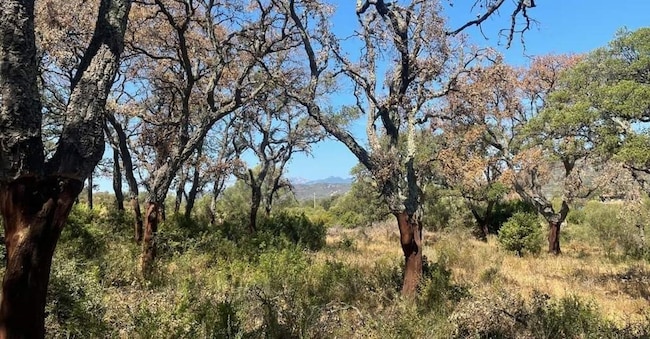
This is the new scourge of the Sardinian countryside, which stems from the mix of these elements that cork plants have to deal with. The raw material of the chain that starts in Gallura and reaches the south of the island.
For some time now, oak forests, which cover more than 140,000 hectares in the region, or 83% of the national cork-growing area, have had to contend with the phenomenon of decay, which leads to the death of the plants.
This is a sector that represents the second most important production chain in the region and is worth around 150 million euro. For this reason, for some time now, even though there is still no census, both producers and the various trade organisations have been asking the institutions, from the Region to the universities, to tackle the problem. It is precisely as a result of these requests that the Department of Agriculture of the University of Sassari and the Agris Agency have begun to observe the deterioration and speculate on the causes of the phenomenon, which has accelerated in recent times. The objective of the working group, in which the Region is also involved, is to create risk and distribution maps of outbreaks caused by Phytophthora species.
'This is a micro-organism of an alien species,' explains Quirico Migheli, professor at the Faculty of Agriculture of the University of Sassari and director of the Desertification Research Centre, 'which was not present in Sardinia in the past, but which has arrived through various activities, including nursery work. These pathogens are of many species and can attack different plants: from cork trees to holm oaks to wild pear trees'. A problem that, for the university lecturer, should not be underestimated, also because it affects different areas of the island: 'In the list of affected areas there is not only Gallura but also Nuorese, Baronia, Marmilla and parts of Campidano and also other areas where outbreaks are registered'. That's not all: 'This is very serious because it not only affects cultivated species, but also the essences of the Mediterranean environment and this greatly increases the impact on the risk of desertification because where plants dry out, the territory is impoverished.

