
The future of aquaponics? It can be developed in disused buildings and school canteens
The Demetra project funded by the Ministry of Enterprise and Made in Italy aims to produce vegetables, fruit and fish with low environmental impact in urban environments

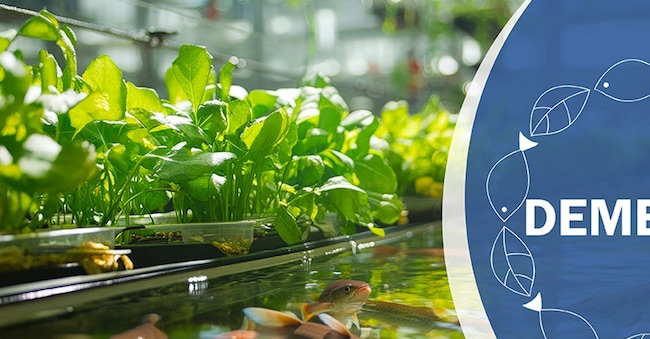
The aim is ambitious: to produce vegetables, fruit and fish with a low environmental impact in urban environments, such as large disused buildings and school canteens, thanks to aquaponics. That is, the technology that integrates aquaculture and above-ground agriculture (hydroponics). This is the project called Demetra, financed by the Ministry of Enterprise and Made in Italy with over 5 million euro, which sees the Enea collaborating with the University Federico II of Naples, the Caisial consortium and the Fos companies that is the lead partner, the Irci and Grafica Metelliana.
The programme envisages the realisation of two low-cost, modular and scalable prototypes. These are an industrial platform for large-scale production of fresh food in so-called urban farms and a more compact home use platform intended for canteens, restaurants, apartment blocks, or RSAs.
"This community mini-plant is designed to supply fresh, quality animal and vegetable protein directly to users and can also be usedby restaurateurs or agritourisms to promote zero-kilometre production," emphasise Enea. Both systems will be produced on a prototype and demonstration scale and will be tested in the facilities of Irci Spa, an industrial partner specialising in hydroponic and aquaponic plants. Reduced, instead, the domestic version
Experimentation involving cultivation should start with chilli peppers. 'A plant that is easy to handle, resistant to disease and whose fibres can be used in the production of food bio-packaging,' emphasises Salvatore Dimatteo, researcher at the Circular Regenerative Bioeconomy Laboratory, 'which will be used to package and sell the food produced in the plant. As far as the fish species are concerned, the focus is on the eel as a possible candidate, due to its high adaptability. In addition, Iot sensors will be used to 'ensure the welfare of animal species'.
"The plant will operate according to the principle of circularity, with zero waste, so that the excretions of farmed fish will become the fundamental nutrients for plant growth," argue Enea. In this system, elements such as nitrogen and phosphorous, deriving both from the excretions and droppings of fish and from the decomposition of feed that is not ingested, will be purified thanks to a biofilter in which there are bacterial colonies that will initiate the nitrification process that will lead to the formation of nitrates, then assimilated by plants".

