Ceuta

Italia v Spain: all-out clash. Madrid is also imposing border controls

EU in Rome and Madrid: ‘Trust between states is the most precious resource’

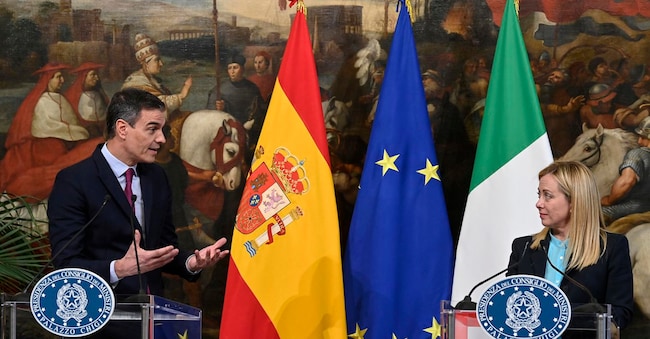
Giorgia Meloni con il premier spagnolo Sánchez  ANSA/RICCARDO ANTIMIANI ANSA

4' min read

Translated by AI
Versione italiana

4' min read

Translated by AI
Versione italiana

“Today I spoke with the Spanish and Italian Ministers of the Interior. Both confirmed that internal border controls are temporary. I emphasised the progress made in the fight against illegal immigration and that trust between Member States is our most valuable asset.” EU Commissioner for Home Affairs Magnus Brunner is attempting to pour water on the fire on X, seeking to restore calm and cooperation between the two countries.

Spain, just last night, had imposed border controls on Italia as a retaliatory measure. The announcement came on the evening of Friday 7 August and follows a day of intense diplomatic tensions between Madrid and Rome after Italia’s suspension of the Schengen Agreement following the arrival of migrants at Ceuta.

Loading...

A day of tension

The Spanish government had warned Italia that it would take ‘proportionate measures’ if by Sunday border controls for travellers arriving from Spain had not been lifted.

But Palazzo Chigi’s response, set out in a statement, left no room for doubt: ‘Italia does not accept ultimatums or impositions from abroad regarding national security and border control. Under no circumstances do we intend to review the decision to suspend the application of the Schengen Agreement for third-country nationals arriving from Spain, at least until 15 August and, in any case, until security and terrorism risks to Italia have been completely ruled out.”

Checks until 7 September

So, later that evening, the announcement came: Spain is imposing border checks on Italia in a retaliatory move. Madrid subsequently clarified that the checks will begin at midnight on Saturday and will last until 7 September.

Security and terrorism risks

“Only when we are certain that there will be no security or terrorist risks for Italia, that there will be no new wave of arrivals, and that there are no irregular migrants heading for European territory, will it be possible to review what has already been decided,” Palazzo Chigi had emphasised. “This is without prejudice to a friendly country such as Spain,” it is emphasised, “in line with similar decisions taken in the past by the Italian government – for example, regarding Slovenia – and by European governments regarding Italia and Spain itself. Should any of these conditions cease to apply, Italia stands ready to continue constructive dialogue with the Government in Madrid.”

Maximum freedom of movement for Spanish citizens

“In the meantime, the Italian border authorities will do everything in their power to ensure maximum ease of travel for Spanish and European citizens who, it is important to emphasise, are not affected by the reintroduction of air and sea border controls,” concludes Chigi.

Madrid’s position

The checks were put in place following the massive influx of migrants to Ceuta. According to the Spanish government, the temporary suspension of free movement between travellers from the two countries – in force since last Saturday – ‘is hampering the mobility of thousands of people and creating legal uncertainty in the middle of the summer season’. “This measure, unprecedented in recent history, was adopted without warning, unilaterally and on spurious grounds, incompatible with both the Schengen Borders Code and the truth.”

In this regard, the Spanish government emphasises that Italy is ignoring the fact that ‘none of the migrants who entered Ceuta illegally last week could or can enter the Schengen area freely, as the autonomous city enjoys special status within it’ and that ‘virtually all of them have already returned to Morocco’.

Ceuta, dopo stop a Schengen in aeroporto un canale dedicato per chi arriva dalla Spagna

Finally, the Spanish government adds that Italia is ‘the Member State that has recorded the highest number of irregular crossings in recent years, with figures twice those of Spain’.

Loading...

“Since 2022, Italia has failed to comply with the Dublin Regulation, placing an additional burden of migratory pressure on the other Member States,” the statement released today goes on to say. Nevertheless, the government continues, Spain has never introduced controls against Italia and has always shown ‘solidarity’ towards it, ‘taking in some of the migrants who arrived in Lampedusa in 2023 and repeatedly opening its ports to migrants rescued on the Central Mediterranean route’. Madrid is therefore confident that “Europeanism, common sense and good faith will prevail. Governments should promote understanding between countries and the general interest of their populations, not create divisions and fruitless conflicts fuelled by domestic electoral motives”, the Spanish government concludes.

Piantedosi: ‘In 15 days’ time, we will see whether the conditions for lifting the Schengen suspension are met

The Italian response was not long in coming. The suspension of the Schengen Agreement with Spain “is a temporary measure permitted under the EU treaties; we will see what happens after 15 August. It is being implemented selectively; there is no additional burden. There has been an over-the-top reaction from our opposition, perhaps because one cannot ‘touch’ a country led by socialists.” This was stated by the Minister of the Interior, Matteo Piantedosi, speaking at the “Bar Italia” meetings in Sorrento organised by FdI. The minister added that it is “difficult to imagine that the conditions” for maintaining the suspension “do not exist”, given that “Spanish intelligence itself has stated that there is a new alert for 15 August” regarding Ceuta.

Spanish Minister for Youth visits Ceuta

Meanwhile, the Minister for Youth and Children, Sira Rego, has travelled to Ceuta to continue providing support to unaccompanied migrant children. So far, 1,342 children have been registered, all of whom “will be looked after. An emergency situation has arisen, but it is now under control,” she said.

On Friday, the government will submit a request to Parliament to summon Ministers Fernando Grande-Marlaska, José Manuel Albares, Margarita Robles and Félix Bolaños to an extraordinary sitting to clarify the migration crisis involving over 72,000 irregular migrants from Morocco. Sources at the Ministry of the Presidency, Justice and Relations with Parliament have indicated that the ministers will appear at the end of August. The People’s Party has requested that they be heard by the Senate next week. Prime Minister Pedro Sánchez will chair a teleconference on Friday with several ministers to coordinate the situation in Ceuta.

EU: ‘Meta and TikTok should step up monitoring and fact-checking of crises such as the one in Ceuta’

The Vice-President of the European Commission, Henna Virkkunen, wrote on X that the Commission had met with Meta and TikTok today regarding the situation in Ceuta. “Platforms must take decisive action to preserve the integrity of the digital space, particularly during crises. We need to step up monitoring and strengthen collaboration with fact-checkers,” said the Finnish politician responsible for technology and innovation in the EU. 

Copyright reserved ©

Brand connect

Loading...

Newsletter

Notizie e approfondimenti sugli avvenimenti politici, economici e finanziari.

Iscriviti