Automotive

Volkswagen’s day of reckoning: four factories in Germany could close from 2031

Chief Executive Oliver Blume will present the project to the supervisory board today. Trade unions and the Lower Saxony government are set to oppose it

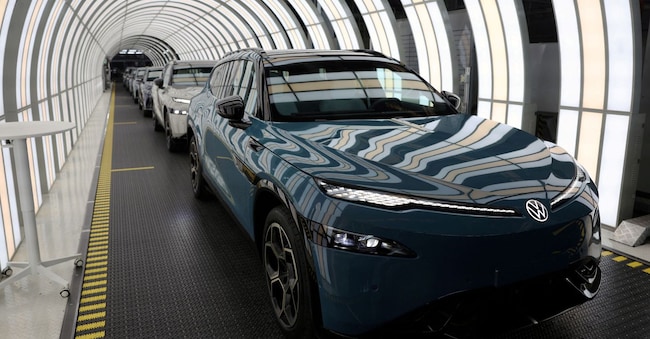
Un veicolo elettrico (EV) Volkswagen ID. UNYX 08 è fermo su una linea di produzione nello stabilimento Volkswagen di Anhui a Hefei, nella provincia di Anhui, in Cina, il 4 febbraio 2026. REUTERS/Florence Lo/Foto d'archivio REUTERS

3' min read

Translated by AI
Versione italiana

3' min read

Translated by AI
Versione italiana

The day of reckoning for Volkswagen. Or perhaps it would be better to say ‘another’ day of reckoning for the Wolfsburg-based manufacturer. Following the major – albeit agreed – restructuring at the end of 2024, another, even tougher round could be on the cards today. According to rumours that have been circulating in the German press for weeks, the group is reportedly planning to close four plants in Germany between 2031 and 2034, as part of a wide-ranging restructuring plan aimed at restoring the group’s profitability.

Four plants at risk

According to *Spiegel*, production at the Zwickau plant (which had been earmarked for conversion by the end of 2024) and the Emden plant is set to cease from 2031, followed by the commercial vehicle plant in Hanover in 2032 and the Audi plant in Neckarsulm in 2034. A total of around 40,000 employees work across the four sites. The plan is said to involve cutting 50,000 jobs by 2030, on top of the other 50,000 worldwide that have already been announced in the past.

Loading...

Chief Executive Oliver Blume will present the plan to the supervisory board today (at 2.30 pm), where he is set to clash with the trade unions. The chair of the works council, Daniela Cavallo, has spoken of ‘irresponsible threats’ that will be ‘opposed with all our might’. Protests are planned at all the company’s plants across the country.

The Government of Lower Saxony, which holds 20 per cent of the voting rights and, together with the trade unions, has the power of veto, has also spoken out against “easy” solutions. Prime Minister Olaf Lies (SPD) and his Green Party deputy, Julia Willie Hamburg, have in recent weeks spoken out against the closure of the plants.

The plan to be presented by Blume would also include a corporate reorganisation that could reduce the state’s influence over future industrial decisions. However, according to the weekly magazine, it seems unlikely that the proposal will be approved at today’s meeting of the supervisory board. It may not even be put to a vote. The executive committee has been in session since eight o’clock this morning.

According to data from Mobility Global, VW’s plants in Germany are currently operating at 81 per cent of their capacity and are set to fall to 73 per cent by the end of the decade. In 2026, Zwickau is the best-performing plant among the four at risk of closure, with a capacity utilisation rate of 88 per cent, although this is expected to fall to 42 per cent by 2030.

Investment is also down

Blume’s aim is to raise the group’s operating margin to 9 per cent by 2030 – more than tripling the current level – whilst maintaining production at nine million cars by the end of the decade. To this end, Volkswagen also aims to reduce investment from 180 to 135 billion euros over the period 2027–2031.

In its heyday, VW had around 670,000 employees and produced nearly eleven million vehicles a year. Those days are long gone now, as Blume reiterated to shareholders at the annual general meeting in June. The group’s profit margin has fallen to its lowest level since the start of the ‘dieselgate’ scandal, and the number of cars produced has not returned to pre-pandemic levels.

The strategy involves transferring production of certain models from German plants to facilities in Eastern Europe, such as Bratislava (Slovakia) and Győr (Hungary), where costs are lower.

The possibility of a role change in defence

Alternative options are reportedly being considered for the German sites, including a possible sale to companies in the defence sector. Such a possibility is already on the table for the Osnabrück plant in Lower Saxony, which is set to be affected by the restructuring already planned by VW for the end of 2024. According to ongoing negotiations, the plant could be acquired by the Israeli defence firm Rafael Advanced Defence Systems to produce equipment for use in the Iron Dome missile defence system. However, the conclusion of a contract is not yet in sight.

When the first cost-saving programme was launched at the end of 2024, the focus was primarily on the main Volkswagen brand. In addition to the brand itself, VW AG also comprises the commercial vehicles division, the components division and a large part of the group’s administration. Even then, the objective was clear: 35,000 fewer jobs by 2030, most of which have already been achieved, without any plant closures (though with the sale of the Osnabrück plant and the conversion of the Zwickau plant) and without redundancies, but through agreed departures. Worldwide, 50,000 job cuts had originally been forecast, a figure that could now rise to 100,000.

Copyright reserved ©
Loading...

Brand connect

Loading...

Newsletter

Notizie e approfondimenti sugli avvenimenti politici, economici e finanziari.

Iscriviti