
Stellantis unveils the new Lancia range to revitalise the Melfi plant
At the event, the call for the EU to ensure a fair car market was reiterated

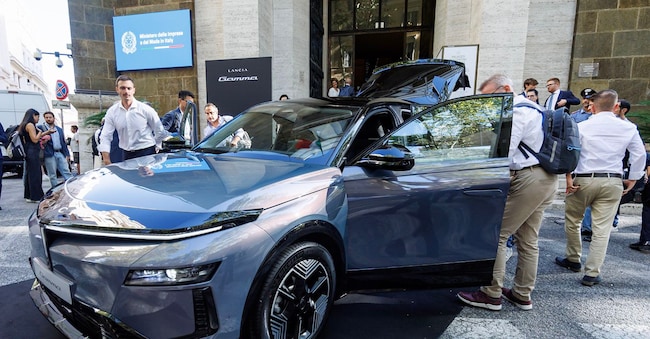
Whilst the Ministry of Enterprise and Made in Italy is discussing the new Lancia Gamma, the bulk of the discussion ends up focusing elsewhere. The car was unveiled yesterday in Rome, at the Mimit, in the presence of Minister Adolfo Urso, the President of the Basilicata Region, Vito Bardi, Stellantis’ COO for Enlarged Europe, Emanuele Cappellano, and the Managing Director of Stellantis Italia, Antonella Bruno. The model was conceived in Turin and takes shape in Melfi, but the central theme of the morning was something else: what Europe must do to ensure that the car industry in Italia continues to produce more than just pre-production runs.
Urso began by describing Gamma as ‘the symbol of the revival of the Italian car industry’, before immediately turning the discussion to Brussels and the reform of the sector called for by Italia – along with a few other countries – several years ago, reiterating the points made by Commission President Ursula von der Leyen.
Cappellano adds: ‘Now is the time for Europe to decide the future of the automotive industry, from manufacturers to suppliers: the entire supply chain.’ He calls for a level playing field for manufacturers across the continent and points out that investment in the automotive sector is planned over years, not a single parliamentary term: decisions, he says, must be taken now, because a plant cannot be converted in a matter of months. In the statement released by Stellantis, he also puts it in black and white: “We need rules capable of restoring competitiveness to the sector, supporting ‘Made in Europe’, compact cars and light commercial vehicles”.
The figures illustrate the urgency behind the words. Melfi produced 390,000 cars in 2015, but just 32,760 in 2025: 8 per cent of that record figure. The first half of 2026 saw a recovery to 35,920 units, up 88.4 per cent on the previous year, but this remains less than a quarter of the 2019 level. The workforce has fallen to around 4,440, following over 2,800 redundancies under voluntary redundancy schemes since 2021, whilst as of September the plant is still operating on a single alternating shift.
Bardi sets out the Region’s viewpoint: 40 per cent of the ‘Mini’ development contracts for the automotive sector go to Southern Italy, ‘a car like this can generate orders for the supply chain’, and calls on the Regions to play a role in the European arena as well, ‘to protect both the environment and manufacturers’.

