
Sushi in Italia, sales boom in discount stores and supermarkets thanks to falling prices
Price reductions and the introduction of ready-made ingredients are pushing sushi into discounters and supermarkets, with increased sales and new fast-food formulas.
Key points
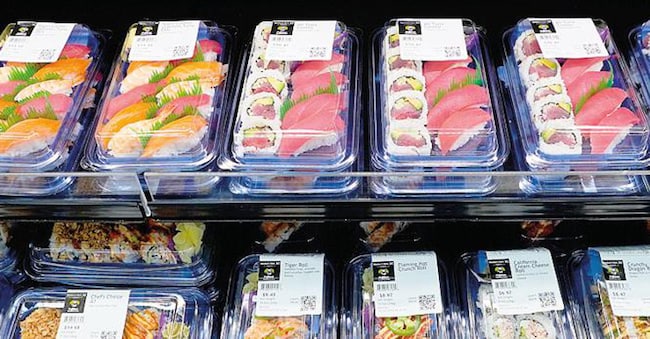
There is more and more sushi in the shopping trolley of Italians. In the year ending October 2025, more than 20.4 million packs were sold between supermarkets, hypermarkets, free service and discount stores, 2.5% more than in the previous twelve months (source: Niq). But turnover remained substantially stable at EUR 167.8 million. "A trend that can be explained by the decrease in the average price (-2%) and the price per pack (-2.7%), as a result of a slight increase in promotional intensity (+0.4 points)," says Federico Bracaglia, account development at Niq.
An increasingly popular dish
It is therefore the greater convenience that sustains sales of sushi in large-scale distribution, a product that is still expensive (the average price is EUR 30.40/kg) but still very popular, so much so that it is purchased by 3.2 million households (source: YouGov). Italians do not seem to want to give up this raw fish speciality, which is especially popular in the North-West, where 47.7% of sales in volume terms are concentrated, and which is often a quick and practical meal solution purchased in small town shops (+10.3% sales in the self-service sector).
Saving strategies
But, given the cost, consumers are implementing cost-saving strategies. On the one hand, they are increasingly turning to do-it-yourself, thanks to prepared ingredients introduced a few months ago on the shelves (such as salmon chunks and diced avocado), and on the other hand they increasingly buy sushi in discount stores, where the average price is almost half that of supermarkets (16.73 and 34.18 euro/kg respectively). As a result, "discounters are the channel with the best annual performance, thanks to sales up 14.3% in volume and 9.6% in value for a total takings of 18 million euro," emphasises Bracaglia.
Boom at discount stores
Behind the proven convenience of the discounter is a strict model: limited range (2 to 4 products), with highly rotational references and only sold in free service. "We try to give a limited but well-trodden range, so as not to create dispersion in such a delicate category as seafood," explains Paolo Jaros, director national buying of Aldi Italia, which offers two formats of sushi, aimed at as many targets: the single-portion 200 gram pack from €3.49 to €3.99 a and the family box from 450-470 grams between six and seven euros in price.
Again for reasons of efficiency and cost, sushi corners set up by fspecialised suppliers in many large-scale retail chains, which thus 'outsource' the management of such a delicate product with a very short shelf life, have not entered discount stores. These specialised suppliers produce sushi, maki and sashimi and deliver them on the same day either to centralised large-scale distribution platforms or directly to supermarkets' refrigerated display cases. There are few brands that do not use them, including Esselunga, which has its own processing centre.

