The Asian landscape

Taiwan and North Korea: two sides of the same coin – the Indo-Pacific

For decades, Washington and Beijing have dealt with the nuclear issue in Pyongyang and the Taiwan Strait issue separately. The two issues have now become intertwined, with consequences that extend as far as Europe and will test Italy’s position in the Indo-Pacific

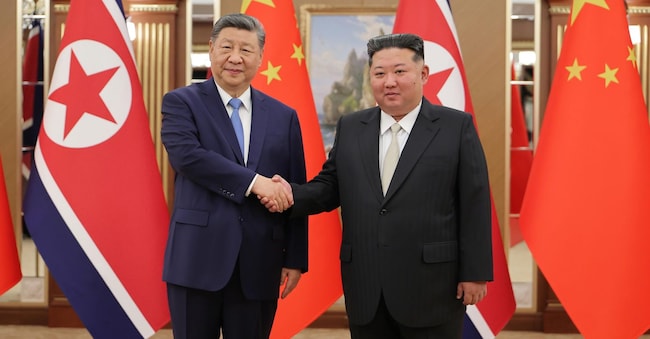
Il presidente cinese Xi Jinping (a sinistra) e il leader nordcoreano Kim Jong Un  EPA

4' min read

Translated by AI
Versione italiana

4' min read

Translated by AI
Versione italiana

For over thirty years, the West has regarded the North Korean nuclear issue as an issue separate from the other crises in East Asia. The idea was that the nuclear proliferation of Pyongyang could be addressed through disarmament negotiations and multilateral mechanisms, without linking it directly to the dispute over the future of Taiwan. However, developments in recent years have called this approach into question. The growing confrontation between the United States and China, together with the paralysis of the UN Security Council, has made it increasingly difficult to keep the two issues separate.

Beijing’s stance on North Korea’s nuclear and missile programme also depends on how the Chinese leadership perceives US moves regarding Taiwan. The issue of the Strait is a top priority for the People’s Republic, which regards the island as part of its territory and rejects any prospect of formal independence. The Americans, on the other hand, are committed to preserving peace and stability in the region.

Loading...

Things are changing on the Korean Peninsula. For the US, the arsenal poses a direct threat to its own security and that of its allies. Meanwhile, Beijing keeps a watchful eye on the supreme leader Kim Jong-un, who acts as a buffer along the border with China. This has shaped relations between China and the United States regarding North Korea for years. Beijing has exerted pressure on Pyongyang, particularly when it has secured, in return, American guarantees on the Taiwan issue.

The Taiwan issue

The history of recent decades shows just how closely this balance has been linked to the situation in the Strait. During the first nuclear crisis of the 1990s, this link did not fully develop, partly due to the time lag between the Geneva Agreements and the subsequent Taiwan missile crisis (1995–1996). Between 2002 and 2008, during the Six-Party Talks – which included North Korea (the country at the centre of the crisis), South Korea, China, the United States, Russia and Japan – China played a central role in the negotiations with North Korea. At the time, the tensions caused by the initiatives of Chen Shui-bian administration in Taiwan prompted Beijing to exert pressure on Pyongyang, including in the energy and financial spheres; in return, China secured a commitment from Washington to preserve the status quo in the Strait.

This balance remained largely intact even during Ma Ying-jeou’s presidency in Taiwan, from 2008 to 2016. The easing of tensions over the issue of independence enabled Beijing to support and impose tougher sanctions against North Korea, including severe restrictions on coal imports and the freezing of certain financial channels used by Pyongyang.

New tensions between the US and China

The situation has changed with the onset of strategic competition between the United States and China. Since 2018, political relations between Washington and Taipei have intensified, as have US sales of defensive weapons to Taiwan and high-level official visits. Consequently, China’s stance towards North Korea has also changed. In May 2022, for example, Beijing vetoed a resolution by the UN Security Council aimed at strengthening sanctions against Pyongyang following a series of missile tests, and Pyongyang has exploited this new room for manoeuvre to consolidate its status as a de facto nuclear power and has developed ever closer cooperation with Russia.

The impact on Europe

The problem, however, no longer concerns just the Asia-Pacific. The interplay between Taiwan, North Korea, China, the United States and Russia also has implications for Europe, both in terms of security and in economic and industrial terms.

If we consider Italia alone, the problem centres primarily on striking a balance between the alliance with America and economic relations with the Dragon. Our economy is heavily dependent on the trade routes linking Asia to Europe via the Indian Ocean and the Suez Canal, and we are already seeing the devastating effects of the closure of Hormuz and the instability at Bab el-Mandeb. A crisis in the Taiwan Strait would have immediate consequences for supply chains, particularly for sectors that rely on advanced semiconductors.

Recently, the Italian Navy has also stepped up its presence in theIndo-Pacific, including through the deployment of the strike group comprising the aircraft carrier Cavour and the multi-role offshore patrol vessel Montecuccoli. It goes without saying that maintaining a significant presence in Asia without diverting resources from security in the Mediterranean would be difficult in the event of a prolonged crisis.

For France, the issue is quite different, as it is the only country in the European Union to have a direct territorial presence in the Indo-Pacific, thanks to its overseas departments and territories, and Paris regards the region as an integral part of its foreign and security policy.

Loading...

Furthermore, for Germany, the issue is an economic one: industry is heavily dependent on China and the East Asian markets. An escalation on the Korean Peninsula would also affect strategic partners such as Japan and South Korea, exacerbating trade and military tensions.

Finally, in London, the situation intersects with the global stance adopted following Brexit and security integration with historic allies. The United Kingdom, bound to the United States and Australia by the AUKUS pact (Australia, the United Kingdom and the United States, to be precise) and a signatory, alongside Tokyo, to mutual military access agreements, has oriented its defence doctrine towards an active role in the Indo-Pacific. This stance is underpinned by a constant diplomatic commitment to supporting sanctions against North Korea and by the condemnation of Pyongyang’s maritime violations. However, Whitehall faces a painful practical contradiction: the reduction in the conventional capabilities of the Royal Navy and the limited long-range logistical sustainability make it almost impossible for Great Britain to ensure a credible deterrent in East Asia without compromising its primary obligations under NATO in the North Atlantic and the North Sea. British diplomacy continues to denounce Russian sabotage and Chinese silence at the United Nations, but notes the growing asymmetry between the stated ambition of a ‘Global Britain’ and the fragmentation of Western coercive instruments.

Copyright reserved ©
Loading...

Brand connect

Loading...

Newsletter

Notizie e approfondimenti sugli avvenimenti politici, economici e finanziari.

Iscriviti