The mobility of the future

Tesla launches robotaxis: a trillion-dollar bet for Musk. Share price +10%.

Objective: to expand the service to at least 25 US cities within the next year, in parallel with the start of mass production of the new Cybercabs

by Alberto Annicchiarico

Aggiornato il 23 giugno 2025, ore 22:30

Aggiungi Il Sole 24 Ore
ai preferiti su Google
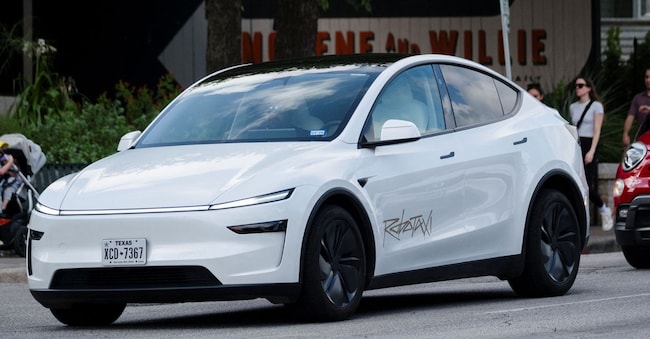
Un robotaxi Tesla percorre la South Congress Avenue di Austin, Texas, 22 giugno 2025. Si vede l’operatore di sicurezza seduto accanto al posto di guida, vuoto. REUTERS/Joel Angel Juarez

4' min read

4' min read

Necessary premise. It may be another decade before the robotaxi industry really comes of age. "For Tesla and competitors like Waymo (a subsidiary of Alphabet) it will be the end of the beginning, not the beginning of the end," according to Philip Koopman, professor of computer engineering at Carnegie Mellon University. But for CEO Elon Musk, the debut of the service in Austin, Texas, marked on Sunday by experimental rides on reservation, represents much more: it is the first step in what he himself calls 'phase two' of Tesla, a company increasingly less tied to the image of a car manufacturer and more and more projected towards services with a high AI content, including robotaxis and Optimus humanoid robots.

Positive trend for the stock on Monday up to $356 (+10%), only to close down at +8.23% ($348.7). The reason? US regulators, according to Bloomberg, have decided to investigate reports of traffic violations by Tesla's self-driving robotaxis. Online videos have shown irregular manoeuvres and speeding. The Nhtsa has gathered information and will consider possible action.

Loading...

The first road test

.

The service, for now, has been limited to a small fleet of ten Model Y self-driving cars declared to be level 4, operating in limited areas of the Texan city, where Tesla has its headquarters, and monitored by on-board security personnel. Invitations for the first passengers - selected from influencers and loyal customers - were sent out by Tesla in recent days, with flat-rate rides of $4.20. The cars rely on a camera-only system, in contrast to (and cheaper than) rivals, which also use lidar and radar.

The service launch comes at a crucial time for Tesla: global sales are down in 2025, the year's targets are slipping away. And in the stock market some downgrades have not helped the recovery after the slump in early June, following the hard clash between Musk and President Trump" over the budget bill, which punished electric mobility.

"Super congratulations to Tesla's software and chip design teams on the successful launch of the robotaxi! The culmination of a decade of hard work. Both the AI chip and software teams were created from scratch within Tesla," Musk wrote in a post on X after re-releasing several videos. One tester wrote on X that he had completed 11 tests with the service with 'no problems'.

Musk's big bet

The tycoon is now banking on AI to make a tarnished image attractive. The declared objective: to convince investors that Tesla's capitalisation, already close to $1 trillion, could double within 18 to 24 months. As analyst Dan Ives, one of the most optimistic about the stock, puts it: 'Tesla's autonomous era alone is worth at least $1 trillion'. For Musk, in short, robotaxis and Optimus are not just technology, but tools to justify still stratospheric multiples, at a time when competition is growing and profitability is falling.

In the short term, Tesla will have to overcome quite a few challenges. Regulation in Texas is permissive (the new framework will come into force in September), but other places such as California require much stricter procedures. The competition is also fierce: Waymo already has active services in several American cities, while Zoox (Amazon) has started production of its first models. Volkswagen aims to operate 1,000 autonomous ID.Buzz cars between Hamburg and Los Angeles by 2027. And among the competitors is also the Korean Hyundai, which with Kia is now one of the major players in the US car market.

The risks for Tesla

.

The difficulties are not only external. In recent months Tesla has lost a third of its top executives compared to two years ago, in what The Atlantic called a 'brain drain'. The head of software engineering, the battery manager and the director of humanoid robotics have left. Add to this tens of thousands of layoffs in 2024 and the growing risk of tensions with some of the more progressive clientele, alienated by Musk's growing ties to conservative political circles and former President Trump.

Next steps

.

Meanwhile, Musk promises to expand the robotaxi service to at least 25 US cities by next year, in parallel with the start of mass production of the new Cybercabs, vehicles without steering wheels or pedals, expected in 2026. "We'll probably get to a thousand cars in a few months and then expand to other cities like San Francisco, Los Angeles, San Antonio," Musk said, predicting strong growth in 2026. Musk also speculated that Tesla owners who pay for the fully autonomous driving option - currently $99 per month, on top of the $8,000 paid at the time of purchase - could make their vehicle available in the robotaxi service when not in use. A project that will, however, have to overcome scepticism, regulatory constraints and a fast-moving competitive environment. For Tesla - which today remains the world's most highly valued automotive company, but perhaps not the most innovative - the robotaxi game has only just begun.

Copyright reserved ©
Loading...

Brand connect

Loading...

Newsletter

Notizie e approfondimenti sugli avvenimenti politici, economici e finanziari.

Iscriviti