Shows & geopolitics

The 80 questions that help you understand the world

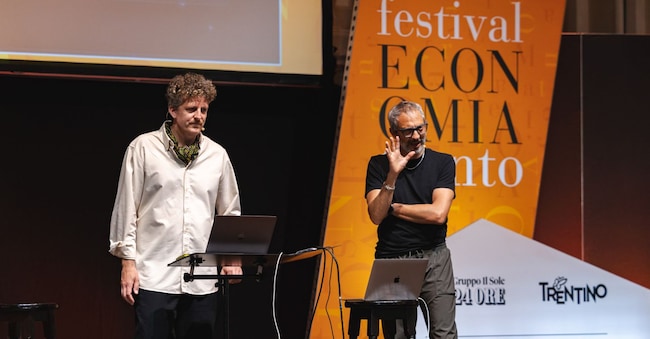
Giampaolo Musumeci and Beppe Salmetti dialogue with the public at the Festival of Economics. Irony and light tones to reflect on wars, crisis and migration
by Marzia Redaelli

Il giro del mondo in 80 domande. Da Borgo Valsugana alla Kamčatka

Nella foto: Beppe Salmetti; Giampaolo Musumeci

2' min read

Translated by AI
Versione italiana

2' min read

Translated by AI
Versione italiana

Understanding the world from a question. Or rather, from many questions. This is the heart of the show "Around the world in 80 questions. from Borgo Valsugana to Kamchatka" presented at the Trento Festival of Economics by Giampaolo Musumeci and Beppe Salmetti: a journey through geopolitics, wars, migrations, technology and global changes told in an accessible, ironic and highly interactive language.

A global journey that starts with the public

The idea stems from a simple observation: audiences today are hungry for foreign news, international scenarios, keys to interpreting an increasingly complex world. So no frontal lectures or congealed conferences, but a show built on dialogue and direct involvement of the audience.

Loading...

"How are you?" This is where the journey starts. From an apparently simple question, which becomes the pretext to cross international crises, oil price rises, conflicts, economic facts and the impact of technology. Because geopolitics is not something far removed from everyday life: it enters homes, influences the price of bread, olive oil, energy.

Geopolitics explained with a smile

The tone is deliberately light, almost light-hearted. 'How is the war going? Boh, what do I know,' the two joke on stage. A way of dismantling the rhetoric of omniscient experts and reminding them that the world does not offer easy answers.

In between jokes, however, come serious topics: from the Strait of Hormuz to Samp/T missile systems, from checkpoints to tensions between China and Taiwan. Issues that we often hear about in the news without anyone really explaining them to us.

So the show tries to fill these gaps, without ever losing its smile. "Very often we take a lot of things for granted," they explain, "but the audience needs someone to tell them clearly.

Changing Perspective

One of the central themes is the change of point of view. Looking at the world from another angle. No longer just with a Eurocentric lens, but trying to understand how those on the other side of the planet see us.

And so we go from Nauru, a tiny Pacific island that has become a symbol of Australian migration policies, to South Africa, to the new global balances drawn by China, Africa and the Middle East.

'We are used to thinking in terms of boundaries,' Musumeci continues, 'but today the world is mainly made up of flows: data, money, people, culture. A global network that connects airports, submarine cables, data centres and digital platforms, completely changing the way we read reality.

"We toil together"

The finale offers no ready-made solutions. On the contrary. Musumeci and Salmetti claim the right to complexity. 'The world is difficult, let's struggle together,' is the message they send to the audience.

Because having an opinion is not enough: you have to build it, study it, delve into it. Really inform yourself.

And so, at the end of the show, comes the phrase that has already become a sort of manifesto: 'Good night and good luck'. An invitation not to turn off curiosity once you leave the theatre, but to continue asking questions. Because, after all, it is precisely the right questions that change the way we see the world.

Copyright reserved ©
Loading...

Brand connect

Loading...

Newsletter

Notizie e approfondimenti sugli avvenimenti politici, economici e finanziari.

Iscriviti