Agriculture

The fight against Xylella continues, but the land affected by the pathogen can be revitalised

Following the felling of centuries-old olive trees in Puglia, there have been examples of intensive olive cultivation and cases of conversion to other crops and tourism. Meanwhile, experimentation continues and new funding is being made available

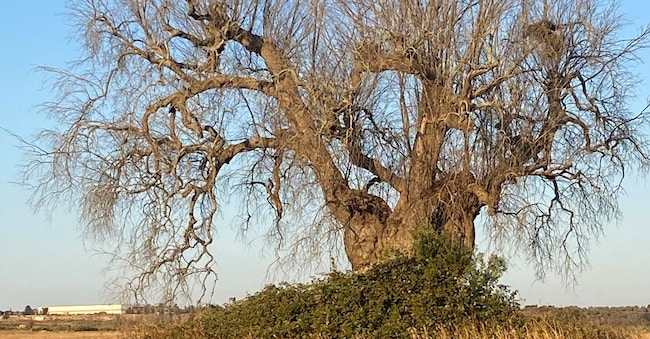
Il Barone è Un olivo di 1.300 anni lasciato come testimonianza in un terreno nel leccese devastato dalla Xylella

4' min read

Translated by AI
Versione italiana

4' min read

Translated by AI
Versione italiana

Cereals, pastureland and super-intensive farming where centuries-old olive trees once stood. Thirteen years after its first appearance, Xylella – the pathogen that has transformed the landscape of Puglia, with over 4 million olive trees felled and at least 600 million in public funds spent – is far from being a thing of the past. The ‘regeneration’ of the affected areas must grapple with the need to coexist with the pathogen and with the crisis in the olive market, but beyond the emergency, a new model based on the circular economy and innovation is emerging.

Pantaleo Greco, owner of the eponymous farm in Lecce, has left a 1,300-year-old olive tree as a “reminder” after surviving “hell” and having replanted over 1,600 trees per hectare using mulch, as well as digitising his business – partly converting it to maize cultivation to feed a cow-and-calf rearing programme – and pioneering the new frontier of olive oil tourism. A circular economy model that has become the subject of study.

Loading...

 Lapo Pignatelli, who owns 120 hectares in the Lecce area near Otranto, has used the wood from the centuries-old olive trees that were uprooted to diversify the farm by setting up a joinery workshop and sowing wheat, planting new olive trees, some at medium density (800 ‘Favolosa’ trees per hectare) and some at high density (1,600).

An event organised by Confagricoltura in Rome took stock of the progress made in research following “the devastation of an entire production area, and it is by no means certain that the spread of this bacterium can be confined to the three affected provinces – said Walter Placida, president of Confagricoltura’s product federation –. Paradoxically, however, the battle waged against Xylella in the Lecce area, Foggia and Brindisi has actually led to those areas becoming more productive thanks to innovation and the adoption of an intensive model, with extensive mechanisation that has made it possible to overcome and improve the cost structure of national olive growing, which was not always sustainable. ‘As is often the case after a conflict, there is a rebirth.’

Learning from mistakes

At the heart of olive growing, however, there remain scars and wounds that are still open. The president of Confagricoltura Puglia, Antonello Bruno, recalled “the worst kind of environmentalism, which for years took precedence over scientific solutions. If we find ourselves still talking about Xylella today, it is partly for this reason: tackling it in accordance with scientific guidelines would have helped resolve the problems, but would have cost political support. Instead of following the tree-felling plan and helping us to convince the farmers, politicians have stopped them. No one can feel safe from Xylella today; a tourist leaving a Puglia agritourism establishment could carry it anywhere, and we might only find out in ten years’ time’.

“The devastation cannot be quantified in economic terms,” said Apulian councillor Francesco Paolicelli, “but Apulia can emerge from this tragedy as a model.” We are increasing resources and reservoir capacity to ensure a water supply – which the monumental olive trees did not require – for the new super-intensive cultivation’.

Three research projects to tackle the crisis

The president of Crea, Andrea Rocchi, spoke of a new “predictive” approach to “changing the strategy for combating” plant diseases, which also includes new biotechnologies aimed at developing more resistant varieties. Meanwhile, there is the most traditional of solutions: that of the commissioner, provided for by the Coltiva Italia programme alongside a further 300 million for the sector.

The meeting summarised three of the main research projects aimed at managing a crisis that is far from over, with the aim of developing an integrated protocol for controlling the disease.

1. A germplasm collection in Calabria and hundreds of resistant varieties being trialled in two fields in Puglia form the core of the Novixgen project run by CREA, which is also being extended to include grapevines.

2. Further findings are emerging from the collection of genotypes across the Mediterranean, launched by the CNR in collaboration with EFSA 10 years ago, which is now yielding its first field results.

Loading...

3. The University of Tuscia, on the other hand, is focusing on nanotechnology for the development of naturally derived plant protection products, working with olive by-products and waste (at present, there is no plant protection product capable of directly targeting the bacterium).

New funding from Coltiva Italia

The new funds allocated by “Coltiva Italia” amount to 300 million for the replanting of olive groves with resistant varieties and the restoration of farms’ production capacity. Following the controversy over the lack of transparency regarding the spending of the 300 million allocated in 2020 to the regeneration plan, the Under-Secretary of State for Agriculture, Patrizio La Pietra, announced “a paradigm shift: first we need to know what the funds are for, and then they must be allocated – not the other way round. So much so that we have reduced the share of funds earmarked for Xylella in the new olive-growing plan. Research must be free; it takes time but needs to be coordinated,” he added, “not least because, if we cannot defeat Xylella, we must learn to live with it.”

A 2.4 billion sector

Following the slump in 2024 caused by the climate crisis and plant diseases, production in this €2.4 billion sector has grown by over 30 per cent to 325,000 tonnes, with over a third of this coming from Puglia.

“Those involved in olive growing,” said Confagricoltura president Massimiliano Giansanti, “fulfil a social function. Puglia welcomes millions of visitors. Today, olive oil is produced in Saudi Arabia and the United Arab Emirates: it is a high-value strategic commodity, and Italy must resume producing more. The swift appointment of a commissioner and the finalisation of the new olive-growing plan are the first steps to be taken. Where there is science and research, there are solutions today,” he concluded.

Copyright reserved ©
Loading...

Brand connect

Loading...

Newsletter

Notizie e approfondimenti sugli avvenimenti politici, economici e finanziari.

Iscriviti