Delivery

Rider, how the corporal's racket works: up to 50 per cent of earnings removed

Irregular migrants in check: some take on debts of 15,000 euro to get to Italy. Fake profiles for 1,500 euro on Telegram, violence and pressure

by Ivan Cimmarusti and Sara Monaci

ANSA

4' min read

Translated by AI
Versione italiana

4' min read

Translated by AI
Versione italiana

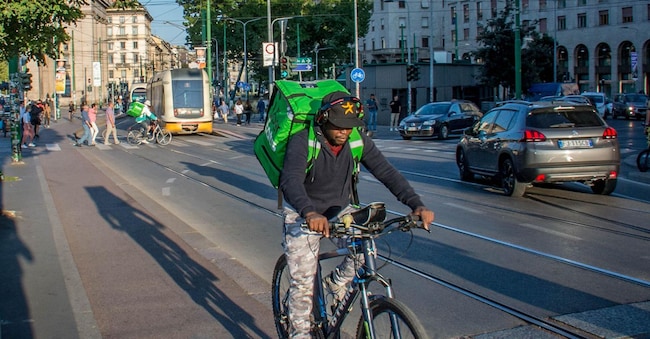
A job paid between two and four euros per ride. And often half of it slips away, into the wrong hands. In the folds of food delivery, a parallel system with a precise name has taken root: digital porter. You don't need squares or vans as in the traditional model: all you need is a rented account, a support account, an electric bike and sometimes a bed in a shared flat. The corporal provides the package. In return he demands up to 50% of the daily takings.

The mechanism is widespread throughout Italy, with a particular incidence among the 30,000 riders of Glovo and Deliveroo (unrelated to the offences): formally self-employed workers, but precisely for this reason more vulnerable to the dynamics of caporalato. A reality that does not involve Just Eat, where the delivery boys were employed under subordinate employment contracts.

Loading...

The Digital Corporal

.

The Carabinieri for Labour Protection are filling reports with the statements of the riders (in particular Pakistani and Bengali), so much so that multiple proceedings are being opened in several Italian prosecutors' offices, including Milan. But increasingly the forerunner is the trade union, the CGIL Nidil, which through its territorial structures is mapping an alarming scenario.

The perfect prey? Irregulars without residence permits and those who have no resources to begin with. There are those who, in order to arrive in Italy, have charged 15,000 euro in debt, becoming de facto servants of the organisation that brought them. Often the networks of digital corporals are of the same ethnic group, but it is difficult for anything to happen without the hand of Italians. Thus, unaware of the platforms, criminal temporary agencies grow. Not only 'job packages': everything is for sale. Fake licences, software capable of manipulating apps to obtain priority in orders, accounts already registered on the platforms that can be bought on Telegram channels for 1,500 euros to increase delivery capacity. The corporal provides, directs, monetises.

Infinite Shifts and Violence

.

A little less than five years after the big legal scandals - such as the Uber Italia case - exploitation seems to have returned through the back door. Different actors, identical script. The riders describe exhausting shifts to cover the daily fee to be paid to the corporal.

The employment contract offered to riders by Glovo and Deliveroo - signed between Assodelivery-Ugl - recognises 10 euros gross per hour. But that 'hour' is not the time on the clock: it is the time estimated by the platform to complete one or more deliveries. If the algorithm calculates 18 minutes, the payment is 18/60 of that hour. Result: just over 3 euros per delivery. On that value is then applied the gestapo of the corporal: 50 per cent. The net for the rider does not exceed 1.50 euro per delivery.

There is also violence. In Parma, a young Pakistani was clubbed by fellow countrymen while filming incidents of lawlessness.

Un’organizzazione

There is also a disturbing fact. Throughout Italy there is an organised movement of foreign riders moving from city to city following the demand for food delivery. Cagliari, last summer: a sudden spike of riders operating in the capital within a few hours. Accounts ready, bikes available, a place to sleep. Too coordinated to be random.

The CGIL Nidil is trying to penetrate this world. The objective is to reduce the grey areas, to open channels with the foreign communities that hold most of the deliveries. It is slow work. Trade unionists often try to convince riders to sign up, in the hope that they will become bridges to wider groups. But not all doors lead to the right place. In the past, impeccable riders have presented themselves: fluent Italian, perfect English, full willingness to collaborate. Ideal profiles, at least on the surface. The doubt grew with every meeting: sincere activists or corporals in disguise?

Meanwhile, intimidation. Riders in contact with the union threatened, with a clear message: do not approach, do not speak, do not cooperate.

The move of the platforms

.

The platforms are also moving. Assodelivery, which, as mentioned, groups together the players in the sector, explains that 'we firmly condemn all forms of labour exploitation and are actively engaged in the fight against such practices. Since 2021, we have been implementing the measures provided for in the protocols for legality, against corporatism, illegal intermediation and labour exploitation in the food delivery sector, through the definition of models 231/2001'. In particular, they explain, 'by setting up a guarantee body and specific measures to collect reports'.

They conclude that 'we are at the forefront of opposing any form of exploitation in the sector' and 'we reaffirm our commitment to promoting regular, transparent working conditions that respect people's dignity, strengthening collaboration with institutions and social partners'. Deliveroo, finally, points out that it has added a 'facial recognition' to the app, in an attempt to inhibit irregular access.

Copyright reserved ©
Loading...

Brand connect

Loading...

Newsletter

Notizie e approfondimenti sugli avvenimenti politici, economici e finanziari.

Iscriviti