The opinion

The controversy over the naming of a roundabout after Giovanni Gentile: reflections on the complexity of his role in fascism

The controversy over the naming of a roundabout after Giovanni Gentile: reflections on the complexity of his role in Italian fascism. An in-depth analysis of his figure and choices. On the eve of a long-awaited book

by David Bidussa

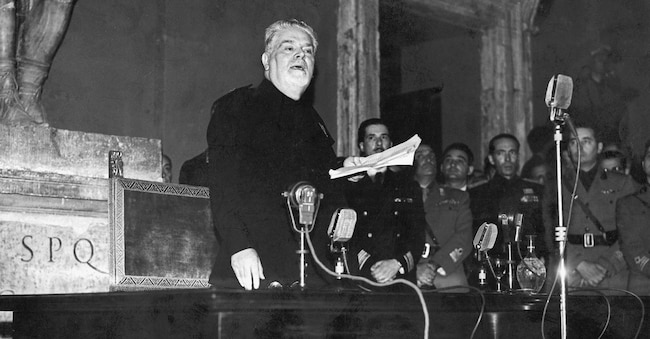
Giovanni Gentile (1875-1944) nella Sala Giulio Cesare in Campidoglio, Roma 1943. (Fototeca Gilardi / AGF)

3' min read

3' min read

There is controversy over Fratelli d'Italia's proposal to name a roundabout after Giovanni Gentile, the philosopher considered with Benito Mussolini the ideologist of fascism.

First of all, the facts.

Loading...

Why Florence? Because it is there that the life of Giovanni Gentile, an Italian philosopher of great cultural depth, comes to an end (I remember a book of great quality written by Salvatore Natoli and published back in 1989 by Bollati Boringhieri, with a very appropriate title: Giovanni Gentile filosofo europeo).

So Florence as a symbolic place. A symbol, however, has the character of summarising in a single point the outline of a history as a coherent choice, shot through with no doubts, only certainties and, above all, no deviations. So that choice fixes a moment and delivers a legacy to the next time.

That moment is a precise time, which is marked by a civil war profile, to which Giovanni Gentile chooses by adhering to a side. The essential text is that of the speech he gives on the Capitol Hill on 24 June 1943.

That text (which has long since disappeared and will soon be republished in an anthology of the philosophical and political writings of Giovanni Gentile, edited by Salvatore Natoli for Fuori scena editions; the book is scheduled for release at the end of May) is a declaration of consistency with himself and his choices since 1921 and is, at the same time, a statement aimed at reaffirming the purity of fascism and, more personally, of 'his fascism'.

There are many things in that fascism of his: there is the praise of the holy truncheon, as he says in Palermo in March 1924 during that election campaign full of fraud and violence by the fascist squads that will cost the life of Giacomo Matteotti (of his assassination Gentile will never say anything); there is his dissent from the Concordat with the Church, which Gentile interpreted as a loss of the secularity of the State; there is his unshouted but consistent dissent to the anti-Semitic racism of Fascist culture as early as 1934, for which he helped all his Jewish friends to find solutions because he understood that the quality of their lives was rapidly falling.

So: Giovanni Gentile was an organic man of the regime, he provided fascism with words, language, cultural structure, but he did not necessarily share everything.

The issue on the agenda is this: titling a square to Giovanni Gentile does not shock me if one publicly declares the complexity, contradictory nature, and even the favours he enjoyed within and supporting a regime of dictatorship.

But then it will be a matter of not losing sight of the possible metamorphosis of that place. That is: will it be a shrine to the Italy that not only lived through the civil war, but thinks that after eighty years the time has come for redemption and its domination? Does that proposal imply a new writing of names, of streets, in short an identity writing of public spaces as a reconquest of the state? The answer is not up to me. It is up to those who opened the game. No guarantees will be needed beforehand. It will be decisive: the language, the choices, the words, the symbols that will be used afterwards. In other words: the political and cultural path they will show they want to support and build, once they have shed the victim's clothes. Or whether that victim language will continue, as a new form of their own hegemony.

Copyright reserved ©

Brand connect

Loading...

Newsletter

Notizie e approfondimenti sugli avvenimenti politici, economici e finanziari.

Iscriviti