
Orban at Putin, EU irritated by trip studies reaction
The Commission's traditional visit at the opening of the six-month presidency could be cancelled, possible infringement proceedings are also being considered
by our correspondent Beda Romano
 Aggiungi Il Sole 24 Ore
ai preferiti su Google
2' min read
2' min read
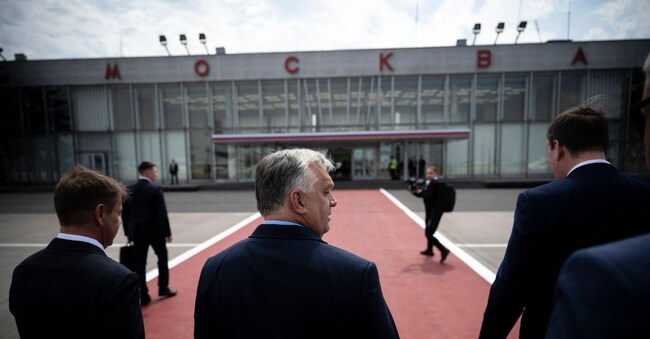
The gulf between Hungary and its European partners has suddenly widened. Hungarian Prime Minister Viktor Orbán's trip to Moscow, where he met Russian President Vladimir Putin yesterday, caused surprise, disappointment, discontent. Two years after the Russian invasion of Ukraine, the European front has highlighted the existence of an increasingly serious Hungarian issue, all the more so since Budapest holds the presidency of the European Union in this second half of the year.
Already on Thursday, when the first rumours about the likely trip had circulated, European Council President Charles Michel was quick to emphasise that the Hungarian Prime Minister had no mandate to negotiate with the Kremlin. Meanwhile, reactions of the same tenor multiplied from all or most European chancelleries. Among others, Swedish Prime Minister Ulf Kristersson called Viktor Orbán's behaviour 'irresponsible and disloyal'.
It matters little whether the Hungarian leader's attempt is officially to restore peace between Kiev and Moscow, as a government spokesman explained yesterday. "Premier Viktor Orbán is visiting Moscow. Appeasement will not stop Vladimir Putin. Only unity and determination will pave the way for a comprehensive, just and lasting peace in Ukraine,' European Commission president-designate Ursula von der Leyen, who is facing a delicate confidence vote in the middle of the month, claimed on X.
From Brussels, a European spokesperson said that by now the EU executive does not rule out cancelling the traditional visit of the college of commissioners to the capital that assumes the six-month EU presidency (the trip is currently scheduled after the summer break). The Hungarian Prime Minister's visit to Moscow was disliked because it highlights differences between the Twenty-Seven, which could easily be exploited by the Kremlin.
Diplomats in Brussels were wondering yesterday about the possible reaction to Hungary. Some wondered whether Prime Minister Orbán's behaviour might not be in breach of Article 4 of the Treaties, which commits member states to 'loyal cooperation'. In this case, the opening of an infringement procedure under Article 258 is possible. Others pondered the possibility of a new Article 7 procedure, although the legal prerequisites - derivation of the rule of law - appear shaky in this case.


