
The first Mac with a touchscreen? ‘Native users expect it’
Tom Boger, Apple’s Vice President of Product Marketing for Mac and iPad, discusses the new products and on-device AI as a solution to ‘tokenomics’

Key points
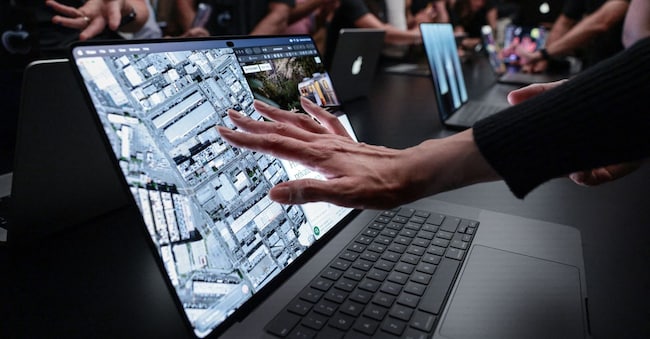
In this particularly dynamic phase – marked by the arrival of the new CEO, John Ternus, and characterised by a faster pace of product launches – following the iPhone Duo, the main talking point at Apple is the first MacBook Pro with a touchscreen and Dynamic Island – two features typical of the company’s mobile devices that are now also making their way onto the Mac. Above all, the new model introduces a ProLED XDR display – in other words, a tandem OLED – with two overlapping OLED layers.
Steve Jobs’ comments on ‘vertical’ touch
On social media, immediately after the presentation, Steve Jobs’s words went viral; back in 2010, he had said that touch surfaces ‘don’t want to be vertical’ and that, for this reason, the right solution was horizontal touch – in other words, the trackpad. What has changed since then?
We put this question to Tom Boger, Apple’s Vice President of Product Marketing for Mac and iPad – the man who leads the strategy and positioning of the Mac and iPad. ‘A lot has changed since that statement,’ he tells us in a meeting room at Apple’s London headquarters, on the top floors of Battersea Power Station, the famous former Victorian power station. “First of all, the vast majority of MacBook Pro users today also own an iPhone and an iPad, so touch is a natural and familiar way for them to interact with their content. At the same time, they’re more multidisciplinary: they do far more things on their MacBook Pro, and in more places. Finally, there’s a new generation of Pro users who have grown up in a world where they’ve never known anything other than the ability to touch the screen.”
We could call them ‘touch natives’. According to Boger, ‘they simply expect to be able to do it. Taking all these factors into account, it made sense for us to add touch to the MacBook Pro. But we’re not saying that the paradigm has changed: the MacBook Pro, and the Mac in general, remains an experience based first and foremost on the cursor, trackpad and keyboard. Touch enriches that paradigm. We don’t think people will use the new MacBook Pro solely with touch: they’ll use it occasionally, when it makes sense.”
The iPad and Mac now look more alike
The demos for the new Mac show a number of uses where touch is an option alongside the trackpad, with very similar gestures: playing instruments in Logic Pro, drawing in Pixelmator Pro, editing videos in Final Cut Pro, manipulating 3D models and editing photos. In a sense, with touch functionality, the MacBook Pro and iPad are becoming more similar – is there a risk they might cannibalise each other? “One aspect that is often misunderstood is that, when the iPad was launched, it was taken for granted that it would compete with the Mac,” replies Boger. “That never happened: the iPad complements the Mac. The vast majority of Mac owners also have an iPad and use them at different times of the day. The Mac remains an experience based first and foremost on the keyboard and trackpad, whilst the iPad remains touch-first and is extremely versatile. For us, adding touch is a natural step. Often one product inspires another, or we introduce a technology on one product and then bring it to another: nanotexture is a great example of this; you now find it elsewhere too. And the touch experience on the MacBook Pro, compared to PC competitors, is significantly better: just look at how responsive it is.”


