

The future of corridors in the geopolitics of nodes (as opposed to that of lines)
What we have learnt from the Covid pandemic, the war in Ukraine and the conflict in the Middle East is that strategic value stems from the chain comprising ports, railways, freight terminals, customs, energy, industry and data. The last century saw the world divided into blocs; then came globalisation, and power developed along value chains. Today, those who manage the intersections between networks (electricity, maritime and infrastructure) hold the keys to the motorways. This is the logistics of the future

Key points
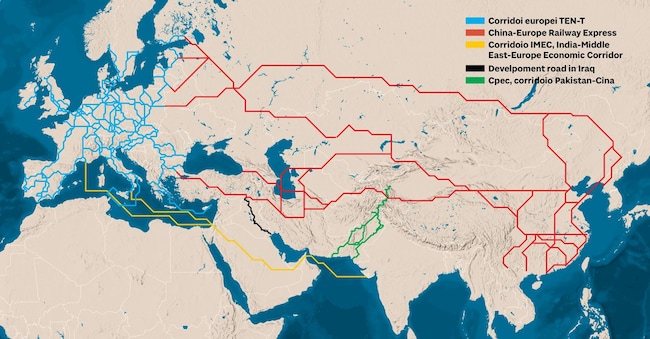
Ports, railways, undersea cables, electricity grids and customs facilities are reshaping the economic landscape between Asia, the Gulf and Europe more rapidly than formal alliances. The India–Middle East–Europe Economic Corridor (IMEC), the Iraqi Development Road, the CPEC/Gwadar between China and Pakistan, the China–Europe Railway Express and EU corridors known as TEN-T, despite numerous cross-cutting tensions, are building an overlapping network of options through which India, China, the Gulf monarchies, Turkey and Europe seek redundancy and the ability to route goods, energy and data flows via alternative routes to Hormuz and those used until six years ago. For Italia, the stakes are exceptionally high: to transform its Mediterranean position from a mere geographical advantage into infrastructural power, becoming the European hub where goods, energy, data and industry could converge. What we have learnt from Covid, the war in Ukraine and the current conflicts in the Middle East is that strategic value stems from the port–rail–freight village–customs–energy–industry and data. The last century saw the world divided into blocs; then came globalisation, and power developed along value chains. Today, we are entering the era of ‘node geopolitics’. These are the points where electrical connections, data, maritime routes and critical infrastructure intersect. Whoever controls these nodes today holds the keys to the motorways. This, therefore, is the logistics of the near future.
Steps already taken by the EU
A maritime terminal without rail links to the hinterland remains merely a point of entry; a port connected to manufacturing, continental markets, cables, electricity grids and interoperable customs procedures, on the other hand, becomes a platform for economic power. At least in theory, this is the logic embedded in the European TEN-T network. The Mediterranean Corridor links the Spanish ports of Algeciras, Cartagena, Valencia, Castellón, Tarragona and Barcelona with the south of France and thence with Genoa and La Spezia, continuing through Turin, Milan, Verona, Bologna, Padua, Venice and Trieste. The Commission also identifies the transalpine Lyon–Turin link and the rail connection to Slovenia as key elements of the axis. For Italia, this means that Genoa, La Spezia and Trieste do not compete exclusively with other ports: they compete on their ability to rapidly transfer cargo to Lombardy, Piedmont, Veneto, Bavaria, Austria and Central and Eastern Europe. The true strategic indicator is therefore the economic reach of the hinterland, not the nominal number of quays. There has been talk of European corridors for years and, in many cases, progress has been made. Now, however, they have become strategic – both amongst themselves and in connection with those coming from the East.
IMEC enters Italian politics
The India–Middle East–Europe Economic Corridor brings a new dimension to this region. The project aims to link India, the Gulf and Europe by integrating maritime transport, land infrastructure, energy and digital connectivity. It is primarily a concept on paper, but its political trajectory has become more concrete. On 20 May 2026, in Rome, the Italian Prime Minister Giorgia Meloni and the Indian Prime Minister Narendra Modi formally reaffirmed Italia and India’s commitment to cooperation on the IMEC.

Should the project become operational, Italia will be in a position to compete to become one of its main European gateways. However, no memorandum automatically guarantees this outcome: rail capacity, customs interoperability, efficient terminals, transalpine connections, digital logistics and energy supply are all required. This is where the competition becomes an industrial one.
The situation facing Italian ports and IMEC
Italia has an advantage that many new corridors have yet to develop: behind its northern ports lies one of Europe’s largest manufacturing hubs. Genoa and La Spezia look towards the Po Valley and Western Europe; Trieste and Venice have a natural reach towards Austria, southern Germany, Slovenia and the Danube region. In particular, the port system of Genoa can draw on a wealth of established expertise in trade with the Indian subcontinent. The long-standing presence of the Compagnia Ignazio Messina, which has been active for many decades in trade with India, is a distinctive feature of the Genoese port system. In August 2026, the company announced the expansion of services on this route, with the launch of the new Red Sea Express service, designed to strengthen links between the Indian subcontinent, the Arabian Peninsula and the Red Sea via a dedicated route between Nhava Sheva, Sohar, Jeddah and the other main ports in the area. Further south, the Italian port system can take on additional transhipment, energy and Mediterranean logistics functions. The problem in Italia is therefore not a lack of infrastructure, but the speed at which individual assets come together to form a system. The Ministry of Infrastructure and Transport is responsible for projects funded by NextGenerationEU totalling approximately 39.85 billion euros, of which 1.1 billion relates to REPowerEU; following the June 2025 restructuring, the MIT must achieve 70 milestones and targets by 2026, 58 relating to investments and 12 to reforms. The previous PNRR programme for ports and logistics had identified €9.2 billion in infrastructure investment, with 47 per cent earmarked for ports in southern Italy. Administrative timelines are crucial. A link that reduces physical distance can lose all its advantages if it introduces delays at ports, at borders or in documentation procedures. In February 2024, the Ministry of Infrastructure and Transport (MIT) allocated €16 million to the Port System Authorities to develop and implement the Port Community System, linking them to the National Digital Logistics Platform. This is a strategic step: interoperability between ports, freight terminals, customs and logistics operators can transform physical infrastructure into a high-speed administrative network. In the corridor economy, minutes and hours of predictability can be worth as much as kilometres of new railway line.

