
The agri-food sector is pulling out all the stops in the US to avoid losing ground in exports
At the Fancy Food Show in New York, companies are optimistic, but uncertainty is holding back contracts. Exports were down 12.8 per cent in the first five months of 2026. Zoppas (ICE): “There is high volatility; promotional activities are now even more important.”

“At this moment, we need to have the courage not to view the figures in a detached manner, but to place them within the context of what is actually happening. The introduction of tariffs has been like a stone thrown into a pond: it has disrupted the linearity and predictability of the variables we were used to. So we are now facing very significant volatility.” This is the comment by Matteo Zoppas, president of ICE Italian Trade Agency , on the situation regarding Italian agri-food exports to the US, which, following a 4.5 per cent decline in 2025 (to 7.5 billion), recorded a further -12.8% in the first four months of 2026.
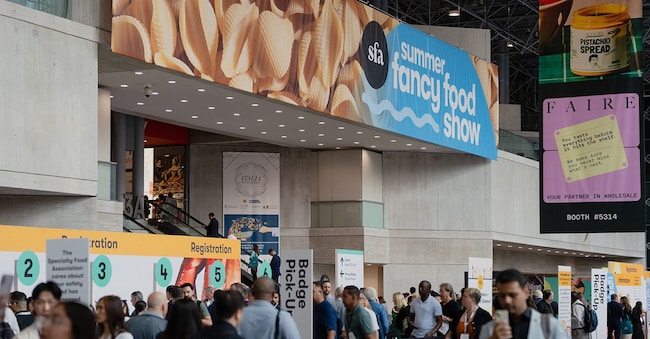
A snapshot taken amongst the pavilions of the Fancy Food Show in New York, the most important trade fair of its kind in the US, which opened on Sunday and closes today, and where, once again this year, Italia is the best-represented country both in terms of the number of exhibitors (around 300) and exhibition space.
“We cannot generalise about the impact of tariffs alone on the market,” continues Zoppas – not least because total ‘Made in Italy’ exports are growing at double-digit rates here in the US in the first few months of the year, and the agri-food sector recorded a 5 per cent increase in 2025 worldwide, despite the succession of international crises. In this context , there is indeed a segment of the agri-food sector that is slowing down in the US, particularly wines, probably because it is the segment most affected by the euro-dollar exchange rate (and by very low consumer confidence among US consumers, ed.). To some extent, the decline was expected because price lists are updated at the start of the year and because the impact of stockpiling carried out in the early months of 2025 – when tariffs had only just been announced – is having an effect. To understand the true dynamics, however, we will need to wait a few more months. But it is precisely at this moment that we must step up our promotional efforts and our support measures. Once ground has been lost, it is very difficult to regain it. Companies are sacrificing their margins to maintain their market positions.”
There is no shortage of optimism amongst the stands, though this is mixed with a general sense of concern about the current uncertainty. ‘We used to come here and sign agreements covering the whole year. Whereas in the past we’d negotiate 15 or 20 containers, now we’re agreeing on individual shipments, because the rules keep changing; for example, we’re currently waiting to see what will actually happen in July,” says Gianni Maoddi, president of the Consorzio Pecorino Rimano, which exports 40 per cent of its production to the US and seemed set to be one of the inevitable victims of the tariffs. “Instead, 2025 ended with a slight increase,” says Maoddi, “whilst 2026 has started with a 20 per cent drop.”
Nicola Bertinelli, president of the Parmigiano Reggiano Consortium, also speaks of a similar trend: ‘Following the positive growth in 2025, exports to the US fell by 16 per cent in January and March, but by the end of May the overall figure stood at +2.5 per cent. However, we must look further ahead. For Parmigiano, the US is the major market of the future. We currently sell 10 per cent of our production there (22 per cent of our exports), but our aim is to double that share within eight years, and to this end we are making significant investments in marketing and distribution agreements.”


