
On display in Rome the emblem of the Italian Republic, how it was born
The participation in the public competition and the various stages in which it took place are recounted in the exhibition through original documents
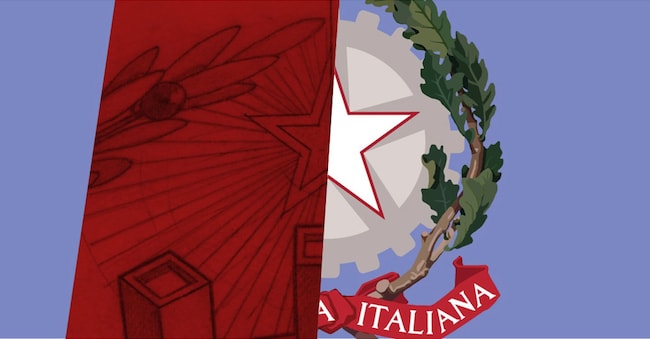
The star, the cogwheel, the olive and oak branches. Until next 27 September, the Casina delle Civette - Villa Torlonia Museums, on the occasion of the 80th anniversary of the election of the Constituent Assembly (1946-2026), presents the exhibition Under a Good Star. The emblem of the Italian Republic in the papers of Paolo Paschetto, dedicated to the history of the national symbol created by Paolo Paschetto (Torre Pellice, 1885-1963), a multifaceted artist and one of the most representative in the cultural heritage of the Casina delle Civette.
The competition
The exhibition illustrates the path that led to the choice of Paschetto's creation, starting on 19 June 1946, when a legislative decree by the President of the Council of Ministers invited the Constituent Assembly to choose the distinctive emblem of the Italian Republic. The commission in charge, chaired by the Honourable Ivanoe Bonomi, announced a competition aimed at artists and technicians, with the recommendation to meet criteria of simplicity and intelligibility, and to introduce the star of Italia among the symbols. As many as 341 candidates responded to the call, from which Paschetto's sketch was chosen in an initial version that was not convincing, leading to a second competition from which the Piedmontese artist emerged the winner once again. On 5 May 1948, Italia acquired its symbol.
Four sections
The artist's participation in the public competition and the various stages in which it took place are recounted in the exhibition through original documents from the Paschetto Archive of the Waldensian Board and documents in anastatic copy, preserved at the Turin State Archives, printed cuttings of the time and more recent illustrative material, in addition to a series of multimedia insights. The exhibition is divided into four sections. In the first, Italians at the ballot, some sketches of voting postcards are presented. This is followed by the stages of the competitions for the emblem, illustrated by the drawings presented to the Commission by Paschetto and the other finalists (Lalia, Luperini, Morbiducci, Retrosi), up to the winning drawing commented by the press review of the time. The third section presents a series of sketches for the creation of postage stamps celebrating Italia Democratica and the magazine Italia Filatelica. Many of the artist's working tools are exhibited, including: paints, compasses, squares and the materials for the engravings. In the last one, a map of the city indicates the places to admire the works Paschetto produced in Rome. A video with an interview with historian Daniele Jalla, which can also be viewed online, completes the exhibition.
The elements
The emblem of the Republic is characterised by three elements. The star, one of the oldest objects in our iconographic heritage and has always been associated with the personification of Italia, on whose head it shines radiantly. The' cogwheel, symbol of work activity, translates the first article of the Constitutional Charter: Italia is a democratic Republic founded on work'. Finally, the olive and oak branches, of which the first symbolises the nation's desire for peace, both in the sense of internal concord and international brotherhood, while the second embodies the strength and dignity of the Italia people. Both, moreover, are expressions of the most typical species of our tree heritage.
Promoted by Roma Capitale
The exhibition, promoted by Roma Capitale, Assessorato alla Cultura e al Coordinamento delle iniziative ricondibili alla Giornata della Memoria, Sovrintendenza Capitolina ai Beni Culturali, is conceived by the Historical Archive and Cultural Heritage Office of the Waldensian Board, curated by Sara Rivoira, Federica Tammarazio and Gaia Dammacco, and realised in collaboration with the Casina delle Civette Museum. Organisation and museum services by Zètema Progetto Cultura.


