
Loro Piana’s commitment to Mongolia’s nomadic herders
The LVMH Group company, which has already launched the ‘Resilient Threads’ programme to boost local biodiversity in support of nomadic herders, took part in COP17, held in Ulaanbaatar

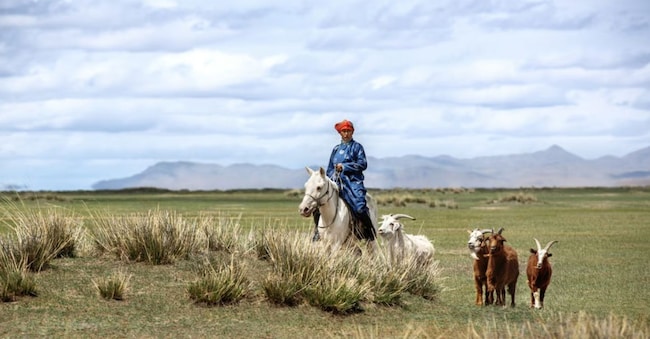
A wafer-thin strand of wool – just a few microns thick, yet stronger than steel – has for decades linked the nomadic tribes of the Mongolian steppes to Loro Piana, the textile company that has epitomised ‘Made in Italy’ excellence for six generations and is now part of the LVMH Group. That highly prized yarn from cashmere goats underpins the well-being of people, the local area, the product and the business.
Coordinating these elements is the central objective of the global strategy for ecosystem conservation set out by the Conference of the Parties (COP) to the UNCCD, the United Nations Convention to Combat Desertification, because efforts to protect the environment must be consistent, as today’s natural disasters demonstrate. COP 17 took place in Ulaanbaatar from 17 to 28 August; it secured $1.3 billion in financial commitments – a third of which were brand new – and called on businesses to play their part.
In the Mongolian capital, LVMH formally joined the United Nations initiative as part of the ‘Business for Land’ programme, following on from ‘Life 360’, the French group’s strategy on responsible sourcing and the protection of ecosystems, Frédéric Arnault, who will take the helm at Loro Piana in June 2025, reiterated to the COP7 audience gathered in a yurt that the group will play its part in strengthening the resilience of the Mongolian steppes and the cashmere ecosystem.
LVMH is continuing the “Resilient Threads” project, launched last year in Sukhbaatar Province to strengthen local biodiversity in support of nomadic herders, focusing on local capacity to manage reproduction, animal health and the region’s resilience to adverse conditions. Furthermore, 2026 has been proclaimed by the FAO as the International Year of Grasslands and Herders (IYRP).
With the enthusiasm and caution of someone taking on a precious legacy, Frederic Arnault explained how, for Loro Piana, the connection with the local area is crucial: sourcing the world’s finest raw materials is not merely a necessity, but a strategic priority. The company invests in the regions and communities with which it collaborates, from Peru to Mongolia and New Zealand, providing long-term support to strengthen local capacity and ensure the continuity of high-quality supply chains.


