Trade war

US-South Korea agreement: car tariffs at 15%. $350 billion investment from Seoul

The US President also announced potential agreements and tariffs reductions with China and reflected on his term of office. Thursday's meeting with Xi Jinping

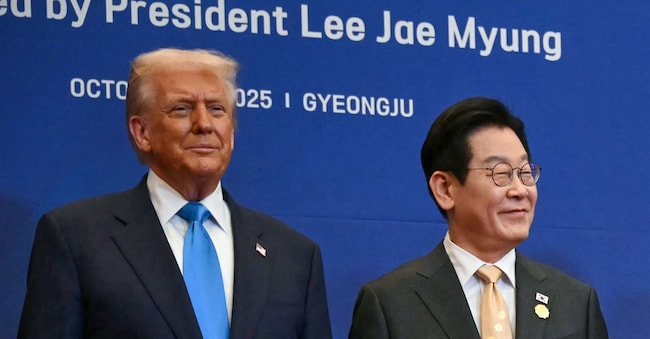
Donald Trump presidente Usa e Lee Jae-Myung presidente della Corea del Sud

3' min read

Translated by AI
Versione italiana

3' min read

Translated by AI
Versione italiana

From our correspondent

NEW DELHI - After months of inconclusive negotiations, the United States and South Korea have announced that they have found a compromise to ground the trade agreement laboriously reached last July by their negotiators. The announcement came as a surprise late afternoon, after US President Donald Trump had been welcomed in the ancient capital of Gyeongju in the morning with every possible honour, including the conferment of the country's highest honour and the gift of a replica of a golden crown, the symbol of an ancient local kingdom.

Loading...

At the end of an 87-minute meeting between the two countries' delegations, led by Trump and his South Korean counterpart Lee Jae Myung, the US president said that a 'trade agreement' had been 'reached' that can be considered 'practically final'. Trump did not provide details, but the South Korean bureau did, explaining what Seoul's promise to invest USD 350 billion in the US economy would result in.

A portion, 150 billion, will be directed towards shipbuilding, so as to revive an industrial sector that has often been at the centre of the White House's negotiating tactics in recent months. In addition to forms of manufacturing cooperation, guarantees and financing will also be part of the package. The remaining 200 billion will go into a fund to invest in the US economy.

The funds, however, will not be disbursed in cash and in one lump sum, as Trump would have wished, but in annual instalments of USD 20 billion, which is the maximum amount indicated in recent weeks by the Bank of Korea so as not to destabilise the dollar-won exchange rate. The funds should not be raised through Seoul's issuance of sovereign debt, but partly through operating profits, interest and dividends generated by Korean assets abroad, and partly through systemic banking institutions such as the Export and Import Bank of Korea.

Trump: "Mi piacerebbe incontrare Kim Jong Un"

The formalisation of the agreement will result in the lowering of US tariffs on imports of steel and vehicles from South Korea from 25 to 15 per cent, a tariff that has been applied until now, which is not only high in absolute terms, but also in relation to the 15 per cent tariff on the same product categories from Japan, a country with an export basket to the US that partly overlaps with Seoul's. 'It seems that both sides agreed that further postponement would not be helpful to anyone,' explains Heo Yoon, an economics professor at Sogang University in Seoul. The announcement quickly translated into a 0.54 per cent rise of the won against the dollar.

Trump is in South Korea for the last leg of the first Asian trip of his second presidency, after having been in Malaysia for the Association of South East Asian Nations (Asean) summit and in Japan to meet the newly appointed conservative premier Sanae Takaichi. The most eagerly awaited appointment of the entire mission is scheduled for today in Busan, where Trump will meet Chinese President Xi Jinping, who is in South Korea to attend the Asia-Pacific Economic Cooperation (Apec) meeting, a regional forum.

The summit between Xi and Trump, the first since the US president's re-election, is raising hopes among investors and policy makers because, as some signals launched in recent days by the US side suggest, it could mark a de-escalation of the trade war between the world's two largest economies. Trump has anticipated that he expects to reduce the 20% tariffs applied to Chinese products in response to what the US calls Beijing's failure to control the export of precursor chemicals used in the production of fentanyl, a drug at the centre of an epidemic of overdose deaths in the US.

The White House's optimism is the result of a series of talks in Kuala Lumpur between the two countries' negotiators that could lead to a one-year moratorium on China's plan to restrict rare earths exports, thus averting the spectre of a new US retaliation in the form of tariffs.

Copyright reserved ©
Loading...

Brand connect

Loading...

Newsletter

Notizie e approfondimenti sugli avvenimenti politici, economici e finanziari.

Iscriviti