
Trump announces economic boom and Christmas bonus for military in first year of presidency
The president celebrates his achievements, promises aggressive reforms and a special dividend for the armed forces, but criticism and doubts about his statements remain.
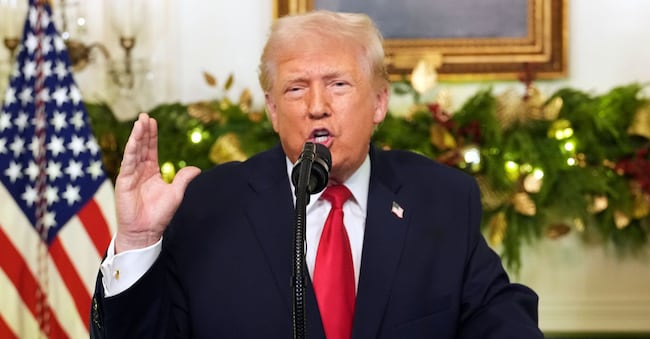
"Good evening, America. Eleven months ago I inherited a disaster and I'm fixing it." Donald Trump thus began his prime-time address to the nation from the Diplomatic Room of the White House, with Christmas ornaments in the background. Words that immediately gave the sense of his speech: in a dry and often defensive tone, in 18 minutes he described his first glimpse of the presidency as an enormous success, both in domestic and foreign policy. He did not announce any significant new policies, but spent a lot of time attacking the past, his predecessor Joe Biden, and his critics, the opposition Democratic Party.
"America is respected, our country is back stronger than ever and we are headed for an economic boom the likes of which the world has never seen," he said in an unusually brief speech for him. "We are the most successful country and that is recognised by every leader I have spoken to in the last five months," he added. Speaking of the opposition, he charged: 'They have plundered our treasury.
The $1,776 cheque to the military
Among the few novelties, he announced a 'warrior dividend' by Christmas of $1,776 to all 1.4 million serving military personnel. An award whose figure derives from the date of American independence. "The cheques have already gone out, no one deserves it more," he assured. They will be funded from tariffs revenue, although in reality only Congress could allocate those funds.
Looking ahead, he promised 'among the most aggressive reforms in American history' in the housing sector next year, without further clarification, and to appoint a next chairman of the Federal Reserve 'who believes in much lower interest rates'.
Drop in drug prices beyond the limits of mathematics
On the economic front, among his main claims, he said that he is already bringing prices down 'very quickly' and that they will fall again 'dramatically, from electricity to everything else' (although inflation remains stubborn today). He boasted that he has cut drug prices by 400, 500 and 600 per cent (a mathematically impossible task because then prices would be more than zero).


