United States

Trump claims: US elections are vulnerable to fraud and conspiracies, and China is manipulating them

In a half-hour address to the nation, the president has once again put forward conspiracy theories alleging plots against him, ranging from manipulation by Beijing to illegal immigrants casting votes. However, documents released by the White House do not substantiate these claims, and the opposition has denounced acts of intimidation.

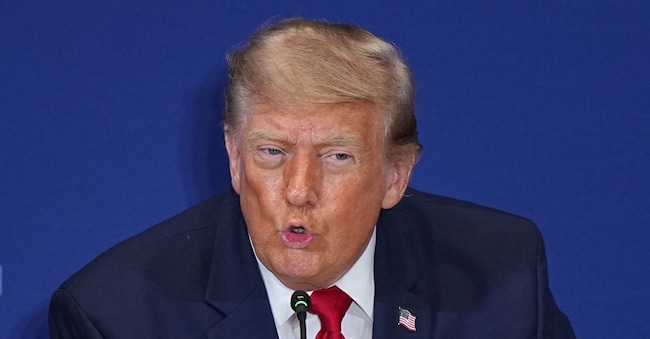
 Il presidente degli Stati Uniti Donald Trump, Studio Ovale della Casa Bianca a Washington, DC, USA, il 29 giugno 2026.  EPA/SAMUEL CORUM / POOL EPA

4' min read

Translated by AI
Versione italiana

4' min read

Translated by AI
Versione italiana

China’s manoeuvres, illegal immigrants, the dark forces of the radical left, and unreliable and manipulable electoral technologies: Donald Trump, in a controversial address to the nation, has revived a wide range of conspiracy theories about electoral fraud (against him) and the serious vulnerability of the American voting system. However, the evidence produced by the White House and cited by the President in support of his accusations appeared to most to be scant, selective and clearly insufficient to justify the alarm, whilst the risk that the message might delegitimise future, undesirable election results – and, more generally, confidence in democracy – seemed clear.

Trump announced the declassification of documents which, he claimed, would prove the validity of his allegations, and promised new federal investigations. Finally, he called on Congress to pass a new law, the Save America Act, to impose stricter ID requirements on voters and to restrict postal voting, which he considers a particular source of fraud.

Loading...

The new campaign ahead of the mid-term elections

The president went on to insist that he wanted to show “just how vulnerable elections are”. And he made no secret of the fact that he had launched this new offensive on the transparency and fairness of elections ahead of the upcoming November vote to renew Congress. He then accused previous Democratic administrations, going back as far as Barack Obama’s, of having covered up fraud and risks.

The controversial nature of the speech led several major American television networks – including ABC, NBC and CNN – to refrain from broadcasting the entire address live, instead relaying it only via their streaming services. Fox and the White House did broadcast the speech. Fox’s own commentators, however, did not comment on the validity of the allegations made by Trump. Trump lashed out at the media: ‘They’re part of the conspiracy. They want to keep this scam going; they want to protect the radical left.’

Numerous critics immediately pointed out a number of claims contained in the president’s half-hour speech that they considered to be entirely unfounded or exaggerated.

Unsubstantiated accusations against China and immigrants

There is no new evidence that illegal immigrants turned out en masse at the polls to skew the results. Meanwhile, when citing foreign influence on the vote, there is likewise a lack of evidence: Trump has singled out China in particular, citing the country’s efforts to undermine him in 2019 ahead of the 2020 election, which he lost (a fact he has never admitted). He mentioned information on American voters that had fallen into Chinese hands, a fact which is, however, already widely known. He also cited documents – albeit heavily redacted – suggesting a Chinese campaign to influence US public opinion and the elections. This latter concern, however, is held by a minority within the US intelligence community, and even its proponents have described it as of dubious credibility.

Trump also referred to a CIA report on the activities of Venezuela over the last twenty years. However, the report actually indicates that the government in Caracas, prior to the recent US-orchestrated change of regime, had demonstrated ‘some ability to manipulate electronic voting systems’ to influence domestic elections, but that there is no evidence of ‘large-scale fraud’ even in Venezuela, and that the country did not, in any case, have the capacity to manipulate results beyond its own borders.

Another example cited by Trump was already well known and was, if anything, seen as an instance of the existing electoral safeguards working effectively, rather than as evidence of the need for tighter controls. A local official in Michigan had spotted irregularities in voter registration carried out by an organisation in one county ahead of the 2020 election. However, no invalid votes had been cast or counted.

The claim regarding the 2020 elections

Donald Trump has always claimed to have won the 2020 presidential election – an election which, in fact, he lost to Joe Biden, as confirmed by the failure of the myriad legal challenges his allies had brought to overturn the result. This claim – in particular, the allegation of widespread voting by undocumented or illegal immigrants, who are not entitled to vote – has been repeatedly disproved by the facts and by investigations.

The president did not openly repeat that he had won six years ago. But at the heart of his claims lie equally explosive allegations, stemming from a report commissioned by his own administration on alleged foreign interference in the 2020 election. In reality, according to investigations and experts, the only significant case of attempted international interference is said to have taken place in 2016, by Russia and in favour of Trump.

Loading...

A climate of high tension

Nor is the debate on electoral security merely academic or historical. It is taking place against a backdrop of high tension in the run-up to another crucial election: the November mid-term elections to renew Congress. The Republican Party, currently reeling from Trump’s low approval rating of under 40 per cent, risks losing its narrow majority in both the House of Representatives and, possibly, the Senate. And a Democratic victory in even just one of the two chambers of Parliament would make it very difficult for Trump to pursue his agenda in the second half of his term. Instead, it could pave the way for parliamentary inquiries into his conduct and that of his administration.

The ‘Save America Act’: an attempt at intimidation?

This is why Trump, with his sights set on the election, is vociferously insisting on the need to adopt the Save America Act, a bill that would tighten voter identity checks, for example by requiring a passport or birth certificate. However, this bill has failed to impress even a number of Republicans, as well as the Democratic opposition, which accuses the administration of intimidation, and to date it appears to have no chance of passing.

Trump has also recently raised the possibility of bringing the electoral process increasingly under the control of federal authorities, despite the fact that legislation and the Constitution entrust its management to the states. And he has raised the spectre of the presence of government agents and ICE officers, the immigration enforcement agency, at polling stations, even though this is widely regarded as an illegal move.

Democratic leaders reacted strongly to Trump’s remarks even before he had uttered them. “He’s afraid of losing,” said Senate Minority Leader Charles Schumer, dismissing the president’s claims of electoral fraud against him as “nonsense” and describing his administration as being in the grip of “chaos and corruption”.

Copyright reserved ©
Loading...

Brand connect

Loading...

Newsletter

Notizie e approfondimenti sugli avvenimenti politici, economici e finanziari.

Iscriviti