The trade war

Trump eases auto tariffs. Michigan rally: 'You ain't seen nothing yet'

"We just want to help during a transition period," Trump said of the car. The 25% tariffs on cars imported into the US will continue, but an executive order prevents additional duties, such as on steel and aluminium, from adding up. Business fears

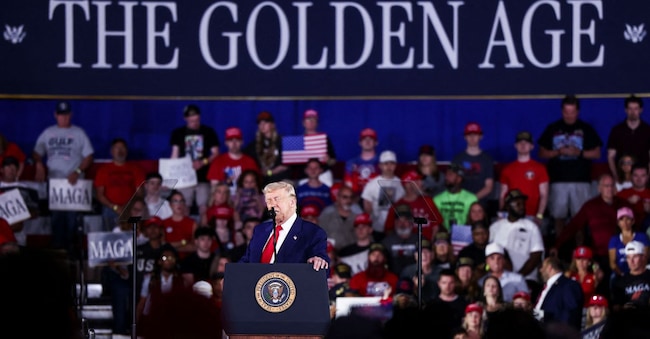
U.S. President Donald Trump speaks during a rally to mark his 100th day in office, at Macomb Community College in Warren, Michigan, U.S., April 29, 2025. REUTERS/Evelyn Hockstein

5' min read

5' min read

Donald Trump celebrated 100 days of his presidency from Michigan, defending his policy of global tariffs even as he eases them on autos, the sector that is at home in the large Midwestern industrial state. From Warren in Macomb County he spoke in the evening in front of a large crowd of faithful and with a banner behind him declaring '100 days of greatness', passing over in silence the controversy over his tumultuous economic and social strategies that see him losing share in the polls. Indeed, in his first rally since taking office in the White House, he relaunched: 'You ain't seen nothing yet'.

Trump in more than an hour speech evoked his most cherished priorities, from the fight against migrants, citing mass deportations, to draconian cuts to a federal bureaucracy to be 'eradicated' to culture wars starting with the one against 'transgender madness'.

Loading...

In one hundred days he signed over 130 executive orders, an activism that his allies compared to an overturned Roosevelt (FDR had expanded the public role and social protections), leaving out the difference in substance: Trump has so far acted by decrees often brought to court, Roosevelt had passed crucial legislation. Trump has promised that laws will also come in the near future, first of all on tax relief.

"We are taking the country back from a sick political class," he said from Macomb Community College, "Instead of putting China first, I put Michigan and America first. A reference to the particularly heavy tariff offensives with Beijing. He then did not fail to launch new attacks on those he considers his internal enemy on the economic agenda, Federal Reserve Chairman Jerome Powell, even without mentioning his dismissal: "I know a lot more about interest rates than he does, believe me," he said, accusing Powell of not having yet lowered the cost of money to help an economy that many analysts believe Trump is now sending into possible crisis with uncontrolled trade conflicts.

Speaking of auto duties in an area dominated by manufacturing, the President assured that the 25% imposed on vehicles coming in from abroad will create jobs in the future. However, he also mentioned some new exemptions offered to the sector in order to avoid excessive immediate shocks. Trump with a new executive order intends to 'help during a transition period, in the short term'. Although it is by no means clear to analysts that the tweak is sufficient to avert shocks. Trump has also maintained tough language with the companies: 'Let's give them some time' to move production to the US 'before we slaughter them if they don't'.

Duties, Trump: with China we will make deal but it must be fair

The President also addressed the Americans in television interviews when it comes to tariffs. "They deserve them." This is how Trump argued to Abc News, when asked whether the 145% tariffs on China were in fact tantamount to an embargo. "They were screwing us over like nobody ever screwed us over before. They don't do that anymore,' the president said.

Speaking at the rally, the US president went on to specify: "With the tariffs on China we are putting an end to the greatest theft of jobs," said Donald Trump, returning to point the finger at Beijing's trade practices, and then specifying: "We will make a deal, but it must be fair.

The business world, far from presidential interviews and rallies, is increasingly worried. The trade war unleashed by the tycoon is being felt on the accounts and even more so on the prospects of businesses. Amazon has defied the wrath of the Republican administration by hinting that it might highlight the impact of duties on prices. Adidas spoke of "inevitable" price increases on products destined for the US.

More articulate has become the discourse on cars, a sign that some fears are being expressed among White House aides. The decision on the revision of tariffs on vehicles arriving from abroad, in more detail, stipulates that manufacturers who will pay the levies on imported models, amounting to 25%, will not also have to pay other taxes to customs, such as those on steel and aluminium, which in turn amount to 25%. In short, the blows to trade will not add up and, retroactively, companies will be reimbursed for what they overpaid.

Change of course

.

What's more: the measures on duties on car parts, which are themselves 25 per cent and come into force on 3 May, will be adjusted. Manufacturers will be paid back duties on parts used to build cars in the US, up to a maximum of 3.75 per cent of the value of each vehicle in the first year and 2.5 per cent in the second. "We want to provide a path for automakers to quickly and efficiently create as many jobs in the US as possible," explained Treasury Secretary Scott Bessent.

The relief of US big business

.

The top executives of the big US brands - from Ford to GM - breathed a sigh of relief, promising to continue to cooperate with the government. The stocks of Ford and Stellantis immediately rose 1.2% and 4.3% on Wall Street.

But on international trade, a climate of general uncertainty remains: Gm in reporting a 6.6 per cent drop in profits in the first quarter nevertheless cancelled its 2025 profit forecasts, denouncing 'the evolving nature of the situation' and the belief that 'the future impact of tariffs could be significant', as CFO Paul Jacobson put it.

Trump: "Piano dazi va molto bene l'America diventerà molto ricca"

Still in the automotive sector, Volvo removed guidance and Porsche calculated an extra ballast of at least EUR 100 million between April and May. In other sectors, Kraft Heinz suspended its forecasts. Adidas, despite having accelerated deliveries to the US in anticipation of the trade wars, explained that tariffs will cause 'inevitable' price increases, and avoided improving its financial performance outlook.

The shipping giant Ups announced 20,000 job cuts, underlining - with CEO Carol Tome - repercussions for trade 'unseen' in the last century. Electrolux emphasised the weakness of shopping at this stage. While Amazon - according to rumours - is considering highlighting on the labels of products on its low-cost site, the part of the price due to duties: the hypothesis, later denied, triggered an immediate clash with the White House, which defined the initiative as 'hostile and political'. Trump himself intervened directly by calling Jeff Bezos on the phone in "very angry tones", according to CNN.

American economy suffering

.

Economic data in turn show the growing strains on the US economy: consumer confidence as measured by the Conference Board in April fell to its lowest level since the pandemic, with the expectations indicator suggesting a recession now looming. The US GDP for the first quarter today is expected to show almost zero growth, 0.3%. Meanwhile, stock market indices on Wall Street suffered their worst performance in a hundred days since Richard Nixon's presidency in the 1970s. A picture that leaves the Federal Reserve in doubt between supporting expansion by cutting rates, and fearing new inflationary flare-ups.

Treasury Secretary Bessent once again supported Trump's manoeuvre on tariffs as an effective choice of 'strategic uncertainty' and promised agreements coming with several countries. Bessent also stated that a trade confrontation is 'unsustainable' especially for China, which could lose 'up to ten million jobs' quickly. Outside observers are much more sceptical: hedge fund king Ray Dalio said it is now 'too late' to escape the severe economic damage caused by Trump's trade wars.

The polls, to be sure, show a distressed Trump at the Macomb rally and the 100-day mark. His approval rate is at lows, close to 40 per cent, and is suffering above all from the rejection on the economy and trade, as well as the harsh anti-immigration measures. The re-launch of America First from the podium in Michigan will hardly be able to heal the economic and social traumas already visible in the United States and appease Americans.

Copyright reserved ©
Loading...

Brand connect

Loading...

Newsletter

Notizie e approfondimenti sugli avvenimenti politici, economici e finanziari.

Iscriviti