

Mali: Violence by the Africa Corps is playing into the hands of armed groups
Human Rights Watch has recorded eight civilian casualties in the latest offensive by contractors, a spiral that is widening the rift with the state and fuelling jihadist recruitment
from our correspondent Alberto Magnani
 Aggiungi Il Sole 24 Ore
ai preferiti su Google
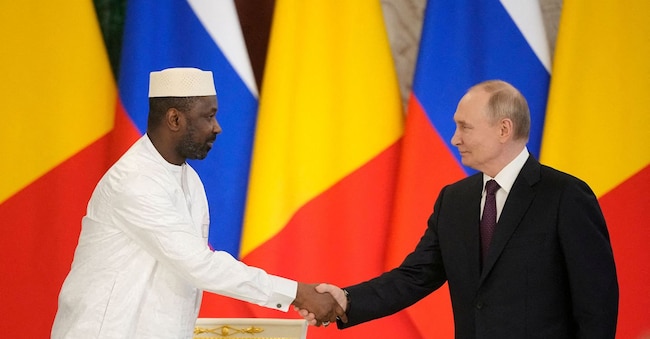
NAIROBI – The spotlight is once again on Russia’s role in Mali, the Sahelian country increasingly under siege from the insurgency led by jihadists from the Group for the Support of Islam and Muslims (Jamaat Nusrat al Islam wa al Muslimin or JNIM) and Tuareg rebels. Last month, the Washington Post reported on speculation regarding potential US anti-terrorist raids on the country, with a view to counterbalancing the agreement between the coup government in Bamako and the contractors from the Russian Africa Corps. Now, a report by the non-governmental organisation Human Rights Watch accuses mercenaries linked to the Wagner Group of killing at least eight civilians in an air raid carried out in mid-June on Kyrnia, a village in the Mopti region that has been under Islamist control for at least six years. The operation was described on Africa Corps’ social media profiles as a blitz to neutralise ‘several commanders’ within the ranks of JNIM. Human Rights Watch refutes the claim that jihadists were definitely among the victims, raising the alarm over new spirals of violence and a boomerang effect on Mali’s increasingly precarious stability.
Russia’s resurgence in Mali following the trauma of 25 April
The Malian junta led by Assimi Goïta came to power following the double coup of 2020–2021 and forged a collaborative relationship with the contractors of the then Wagner Group, who took over following the withdrawal of French and Western troops. These ties began informally during the days of the old Wagner Group, before being redefined following the dissolution of the private company and its transformation into Africa Corps: the unit that has taken up the mantle of the ‘musicians’ and falls under the remit of the Russian Ministry of Defence.
Cooperation between Malian security forces and contractors has suffered more than one setback in recent years, starting with the major joint attack by Islamists and Tuareg rebels from the Azawad Liberation Front on 25 April: an offensive unprecedented in its scale and tactical implications, given that it took place simultaneously across several areas of the country and marked a collaboration between jihadists and separatists. Moscow has reaffirmed its intention to maintain its presence in the Sahel and its counter-terrorism activities, reiterating its solidarity with its partners through Foreign Minister Sergei Lavrov’s latest tour of Africa and his meeting with the foreign ministers of the Sahel Alliance. However, the strain on Russia’s presence in the region – now under threat from renewed US momentum – raises fears of a déjà vu of violence against civilians, either as an outburst or a consequence of a transitional phase in relations.
The risk is ‘very real’, confirms Ilaria Allegrozzi of Human Rights Watch, highlighting a strategic vulnerability: the management of the conflict has been “based almost exclusively on a military response”, without addressing the key issues needed for more lasting stabilisation, such as economic support for the most marginalised regions or an attempt at dialogue with armed groups. In this context, Allegrozzi adds, the abuses attributed to Malian forces and the Africa Corps “only serve to widen the rift between the population and the state”, fuelling social frustration and providing a valuable recruitment tool for jihadist-affiliated armed groups.
Side effects
The backlash from a ‘security-only’ approach, explains Allegrozzi, risks materialising even in the event of US intervention. At present, the prospect of a US blitz appears limited and the details remain to be clarified; it is likely to involve air strikes rather than a boots-on-the-ground operation. Whatever the outcome, says Allegrozzi, ‘the experience in the Sahel shows that military operations focused exclusively on eliminating jihadist leaders may temporarily weaken certain jihadist groups, without, however, addressing the root causes of the conflict’. In some cases, he adds, this “can alter the balance of power between armed organisations, favouring the expansion of rival groups (see the case of JNIM and ISIS-linked groups) or prompting fighters to reorganise in new areas”.


