
Volkswagen: 10 factories at risk in Germany, cuts start
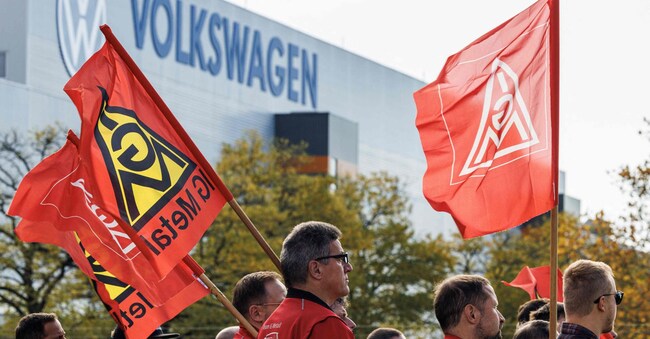
Group cuts costs by 4 billion, protests start: strike and meetings. 10% cut in wages. The group's workers in the country will stop for an hour today, halting production. 'A clear plan is missing'

7' min read
7' min read
Volkswagen's top management is pressing ahead with a restructuring plan unprecedented in the group's 87-year history. The management's goal is to bring costs under control and decisively improve competitiveness. The plan aims at savings of EUR 4 billion and includes the closure of at least three factories in Germany, the cutting of tens of thousands of jobs and a 10% pay cut, with a freeze on any increase until 2026. The news filtered through the German media on Sunday and was made official on Monday by the chairwoman of the works council (the internal union), Daniela Cavallo.
The leader of the Betriebsrat, the business newspaper Handelsblatt reported, told the employees that 'the management board plans to cut all remaining plants in this country'. Cuts that would affect products, volumes, shifts and entire assembly lines. 'All German Vw plants are affected. No one is safe,' warned Daniela Cavallo, who accused the management of offloading the consequences of questionable choices onto the workers: from a poorly managed transition to electrics to bad pricing policies. 'Management has not yet presented a clear plan for the future,' Cavallo insisted. There are just under 300,000 employees in Germany. But any substantial reduction in employment at Vw could have serious social repercussions. Not only for the company, but for the entire German economy. And perhaps Europe.
The Top Management Reply
.The company's top management defended the decision to proceed with heavy restructuring, but did not comment on the possibility of cuts in the tens of thousands of jobs. The CEO of the Vw brand, Thomas Schaefer, stated that costs 'are currently 25 to 50 per cent higher than we had anticipated. It means that the German plants are twice as expensive as the competition'.
Schäfer reiterated that the goal remains to increase profitability, i.e. an operating margin to 6.5% by 2026 (at the end of the first half of the year it was 2.3%, down from 3.8% in 2023, and compared to 8.4% for Skoda, another brand in Vw's so-called Brand Group Core). This would be the only way to finance the necessary future investments. The head of human resources, Gunnar Kilian, pointed the finger at the works council: 'The situation is serious and the responsibility enormous. The German co-determination law means that employees have very high bargaining power. In the supervisory board of the Volkswagen group, out of a total of 20 members, 10 are employee representatives and 10 shareholder representatives (among them, with 20% of the shares, is the Spd-led state of Lower Saxony).
The government takes the field
.The Volkswagen situation has obviously raised the bar for the Berlin government. 'For now there is no official news and we have to wait for Vw to clarify,' commented German Chancellor Olaf Scholz's spokesman Wolfgang Büchner. The spokesman recalled that Scholz had already said in recent weeks that 'any wrong decisions by management should not fall on the shoulders of the workers and that jobs should be safeguarded'.


