

Vucic is playing the stability card. Serbia needs access to EU corridors
After 14 years in power, the former president – whose government is under pressure from student protests – is aiming to become prime minister. His aim is to push ahead with plans worth 17 billion that tie in with the development of Balkan infrastructure supported by Europe. This is one of the reasons why he has supplied ammunition to Ukraine.

Key points
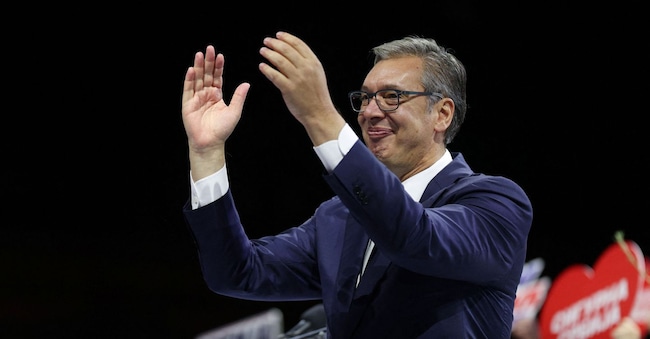
Alksander Vucic – former Minister of Information, Minister of Defence, Deputy Prime Minister, Prime Minister from 2014 to 2017 and President of Serbia until 28 September – with a view to the election campaign he himself has launched with the aim of regaining the post of Prime Minister, he saw fit to return to the scene of the crime. He travelled to Novi Sad, where the wave of protests began in 2024. It was November when the reinforced concrete canopy at the railway station collapsed, killing sixteen people. That moment marked a turning point in a political trajectory which, for over a decade, had been based on the myth of rapid, high-handed and unquestionable infrastructure modernisation. In the weeks following the disaster, technical reports and journalistic investigations uncovered a chain of systemic omissions.
The collapse of the bus shelter in Novi Sad
What turned the tragedy into an institutional crisis was the regime of contractual secrecy imposed by the Ministry of Construction, which, under agreements with Beijing, had removed the technical annexes and supervision records from public scrutiny. The resignations of a minister and two officials were not enough to halt the mobilisation led by student groups, characterised by the slogan Korupcija ubija (‘Corruption kills’). Today, those movements have become a political party. In the election on 25 October, the government list SNS and the socialists of SPS are facing competition from the ‘People’s Choice’ and ‘European Serbia’ lists, alongside four minority groups. Three opinion polls have been published. Faktor Plus puts Vucic’s party at 48.6 per cent and the student list at 37.1 per cent. NSPM, in a survey conducted in early September and published on 30 September, reports 41.7 per cent and 44.4 per cent respectively. The CRTA/Stanford D survey from June indicates 35.7 per cent and 44.9 per cent amongst voters who openly declare themselves to be opposed to the government.
However, none of the polls appear to have any scientific basis, and last week the European Union and international observers issued their usual warning regarding electoral transparency. It is likely that on Sunday, the conservative party led by Vucic will secure victory, perhaps by a narrow margin.
The wait for the European capitals
At least, that is what the international community expects, and also – albeit not officially – the EU’s foreign ministries. In practice, they have backed the national ‘Leap into the Future’ plan, which aims to mobilise over 17 billion euros from 2027 onwards. The occasion is the Expo, which will take place between May and August. Under this umbrella, 323 infrastructure projects on a national scale: from the National Stadium in Surčin to the Morava and Fruška Gora motorway corridors, from the BIO4 Campus biotechnology hub to the high-speed rail line between Novi Sad and Subotica. An infrastructure plan that bypasses parliamentary legislation and the scrutiny of the local Court of Auditors.
Logistics and energy in the Balkans
An extraordinary scheme which, however, helps to underpin the Growth Plan for the Western Balkans approved by Brussels and worth a total of almost 16 billion. The EU needs Serbia to play an active role in the development of energy and logistics corridors. On the one hand, there is the Trans-Balkan power line, a Global Gateway project linking Serbia, Montenegro and Bosnia and Herzegovina with Croatia, Hungary, Romania and on to Italia. On the other, the Corridor VIII, which links Bari to the Black Sea. Both serve the exchange of goods and energy and are an essential element within NATO for the military mobility of the future EU Common Defence.


