
When a fact becomes an institution
If we are the ones who create these institutions, we might think that this makes them fragile or arbitrary. But the opposite is true. Precisely because they are recognised collectively, no single individual can change them on their own

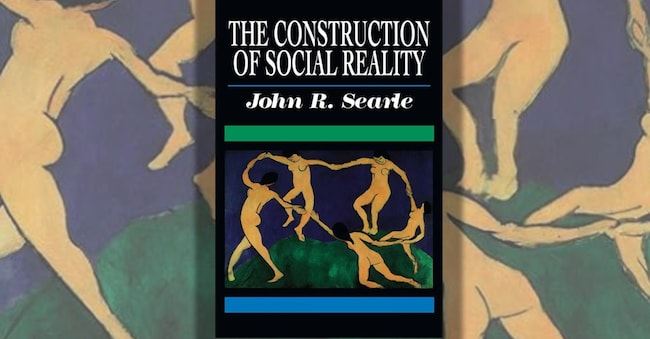
Let’s take a twenty-euro note. It weighs less than a gram, is made of cotton fibres, and has numbers, images and symbols printed on it. However, none of these physical characteristics explains its symbolic nature – the most important thing we can do with it: for example, walking into a café, placing it on the counter and receiving a cappuccino, a brioche and change in return. No other sheet of paper of exactly the same weight and size could produce the same result. The difference lies not in the material, but in the meaning we attribute to it. Let us now consider a person entering a room. Everyone stands up. That person speaks, and what they say radically changes someone else’s life. It acquits, condemns, authorises. We are standing before a judge, and no other person, uttering exactly the same words, could produce the same effects. Or let us think of a signature. From a physical point of view, it is merely a mark of ink on paper. Yet, in certain circumstances, that mark can transfer ownership of a house, commit millions of euros, establish a business or create a legal obligation. Every day we come into contact with people, actions and objects that have a certain physical nature but which, at the same time, are something more. That ‘something more’ is the problem addressed by the American philosopher John Searle in his seminal The Construction of Social Reality (Free Press, 1995). How can an immaterial reality exist that depends entirely on what we think and yet is perfectly real and capable of having perfectly tangible consequences for us?
This is a particularly important question for understanding economic reality. In “What Is an Institution?”, published in 2005 in the Journal of Institutional Economics, Searle recalls that when he was studying at Oxford, economics was taught as if it were a natural science. The equation between saving and investment, he explains, was presented in the same tone as the way in which physics teaches that force is equal to mass times acceleration. Yet there is a radical difference between the two. Gravity does not require anyone to believe in it in order to exert its effects. Money does. Firms, contracts, property, interest rates, debt, employment and financial securities would not exist without human beliefs, rules and attitudes. Even the definition of economics as the study of the allocation of scarce resources, Searle observes, takes for granted “a huge invisible institutional ontology”.
Two types of reality
Let us begin, then, by distinguishing between what would exist independently of us and what exists only in relation to us. Searle calls the former brute facts, ‘brute facts’. Mount Everest has a certain mass, water is composed of hydrogen and oxygen, and the Earth is at a certain distance from the Sun. We may be mistaken in our descriptions of them, but the existence of ‘brute facts’ does not depend on our descriptions. Then, on the other hand, there are institutional facts, or ‘institutional facts’. The fact that Mario owns a flat, that Anna is an Italian citizen, that that person is the chief executive of a company, that this piece of paper is money. None of these facts could exist without human beings and without some form of agreement and collective recognition. This does not mean, however, that they are merely opinions. It is here that Searle introduces a subtle but decisive distinction between ‘epistemic objectivity’ and ‘ontological objectivity’. The existence of money is ontologically dependent on human beings. If all human beings were to disappear, money would also disappear. But it is epistemically objective that there are one thousand euros in my current account and not ten thousand. I cannot alter that reality simply by unilaterally deciding to interpret it differently. We can therefore have facts that are objective even though they concern a reality that exists only because we have constructed it. And it is precisely this apparent paradox that makes Searle’s social ontology so interesting. The fact that a fact is constructed does not mean that it is imaginary, any less real, or any less of a ‘fact’. A border between states is a social construct, but crossing it can lead to my arrest. A property right is a constructed reality, but it can nonetheless prevent me from entering a house. The university is a construct, but it can still award me a degree that may alter my career prospects. Institutions do not belong to nature, and yet they alter the nature of the possibilities open to us.
One example in this regard strikes me as particularly effective. Let us imagine a community building a wall around its territory. Initially, the wall fulfils its function thanks to its physical properties. It is tall and sturdy and physically prevents outsiders from crossing it. As time goes by, however, the wall crumbles. All that remains is a row of stones. Anyone could climb over it. Yet no one does. The inhabitants continue to regard that row of stones as the boundary of their territory. What once physically prevented passage now prevents it institutionally. The function has remained, but the mechanism underpinning it has changed. Previously, it was the mass and height of the wall; now, it is collective recognition. The difference, writes Searle, is encapsulated in the ambiguity of a very simple sentence: “You can’t cross that”. A sentence that can mean ‘you cannot cross it because it is too high’, or ‘you cannot cross it because you are not allowed to’. (2005, p. 8). Much of the distance separating nature from society lies between those two ‘you cannot’s’. The second ‘you cannot’ does not describe a physical obstacle, but a status. The row of stones serves as a boundary and, precisely for this reason, acquires a function that the stones, on their own, could not fulfil. A function that, paradoxically, becomes more robust than the stones themselves.
X counts as Y
It is in this context that we encounter perhaps the most famous formula in Searle’s theory: “X counts as Y in context C” (X counts as Y in context C). A certain piece of paper counts as money. A certain procedure counts as an election. A certain arrangement of pieces on the chessboard counts as checkmate. A person who meets certain conditions counts as a judge. A specific sequence of words spoken under the appropriate conditions counts as a binding promise. The term X denotes the initial reality, Y the status we attribute to it, and C the context in which that attribution functions. We are not simply giving a different name to the same thing. We are creating a new causal and social possibility. Being a judge is not a biological property of a person, just as being money is not a chemical property of a banknote. And yet, once that status has been attributed, that person and that object can do things they could not do before. Searle calls these properties “status functions”. These are functions that something or someone can perform not because of their physical structure, but solely because a community recognises a certain status in them. Human civilisation, writes the philosopher, has been built upon ‘status functions imposed on the basis of constitutive norms and procedures’ and – he adds – ‘status functions represent the glue that holds human societies together’ (pp. 9–10).


