
Sahra Wagenknecht: the red-brown star challenging the German political system
Her party is the real novelty in the elections in Saxony and Thuringia, but its positions on NATO, Ukraine and immigration resemble those of the ultra-right. Sahra Wagenknecht is the new political figure emerging in Germany, with a movement that combines left and right-wing populist themes

3' min read
3' min read
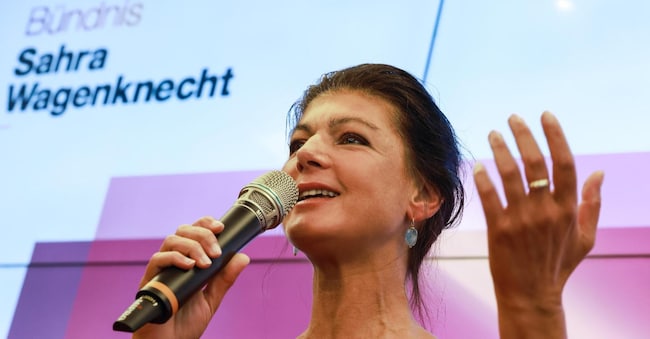
Sahra Wagenknecht is the real novelty in the German political system. In the 2024 elections in Saxony and Thuringia, the party bearing her name went into double figures. In Thuringia, where Afd has a relative majority, the Sahra Wagenknecht Alliance (Bsw) entered the government in coalition with Cdu and Spd. Wagenknecht emptied the Linke, from which it broke away in January, and imposed itself with populist and sovereignist themes, often overlapping with those of the ultra-right, with which it shares an aversion to NATO and support for Ukraine. An echo of the arguments used by pro-Putin propaganda. Bsw also calls for a crackdown on immigration. However, the party's rise suffered a setback in the campaign for the early elections on 23 February 2025: in the polls it fell below the 5% threshold.
A red-brown mix
.Wagenknecht (55) is a familiar face in Germany and has built his fortune in the former communist states of the East, to which he offers an economic recipe of 'left-wing welfare combined with right-wing social policy', explains political scientist Jan Philipp Thomeczek. It supports the increase of pensions and the minimum wage and investment in schools, it puts the brakes on energy transition, asylum and migrants. A left-wing and conservative party, emblematic of the red-brown hybrid, which also elsewhere in Europe fishes for right-wing and left-wing populism.
Bsw is proudly anti-caste and anti-establishment, just like Alternative für Deutschland, with which it swears it wants no alliance: 'They have an ethnic worldview and therefore a thousand miles away from us,' said Wagenknecht, in the aftermath of the vote in Thuringia.
With rhetoric against 'those at the top', Wagenknecht plays the role of the 'lawyer of the common people' and addresses the working classes who feel left behind by the federal government and globalisation. He calls the ruling parties 'dangerous, stupid, greedy and hypocritical'. One day after the European elections in June 2024, in which Bsw had already obtained 6.2 per cent of the vote, Wagenknecht said: 'We are there for the people who have lost faith in democracy' and went on to say that his party is on the side of the 'desperate'.
The timing could not have been better, the party launched its challenge with the German economy stranded in a long economic crisis. The heterogeneous government coalition would fall within a few months.


