
Instability in the Middle East

Bab el-Mandeb is back under Yemeni control. It is merely the latest chapter in the war

After weeks of advances and counter-attacks, forces loyal to the government have recaptured Mokha and the strategic positions on the strait leading to the Red Sea. Meanwhile, the fighting has shifted towards Taiz and the number of displaced people has risen to 184,000.

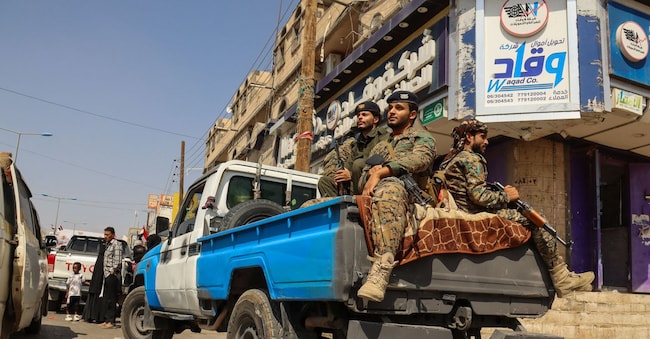
Agenti di polizia yemeniti pattugliano le strade della città del governatorato di Marib, regione del Paese ricca di petrolio  REUTERS/Ali Owidha

7' min read

Translated by AI
Versione italiana

7' min read

Translated by AI
Versione italiana

Just a few weeks ago, the military balance along the western coast of Yemen appeared to be shifting rapidly in favour of the Houthis. The group had taken control of Mokha and had advanced towards Bab el-Mandeb, one of the world’s most important maritime chokepoints. This advance had raised concerns far beyond Yemen’s borders, affecting energy markets, shipping companies and countries bordering the Red Sea.

Today, the situation has changed once again. Forces loyal to the internationally recognised Yemeni government have announced that they have regained control of the Bab el-Mandeb area and Dhubab. Subsequently, pro-government forces also announced that they had recaptured the town of Mokha following intense fighting. But this does not mean that the war has come to an end. On the contrary, the latest developments perhaps reveal something even more significant about the nature of the current conflict in Yemen: the front lines are shifting rapidly, whilst the war is spreading.

Loading...

Whilst the Houthis are retreating along the western coast, fighting continues in other areas, particularly around Taiz, where the group has in turn made gains on some fronts. The question, therefore, is no longer simply who controls Bab el-Mandeb, but where the war will move after Bab el-Mandeb.

Bab el-Mandeb returns to government control

The recapture of the Bab el-Mandeb area represents a significant military and strategic development for the Yemeni government. Pro-government forces, including units from the Nation’s Shield Forces and the Giants Brigades, have advanced towards Dhubab and positions surrounding the strait, with Saudi air support. According to government sources, they have also taken control of the Dhubab airstrip and cut off some of the Houthis’ supply lines in the area.

This area is of exceptional importance because it lies near one of the narrowest points of Bab el-Mandeb, where the Red Sea connects to the Gulf of Aden and, via it, to the Indian Ocean. For this reason, military control of the coastline adjacent to the strait is not merely of domestic importance to Yemen. Bab el-Mandeb forms part of the trade and energy network linking Asia to the Middle East and Europe via the Suez Canal. Any prolonged threat to shipping can therefore quickly become an international economic issue. However, recapturing the coastline does not necessarily mean completely eliminating the threat.

The Houthis retain the capability to deploy missiles and drones from areas further inland. Ground control of Bab el-Mandeb may therefore reduce some immediate risks originating from the coast, but does not necessarily eliminate the group’s ability to threaten shipping.

Mokha changes hands once again

The symbolic and military significance of the recapture of Mokha is perhaps no less than that of Bab el-Mandeb itself. The city, which had fallen under Houthi control in September, has, according to an announcement by government forces, returned to the control of forces loyal to the government following intense fighting. Mokha has therefore changed hands twice in the space of a few weeks. This fact alone demonstrates just how fragile the current front lines are.

In the Yemeni war, control of a city or a road does not necessarily mean that the military situation has stabilised. A force may advance rapidly only to find itself, a few days or weeks later, facing a counter-offensive capable of redrawing the front lines once again. Mokha is a clear example of this. Less than a month ago, its capture by the Houthis had fuelled fears of a lasting strategic shift along the western coast. Today, however, the group finds itself facing a counter-offensive that has forced it to withdraw from the city and from key areas around Bab el-Mandeb. But this retreat does not mean that the Houthis have lost the ability to take the initiative on other fronts.

Taiz, the front line that never stopped

Whilst government forces advanced towards Bab el-Mandeb and Mokha, the battle around Taiz followed a more complex course. In recent days, the areas surrounding the city have seen fierce fighting, and Houthi forces have made gains on some high ground and along strategic routes, according to government military sources quoted by the international media. It is here that the main paradox of the current phase of the conflict emerges.

The government is advancing along the coast, whilst the Houthis are attempting to increase the pressure on Taiz from the high ground and along inland routes. The war, therefore, is no longer moving in a single direction. It has become a succession of offensives and counter-offensives on fronts that are geographically linked but of varying military significance. Bab el-Mandeb is vital for international shipping. Mokha is important for control of the coastline. Taiz, on the other hand, is a geographical and demographic hub linking vast areas of southern, western and central Yemen.

Loading...

For this reason, the battle for Taiz is no less important for the future of the conflict within Yemen, even though Bab el-Mandeb continues to attract the most international attention.

Has the balance of the war shifted?

It would be easy to interpret the recapture of Bab el-Mandeb and Mokha as a definitive turning point. The experience in Yemen, however, suggests greater caution. The front lines, which had remained relatively stable for years, began to shift rapidly once again following the end of the period of relative calm that began in 2022.

Recent developments have shown that neither side can yet regard its territorial gains as definitive. In September, the Houthis had managed to advance rapidly along the western coast and capture strategic areas. Now government forces have launched a counter-offensive and announced the recapture of key territories, supported in part by Saudi air strikes. Meanwhile, clashes continue in Taiz and other areas. Perhaps, therefore, what has changed is not only the territorial balance, but the very pace of the war.

After years of virtually frozen front lines, the military situation in Yemen is shifting once again. And this shift entails risks that go far beyond the mere transfer of a city from one side to the other.

184,000 displaced people: the other side of the offensives and counter-offensives

There is another map that changes in tandem with the military one. It is the map of displacements. Just a few days ago, the number of people forced to flee their homes due to the latest escalation was approaching 130,000. Now, according to the International Organisation for Migration, the figure is said to have reached around 184,000 people since the start of the new phase of fighting. This rapid increase highlights the true cost of the constantly shifting front lines.

When a town is captured by one side and then recaptured by the other a few weeks later, the population does not necessarily return to the situation as it was before. Homes may have been damaged. Roads may have been cut off. Services may have ceased to function. And a family that has already fled once may be forced to flee again. War thus transforms from a series of shifting lines on maps into an equally rapid human exodus. In my previous article, one of the most striking images was that of Yemeni families crossing Bab el-Mandeb in small boats heading for Djibouti in search of safety. Today, military control of the strait has changed once again. But the reasons that forced those families to flee have not disappeared.

What does the recapture of Bab el-Mandeb mean for Europe?

For Europe, the return of the coastline adjacent to Bab el-Mandeb to government control might appear to be reassuring news. Government control of the area may reduce the ability of the Houthis to exert direct pressure from the coast on one of the most important maritime corridors leading to the Suez Canal. But it would be a mistake to consider the problem solved.

Security in Bab el-Mandeb does not depend solely on who controls a few kilometres of coastline. Missiles and drones can reach the sea from greater distances, and the ongoing war in the country’s interior means that the risk of a further escalation will remain. Above all, the experience of recent weeks has shown how quickly control of the territory can change. Mokha has changed hands several times in the space of a few weeks. Bab el-Mandeb itself has become a direct theatre of military operations. The safety of shipping cannot therefore depend solely on the outcome of a single battle.

Who controls the territory and who controls the future?

This is perhaps the most important question following the recapture of Bab el-Mandeb and Mokha. Government forces can recapture a city. The Houthis can advance up a mountain or along a road. Air superiority can alter the balance of a battle in a matter of hours. But the political question remains far more difficult: what happens next? If the war in Yemen reverts to a succession of offensives and counter-offensives without a parallel political process, the map could change many times over, whilst the state continues to weaken and the number of displaced people continues to rise.

For this reason, the significance of the recapture of Bab el-Mandeb should not be measured solely by the number of military positions that have changed hands. The real test will be whether this development helps to create a balance capable of fostering a political solution, or whether it will simply mark the beginning of a new military phase on other fronts.

The war is moving on, but it’s not over

Less than a month ago, the question was what would happen following the Houthis’ arrival in Mokha and Bab el-Mandeb. Today, according to government authorities, those areas have returned to the control of forces loyal to the government, whilst fighting continues in Taiz and other areas. The situation on the ground could change again. And that is precisely the lesson to be learnt from recent weeks.

In Yemen, regaining territory does not necessarily mean restoring stability. Bab el-Mandeb may now be under the control of government forces and Mokha may have returned to their hands, but the war has not ended on the coast. It has once again shifted to the mountains, roads and towns. And every time the front line shifts, thousands of civilians move with it. For this reason, the question that will define the next phase is not merely: who controls Bab el-Mandeb? But an even more important question: will it be possible to transform military control of the territory into political stability capable of preventing Yemen from returning, yet again, to the same cycle of war and displacement?

Arhab Mohamed Al Sarhi, President of the Yemeni-Italian Friendship Association

Copyright reserved ©
Loading...

Brand connect

Loading...

Newsletter

Notizie e approfondimenti sugli avvenimenti politici, economici e finanziari.

Iscriviti