

China is looking to Jordan and Egypt to provide a Plan B in the Middle East
Whilst Iran’s allies are stepping up their activities once again, the recent meetings between Xi Jinping, King Abdullah II of Jordan and Abdel Fattah al-Sisi are not merely aimed at finalising infrastructure deals. Beijing needs to distance itself from Tehran and is seeking to expand its intelligence network to manage trade flows through the Straits

Key points
Whilst tensions in the Strait of Hormuz and the Bab-el-Mandeb Strait are mounting, China’s diplomatic return to Cairo and Amman heralds a new Middle Eastern alliance, but also reveals a vulnerability. Beijing depends on energy from the Gulf, the Suez Canal and the continuity of shipping routes between Asia and Europe, but continues to entrust the military protection of these interests to others. The crises in Gaza and the Red Sea, the pressure on the Strait of Hormuz and the proliferation of armed groups have made this strategy increasingly unsustainable. Italia, France, Germany and the United Kingdom are therefore not merely witnessing a Chinese diplomatic offensive: they are observing the construction of an architecture designed to link infrastructure, intelligence, technology, political mediation and maritime security. Its outcome will determine who will exert influence over Europe’s economic lifelines without necessarily bearing the costs. And the meetings within the BRICS alliance are certainly not needed to ease tensions surrounding the energy sector.
Bilateral meetings with Egypt and Jordan
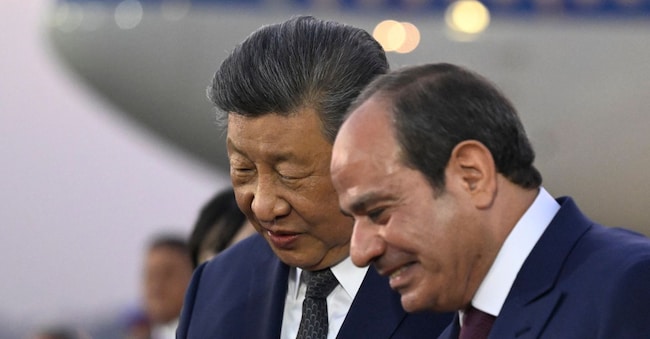
On 24 August 2026 Xi Jinping received King Abdullah II of Jordan in Beijing; the King had arrived in the country for his ninth visit since his accession to the throne. The two leaders agreed to deepen the strategic partnership established in 2015 and witnessed the signing of documents relating to foreign affairs, trade, industrial chains and judicial cooperation. A few days later, Xi travelled to Egypt as part of a state visit that took place between 30 August and 3 September, culminating in a meeting with President Abdel Fattah al-Sisi. In Cairo, more than twenty agreements were concluded in the fields of the digital economy, artificial intelligence, science, education, transport and supply chains. The bilateral programme covers infrastructure, electricity, agriculture, telecommunications, electric vehicles, green technologies and aerospace. Al-Sisi also called for a strengthening of military and security cooperation. Xi proposed a regional framework based on ‘endogenous’ security, integrated conflict resolution, economic development, the protection of waterways and coordination within the United Nations.
The Beijing Network
China does not suffer from a lack of diplomatic relations: it maintains dialogue with Israel, Iran, Saudi Arabia, the United Arab Emirates, Qatar, Egypt, Jordan and the Palestinian authorities. It suffers from an insufficient capacity to translate these relationships into strategic foresight. In the contemporary Middle East, decisions capable of disrupting a trade route may be taken outside state structures, by armed organisations whose conduct does not necessarily align with that of their sponsoring governments. Beijing therefore needs interlocutors capable not only of conveying official positions, but also of interpreting intentions, escalation thresholds and actual chains of influence. Egypt brings together in a single capital almost all the issues affecting China’s economic security: it controls the Suez Canal, borders Gaza, maintains the peace treaty and security channels with Israel, engages in dialogue with Hamas and the Palestinian Authority, participates in Arab and African diplomacy, and maintains operational relations with the United States, Europe, the Gulf monarchies, Russia and Iran. Investments in ports, industrial estates, energy, telecommunications and transport acquire a value greater than their immediate profitability when they provide institutional access, insight into trade flows and the capacity for emergency planning. Security cooperation, even without a Chinese military presence, can improve staff protection, the evacuation of citizens, maritime surveillance and the continuity of infrastructure.
This does not mean that Egypt is entering a Chinese sphere of influence. In 2025, the European Union remained its largest trading partner, accounting for 24.6 per cent of total trade. Trade in goods between the EU and Egypt reached €32.3 billion; the EU accounted for 27.7 per cent of Egyptian exports and 23.1 per cent of imports. The stock of European direct investment in Egypt stood at €35.4 billion in 2024. Cairo is building a multipolar structure in which Chinese capital, European markets, Gulf finance and American cooperation are becoming tools for negotiating autonomy.
The Middle Eastern Sensor
Jordan offers a different kind of asset. It does not have the economic scale of Egypt, but it borders Israel, the West Bank, Syria, Iraq and Saudi Arabia; through the Hashemite monarchy, it plays a significant role regarding the Muslim holy sites in Jerusalem; it hosts sizeable refugee communities and maintains political and security links with Western governments, Arab monarchies, Palestinian institutions and Israeli authorities. The Aqaba summit on 26 February 2023 demonstrated this role: Jordan brought together Israeli, Palestinian, Egyptian, American and Jordanian representatives in an attempt to curb the escalation. Amman can provide China with what major economic partnerships do not guarantee: an understanding of Palestinian dynamics, the religious sensitivities surrounding Jerusalem, the tribal networks spanning Syria and Iraq, and the gap between public statements and an actual willingness to compromise.

