
From Cingoli to the Fiastra and Mivola valleys, a journey through nature and history in the Marche region
Cingoli, the 'Balcony of the Marche' between history and nature

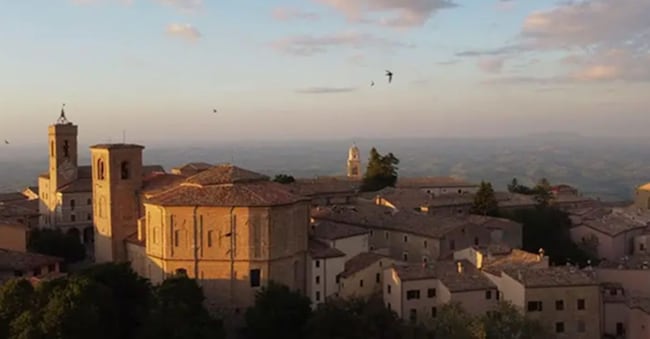
It is one of the symbolic destinations of the Marche hinterland thanks to its privileged position: at an altitude of 631 metres, the village dominates a landscape that on clear days extends as far as the Adriatic, offering one of the widest and most evocative views of the entire Marche region. The historical centre of Cingoli, whose name derives from the Latin "cingulum", a term that recalls the idea of a rocky outcrop or a shelf overlooking a mountainside, is enclosed by an almost completely intact city wall and develops along an urban fabric populated by noble palaces, Renaissance portals and churches that recall a centuries-old past. Piazza Vittorio Emanuele II, overlooked by the Cathedral of Santa Maria Assunta, is the heart of city life, while the Palazzo Comunale houses one of the masterpieces of the Marche Renaissance, Lorenzo Lotto's Madonna del Rosario, a famous painting from 1539. The archaeological heritage is instead preserved in the State Archaeological Museum, with exhibits ranging from prehistoric times to the Hellenistic-Roman period. In addition to its historical-artistic dimension, Cingoli is also distinguished by its natural surroundings: the Castreccioni lake, the Canfaito beech forest, the Macchia di Tassinete and the Bosco di Montenero broaden the travel experience and are mirrored by the pleasure of a gastronomy that tells of the territory through its typical products, from the Mignola extra virgin olive oil to the cheese pizza and the traditional country desserts such as the "Serpe".

