The analysis

Eisenkot has been tasked with forming the new Israeli government. Bibi’s days appear to be numbered, but the threat of war with Iran remains

The task entrusted to the former Chief of the General Staff has triggered a political crisis that extends far beyond Benjamin Netanyahu’s personal future. The potential change in leadership of the Jewish State coincides with the war against Iran, the new balance of power in Washington and the redefinition of regional power dynamics, from Lebanon to Yemen, where Hezbollah and the Houthi rebels are active respectively.

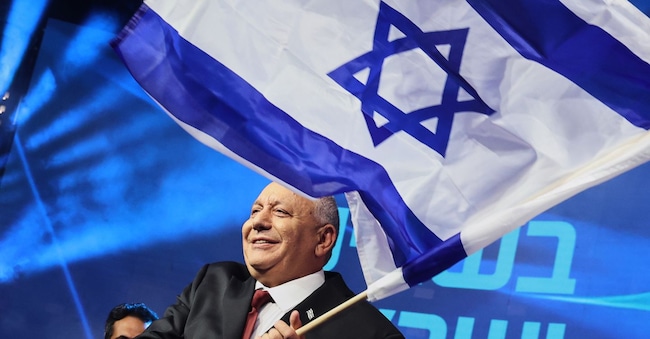
 Gadi Eisenkot, incaricato di diventare il nuovo primo ministro di Israele Foto IPP/Gil Cohen-Magen/dpa via ZUMA Press

9' min read

Translated by AI
Versione italiana

9' min read

Translated by AI
Versione italiana

The decision by the Israeli President Isaac Herzog to entrust Gadi Eisenkot with the task of forming a new government is not merely a constitutional step following parliamentary elections that failed to produce a clear majority, but it is also a development with political and strategic implications that go far beyond the rivalry between two leaders, at a time when Israel is going through one of the most complex phases in its recent history.

Benjamin Netanyahu, who has made the confrontation with Iran and the containment of its regional influence one of the cornerstones of his security strategy, now faces the prospect of losing power whilst a war continues that is closely linked to his leadership and his political and military decisions. Eisenkot, former Chief of Staff of the Israel Defence Forces, faces the challenge of forming a government against a backdrop of political contradictions no less complex than the security issues awaiting the next administration.

Loading...

The fundamental question, therefore, is whether Eisenkot’s appointment marks the beginning of the end of the Netanyahu era or whether Israel is preparing for a change in leadership whilst keeping its military strategy essentially unchanged. For the Middle East, however, the most important question is another: would Netanyahu’s possible departure from the political scene help to de-escalate the conflict with Iran and its regional allies, or would it simply lead to a reorganisation of the confrontation through different political and military means?

Netanyahu loses his majority, but not yet his power

The Knesset elections on 27 October significantly altered the political landscape in Israel, without, however, delivering a clear parliamentary majority to either of the two main blocs. Netanyahu’s bloc secured 53 seats out of 120, compared with 48 for the camp led by Eisenkot, whilst the Arab parties won a total of 19 seats.

Although Netanyahu’s bloc holds more seats than the opposition, the endorsement of 67 MPs for Eisenkot has enabled him to be given the first mandate to attempt to form a government.

But Eisenkot must secure a parliamentary majority capable of supporting his government, a goal made difficult by divisions within the opposition, particularly regarding the possible support of Arab parties, the participation of religious groups and the issue of compulsory military service for ultra-Orthodox Jews. His appointment therefore does not, at least for the time being, represent an actual transfer of power, but rather the start of a political test that could result in the formation of a new government, a further term in office, or a return to the polls.

However, the mere fact that political initiative has shifted from Netanyahu to his main rival sends a significant signal: the Prime Minister, who for years managed to remain in power through shifting alliances, is now facing increasing difficulties in rebuilding the majority that previously supported him.

Has Netanyahu’s downfall really begun?

A distinction must be made between three issues: the end of the current Netanyahu government, the end of his ability to return to power, and the end of the political and strategic approach associated with his name.

Netanyahu could lose the leadership of the government without losing his influence within the Likud or amongst the Israeli right-wing electorate. He could also return to lead the country should the opposition fail to form a stable coalition. Current developments suggest, however, that the political formula on which he has relied in recent years no longer automatically guarantees his continued hold on power. Netanyahu has built a significant part of his political image by presenting himself as the leader best able to tackle the Iranian threat, manage relations with Washington and preserve Israel’s military superiority.

The continuation of the war, its economic and human costs, and internal divisions over the conduct of operations and the future of Gaza have, however, placed this image under increasing political pressure. This does not mean that Israeli voters have expressed a unified stance against the war or against a confrontation with Iran. The domestic debate also centres on the manner in which the war is being waged, the stated objectives, the results achieved and the price paid by Israeli society. Talk of Netanyahu’s demise should not automatically lead to the conclusion that Israel is ready to radically alter its regional strategy.

Loading...

Eisenkot is not the polar opposite of Netanyahu on the Iran issue

Eisenkot embodies a different leadership style, but he does not come from outside the Israeli security establishment. He is a former Chief of the General Staff with extensive experience in managing military operations and dealing with regional threats, in particular Hezbollah and Iran. Throughout his military career, his name has been associated with a doctrine that calls for the use of significant force against armed threats. It would therefore be inaccurate to automatically portray him as a leader inclined towards a policy of conciliation.

The potential difference between Eisenkot and Netanyahu does not necessarily concern the recognition of Iran as a threat; rather, it concerns how to deal with it, the definition of military objectives and the relationship between the use of force and diplomacy. A potential Eisenkot government might focus on greater coordination with the military leadership and the security services, on a reorganisation of relations with the United States and on a more precise definition of the objectives of the conflict. However, there is no guarantee that this would automatically lead to a reduction in military operations. A change in leadership could result in a reassessment of the war or its continuation under a different strategy.

The war with Iran: what will change?

Iran represents the main external challenge for any new Israeli government. The ongoing confrontation no longer concerns only the Iranian nuclear programme, but extends to missile capabilities, the network of regional alliances, the security of maritime routes and military relations between Israel and the United States.

The possible appointment of Eisenkot as head of government would therefore not automatically mean an end to military pressure on Tehran. The new government could face three strategic options. The first would be to continue military operations, redefining their objectives and seeking to avoid any unnecessary escalation of the conflict. The second would be to seek agreements to reduce tensions in coordination with Washington, should sufficient guarantees emerge regarding Iran’s nuclear programme, its military capabilities and Israeli security. The third would be to continue the regional confrontation without a comprehensive solution, but with a different approach to managing levels of escalation compared to the previous phase.

It is not possible to determine which of these options will prevail until we know the composition of any coalition, the positions of its partners, and how military operations and international negotiations unfold. One central question remains, however: any Israeli government will have to address a question to which the war, on its own, has not yet provided a definitive answer.

The implications of the US election for Israel

Eisenkot’s appointment coincides with the results of the US mid-term elections, which have shifted the political balance in Congress and strengthened the Democrats’ ability to exercise oversight over the administration of President Donald Trump.

The relationship between Netanyahu and Trump has been a key factor in managing the standoff with Iran. The political changes in Washington, however, mean that any Israeli government must reassess its ability to secure US military, financial and diplomatic support on the same terms as before. The new Congress will be able to exercise more effective oversight over aid, military operations and decisions relating to war, whilst still leaving the President with broad powers in foreign policy.

According to Eisenkot , there may be an opportunity to rebuild relations with various US institutions, thereby reducing dependence on the direct political relationship between the two heads of government. This does not mean that Washington will abandon Israel’s security or that the Democrats will adopt a unified stance towards Iran. US support for Israel, the Iranian nuclear issue and the United States’ strategic interests in the Middle East involve considerations that transcend party divisions.

The balance of power between Hezbollah, Hamas and the Houthis

It would be a mistake to regard Iran and its regional allies as a single bloc that always acts on the basis of centralised decisions, given that Hezbollah in Lebanon, Hamas in the Palestinian territories and the Houthis in Yemen each have their own political and military structures and their own local priorities, whilst maintaining relationships with Tehran that vary in nature and intensity; a change in Israeli leadership could therefore have different consequences on each of these fronts.

In Lebanon, a new government could reassess the objectives of operations against Hezbollah, the limits of escalation and the possibility of reaching security agreements along the border. In Gaza, Eisenkot’s political opposition to Netanyahu does not mean that he adopts a conciliatory stance towards Hamas. Eisenkot has, in fact, expressed his opposition to the movement remaining in power in Gaza and to it retaining its military capabilities.

As regards Yemen and the Red Sea, the consequences of the political change in Israel would, in many respects, be indirect. The conflict with the Houthis is linked to the security of shipping, regional rivalry with Iran, the strategic calculations of the US and the Gulf states, as well as the internal conflict in Yemen. It is important to remember that the security of the Strait of Bab el-Mandeb cannot be guaranteed on a long-term basis through military operations alone, without a Yemeni state capable of exercising its sovereignty and protecting its own coasts and ports.

Iran’s advantage in the Israeli political crisis

Tehran might interpret political developments in Israel as a new factor in its strategic calculations. The presence of an outgoing government, complex negotiations to form a coalition and the possibility of a transfer of power are all factors that could influence the speed at which certain political decisions are taken and the government’s ability to launch long-term initiatives.

But it would be a mistake to assume that political division in Israel necessarily leads to a weakening of its military capabilities. Israel’s military and security institutions continue to operate independently of changes in government. Furthermore, an outgoing government retains significant powers in the management of security emergencies. Tehran might therefore see the transition period as a diplomatic opportunity, but it cannot regard it as a guarantee of a reduction in Israeli military operations – and the same applies to Israel.

Palestinians and Arab parties: the paradox of government formation

One of the main contradictions in the new Israeli political landscape concerns the role that Arab parties might play in the selection of the next prime minister. The Arab parties won a total of 19 seats and recommended Eisenkot for the post, despite deep political differences with some sections of the Israeli opposition. This means that the vote of Israel’s Arab citizens has become an important factor in the parliamentary balance of power.

However, the ability to influence the formation of the government does not necessarily imply the ability to determine its policy towards the Palestinians, Gaza or the West Bank.

Some of Eisenkot’s potential allies are, in fact, unwilling to rely on the support of Arab parties, whilst Eisenkot himself opposes the creation of a Palestinian state, despite having criticised the violence perpetrated by extremist settlers.

A contradiction is emerging between the need for Arab votes to bring about a change in leadership and the persistence of deep differences over Palestinian political rights and the future of a possible agreement. This could become one of the main tests for a new government: will it be possible to broaden political participation within Israel without altering fundamental positions on the Palestinian question?

Three possible scenarios for Israel

Current developments open up three possible political paths. The first scenario is the formation of a government led by Eisenkot. In this case, Israel would witness a transfer of power that could entail changes in the style of government, in relations between political institutions and the security apparatus, and in the assessment of certain aspects of the war and foreign policy. Secondly: a unity government or a power-sharing arrangement. Negotiating difficulties could encourage the search for an agreement between rival factions, including Netanyahu and Eisenkot. The third scenario is the failure to form a government and a return to the polls.

At present, there is insufficient evidence to determine which of these paths will actually be taken. Netanyahu’s possible departure from power would represent a significant change in Israeli politics, but would not in itself be sufficient to bring about a corresponding transformation in Israel’s relations with Iran, the Palestinians or other countries in the region.

If Eisenkot were to succeed in forming a government, he would face a twofold challenge: to demonstrate his ability to lead a politically diverse coalition, and to decide whether to continue the war along the same lines as before or to attempt to transform it into new political and security agreements.

For Iran, the Gulf states, Lebanon and Yemen, the issue should not be confined to the identity of Israel’s next prime minister, but should concern the strategy Israel will adopt, the limits of US support and the possibility of reaching regional agreements capable of reducing the risks of war. Eisenkot’s appointment could mark the beginning of the end of a political era dominated by Netanyahu, but not necessarily the beginning of the end of the standoff with Iran.

The real test will not only be Israel’s ability to form a new government, but also that of this potential government to answer a far more complex question: Will Israel be able to move from managing its security through recurring wars to forging agreements capable of reducing the need for further conflicts, or will the change in leadership leave the Middle East facing the same wars, merely with different political protagonists?

Arhab Mohamed Al Sarhi, President of the Yemeni-Italian Friendship Association

Copyright reserved ©
Loading...

Brand connect

Loading...

Newsletter

Notizie e approfondimenti sugli avvenimenti politici, economici e finanziari.

Iscriviti