

Erdogan, the US point of contact within NATO, celebrates the end of the Arab Spring
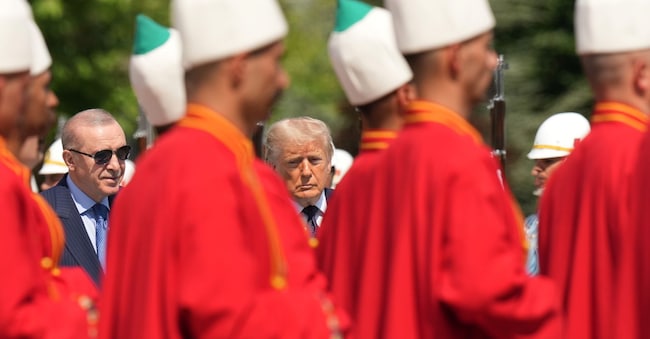
The NATO summit in Turkey highlights the country’s ambiguity. This is a model that now seems to appeal to Donald Trump, who is focused on the Indo-Pacific, and confirmation of this comes from the go-ahead for the F-35s. After 15 years, the framework that had sparked the uprisings in the Maghreb has been consigned to history.

Key points
Following the meeting of the world’s seven major powers in Evian, which concluded without a joint final declaration, the NATO summit in Ankara is also following a now familiar script: the search for the bare minimum. The maximum possible is, in fact, out of the question, given the waning interest in solidarity-based multilateralism, which has been undermined by the return of spheres of influence and divergent geopolitical interests. The Atlantic Alliance as a whole breathes a sigh of relief at having narrowly avoided a rift. But doubts and tensions remain. The Europeans are returning home convinced that they must accelerate their path towards strategic autonomy. Increasing defence spending is now a matter of survival. And they are aware that they have persuaded the US President to continue supporting Ukraine – a move that suits the White House at this stage, given the uncertainty surrounding the conflict with Iran and Kyiv’s clear ability to turn the tide of the war. Trump, for his part, will be able to claim at home that he has maintained the same stance abroad, having, moreover, had no qualms about tearing up the framework agreement with Iran in the middle of the summit with new air strikes, even more intense than those in June.
Ankara
The host, Turkish President Recep Erdogan, is observing all this with a certain degree of satisfaction and delight. With this summit, the era of Turkish strategic uncertainty can indeed be said to have come to an end. Long gone are the years when Ankara was knocking on the European Union’s door, hoping for some form of membership. Nor are the years when the White House took a dim view of Turkey’s ambiguity – a NATO ally yet committed to containing the rise of Saudi Arabia, another strong US ally, including through support for Sunni groups and organisations linked to terrorism. Turkey is now a key geopolitical player in the region stretching from Libya to Central Asia, via the Horn of Africa. Syria is effectively its protectorate, whilst Erdogan has now raised the banner of staunch defence of the Palestinian cause. If there is any hope of resuming negotiations between Russia and Ukraine, it is due solely to Turkey’s role; before winter sets in, Turkey will once again become the natural venue for a new round of talks between Moscow and Kyiv. The long-standing Kurdish question is now beyond the reach of the international community and depends solely on concessions from Turkey. Furthermore, Erdogan has already done his homework thoroughly when it comes to defence investment: today, Turkey is NATO’s second-strongest military power, has an advanced industrial base – particularly in the field of drones – and is preparing to unblock the supply contract for new F-35 fighter jets.
The new role
All this places Ankara in a privileged position: what we Europeans continue to call and regard as ambiguity is seen in Washington as a show of strength. Turkey will continue to establish itself as a player capable of operating on multiple fronts, engaging with the Europeans on trade hubs and outposts in the Mediterranean, with Moscow on energy policies, and with China on global trade routes. Provided, however, that it has a free hand in its own backyard, particularly in curbing the ambitions of its two main rivals: Saudi Arabia and Iran.
The Balances
The proxy war waged by the three under the guise of the so-called ‘Arab Spring’ has established a new balance of power, based on the division of spheres of influence. Erdogan certainly did not protest at the resumption of American attacks on Iran, whose nuclear ambitions also alarm Ankara in terms of a possible strategic imbalance. The relationship with Riyadh in recent years has been a spurious and opportunistic one, driven by anti-Persian sentiment. Today the field is clear, bolstered by Donald Trump’s personal support. If there is one dynamic that will need to be watched very closely in the coming years, it is the growing tension between Ankara and Tel Aviv. The two are already stepping on each other’s toes and will do so increasingly, from Cyprus to Lebanon, and of course right through to Gaza. The relationship between the US President and Netanyahu appears to have soured; the special bond is no more. This legitimises Turkey’s role as a strategic pivot in the region, and Washington will invest much of its political, strategic and military capital in this role in the coming years. With ties to Tehran severed and a wary Saudi Arabia, the America of the future – which is looking towards the Indo-Pacific – needs a foothold in every region. The natural choice for the coming years in the Mediterranean, the Middle East and the Persian Gulf could well be Turkey itself.

