
The meeting

Government and regions: ahead with the reform of family doctors, here are the latest news

At the Ministry of Health the thawing meeting between the government, the regions and the trade unions is taking place, but they remain on the warpath. The decree expected in the Cdm at the end of the month

by Marzio Bartoloni

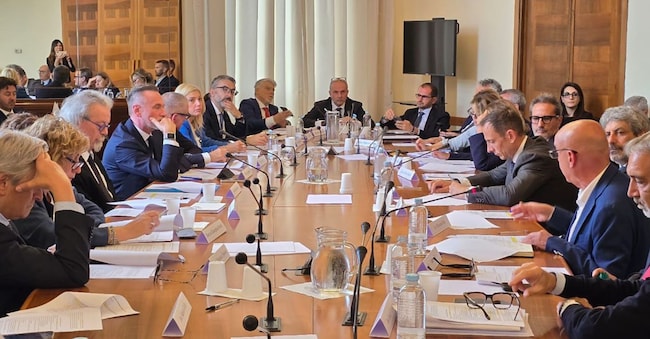
L'incontro dei governatori con i sindacati dei medici di famiglia alla presenza del ministro della Salute Orazio Schillaci

4' min read

Translated by AI
Versione italiana

4' min read

Translated by AI
Versione italiana

Trials of reconciliation on the reform of family medicine. At the Ministry of Health the thaw meeting between the government, the regions and the trade unions is staged, but they remain on the warpath: all together around a long oval table.

The governors came up with a draft decree on which they are all in agreement and which provides for a dual channel: the ordinary channel with the current convention and the residual channel - limited to local needs - which for the first time allows the regions to hire family doctors as employees to work mainly in community homes or where there are shortages.

Loading...

There is also provision for an hourly debt of at least six hours that non-employed family doctors will have to 'consume' within the Community Homes. The reform takes a new step forward pending the counter-deductions of the family unions expected next week. Now the green light of the decree in the Council of Ministers is expected by the end of the month.

All around the table: government, regions and unions

 With the Minister of Health Orazio Schillaci flanked by the undersecretary Marcello Gemmato at the centre of the table are, on the one hand, the representatives of four category trade unions - Fimmg (Italian Federation of General Medicine Doctors), Snami (National Union of Autonomous Italian Doctors), Smi (Italian Doctors' Union) and Fmt (Federation of Territorial Doctors) - and on the other Massimiliano Fedriga (Friuli-Venezia Giulia), president of the Conference of Regions and Autonomous Provinces, with fellow governorsRoberto Fico (Campania) and Francesco Rocca (Lazio), and councillors Massimo Fabi (Health Policies, Emilia-Romagna) and Guido Bertolaso (Welfare, Lombardy). Among others, the undersecretary for Relations with Parliament Paolo Barelli, Senator Fdi Francesco Zaffini (chairman of the Commission for Social Affairs, Health, Public and Private Labour, and Social Security at Palazzo Madama) and Senator Lega Elena Murelli.

A broad parterre for a complex mission: to finally arrive at a solid consensus on the future of general practice.

Unions remain on the warpath  

All participants have a stack of papers in front of them. It is the draft decree on which they are discussing: a mediation offered by the regions from Minister Schillaci's text.

The regions presented the contents and the proposal put on the table, and from there the debate began, with the minister calling for a 'calm discussion', reiterating the objective: a more modern healthcare system that is closer to the citizens.

A step forward after the rifts and tensions: some unions of family doctors have even proclaimed an agitation at the announcement of a decree to reform territorial medicine. The Fimmg, the main union of family doctors, spoke of a 'decree'.

While Schillaci, during the last question time on the subject, toned down the tones by opening up to dialogue with the trade unions and reiterating that 'we do not want to dismantle the figure of the family doctor', but the model must be changed, and that the 'reform will be discussed with the regions and trade unions'.

So the day of the meeting has arrived. A first face-to-face to return to cooperation.

The dual channel: convention and dependence

The latest draft of the decree that Il Sole 24 Ore has been able to read already makes things clear in Article 2 by stating that 'general medicine and paediatrics of free choice are exercised primarily within the conventional relationship with the National Health Service', but then adding that 'the salaried employment relationship constitutes a residual and complementary channel, selective and programmed, that can be activated by the Regions and Autonomous Provinces to cover vacant appointments not assigned through the conventional channel, the structured territorial functions and the unmet care needs'.

Priority will therefore be given to Community homes, which will also be eligible for a quota 'equal to at least six hours per week for 48 weeks per year' for other non-employed doctors, a quota that may increase depending on the number of patients and regional needs.

Among the latest changes in the draft is also the definition of the age for registration as a paediatrician, which 'is included from the birth of the child until the completion of the sixteenth year of age', an age limit 'that can be raised to eighteen years through autonomous regional organisational determinations'.

The School of Specialisation in Primary Care is born

The decree then establishes 'the school of specialisation in territorial, community and primary care medicine, as a specialised university course aimed at training doctors for territorial primary care' and pending the new school, those who have a specialisation in community and primary care medicine can also become employed family doctors; internal medicine; geriatrics; pneumology; metabolic medicine and diabetology; cardiology; emergency-urgency medicine; nephrology; rheumatology; endocrinology and diseases of the metabolism; cardiovascular diseases and oncology.

Recruitment through the dependency channel 'shall be arranged,' reads the draft, 'within the limits of the needs identified by the regional planning, the authorised quotas and the resources available under current legislation, with priority given to the Community Homes identified by the Region, the deficient areas and the other organisational models envisaged by Ministerial Decree 77.

Copyright reserved ©

Brand connect

Loading...

Newsletter

Notizie e approfondimenti sugli avvenimenti politici, economici e finanziari.

Iscriviti