Climate change

Guterres: 'The world has failed on the 1.5 degree target'. Downward expectations on Cop30 in Brazil

At the Belem Summit, the UN Secretary General admits defeat: it is impossible to avoid an increase in global temperatures above the threshold already in the next few years. Starmer: 'Consensus is lost'. American Trump, Chinese Xi and Indian Modi absent. Lula: 'Extremist forces' spread lies about climate change

by Gianluca Di Donfrancesco

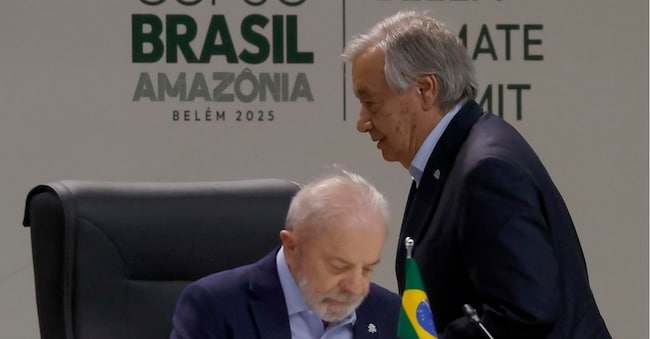
Il segretario generale delle Nazioni Unite, Antonio Guterres (a destra), e il presidente brasiliano, Luiz Inacio Lula da Silva (a sinistra)(EPA)

4' min read

Translated by AI
Versione italiana

4' min read

Translated by AI
Versione italiana

Ready, go: with the parade of government representatives from around the world, the United States aside, the show has begun at the UN Climate Change Conference in Brazil: the 'Cop of Truth', as the host, Inacio Lula, presents it. As with all COPs in recent years, the mood on the eve is one of 'tipping point'. As never before in recent times, however, expectations are on the low side.

The issues on the agenda at the Belem conference are many and critical: from the implementation of the 2015 Paris Agreement, which ten years on is dragging its feet, to aid to developing countries in the dual challenge of energy transition and adaptation to a climate that is already changing, overwhelming lives and economies.

Loading...

What is looming, however, is a self-referential result, as in the last three Cops, useful perhaps to save the negotiating process, but without marking significant progress in the fight against global warming. There will also be a fight to defend the principle of the gradual abandonment of fossil fuels and the red lines of the Paris Agreement, i.e. the objective of containing the increase in global temperatures to as close as possible to 1.5 degrees and well below 2 degrees at the end of the century, compared to the pre-industrial period.

Under current commitments, we are heading for an increase of close to 3 degrees, and 30 years after the first COP, greenhouse gas emissions have risen by a third, instead of falling. Exceeding the 1.5 degree threshold is now a foregone conclusion, even in the short term: "We have failed," said UN Secretary General Antonio Guterres in Belem, who urged governments not to "remain prisoners" of fossil industry interests.

Weight loss

However, the spotlight of the leaders' parade, which takes place over two days and closes on 7 November, is mainly on empty chairs. Starting with that of Donald Trump, the president who took the United States out of the Paris Agreement, beyond the confines of climate denialism and into an unprecedented era of oil revanchism.

Trump and his Republicans are not content with pushing as hard as possible the production of crude oil, gas and coal, the main culprits of climate change (to get an idea of the consequences on people's lives, see Hurricane Melissa). Nor are they content to dismantle green investment programmes and strategies at home, including those of the private sector. In his crusade against the green transition, the American president openly threatens states that are committed to decarbonisation, including Europe, on which he imposes massive (and unrealistic) purchases of fossil fuels, with the blackmail of tariffs.

In his speech, Lula warned against 'extremist forces' spreading lies. More direct was the Chilean president, Gabriel Boric, who explicitly accused Trump of lying when he dismissed climate change as 'the biggest scam' in history.

Another weighty absence is that of Xi Jinping, president of two-faced China: first in greenhouse gases, but also in investment in renewables. Indian Prime Minister Narendra Modi is also absent.

Europe defends the Paris Agreement

The EU summit leaders, with Ursula von der Leyen and Antonio Costa, risked arriving in Brazil without an updated climate plan. Only in extremis and with great effort did the Twenty-Seven manage to find a compromise downwards. With the launch of the Green Deal in 2019, Brussels aspired to a leading role in green industry and finance. Covids, the energy crisis, misjudgements and delays, and above all the change in the political balance, have scaled back that vision. The EU is also the large economic area that has cut greenhouse gas emissions the most by 2024 (-2.5% compared to 2023). Compared to 1990, the cut is 37.2%. Without sacrificing economic growth: in the same period, its GDP increased by 71%.

In Belem, von der Leyen assured that 'Europe stays the course', adding that this must be the Cop defending the Paris Agreement targets and the commitment to triple renewables by 2030.

Among the European leaders who have responded to the call are France's Emmanuel Macron, Germany's Friedrich Merz and Britain's Keir Starmer, who realistically admits: 'The general consensus on the climate emergency is lost'. Prime Minister Giorgia Meloni sent her deputy, Antonio Tajani, to repeat her mantra: 'No to ideology, environmental defence must put the person at the centre'. And in the name of technological neutrality, Tajani announced an initiative with Brazil and Japan to quadruple biofuel production by 2035.

On the sidelines of the summit, Brazil, which holds the chairmanship of Cop30, presented an ambitious plan to multiply climate funding to USD 1.3 trillion per year from 2025 and launched a rainforest fund, which aims to raise USD 125 billion, but which has already been rejected by the UK.

After the leaders' parade, from 10 November the negotiators, those called upon to produce concrete results, will take the field. Closure is scheduled for the 21st, barring last-minute dramas and extensions to save what can be saved. This too is now a tired habit.

Copyright reserved ©
Loading...

Brand connect

Loading...

Newsletter

Notizie e approfondimenti sugli avvenimenti politici, economici e finanziari.

Iscriviti