Caronte High-Pressure System

France’s hottest day on record. 45 degrees in Spain

Tomorrow, Thursday 26 June, the number of Italian cities designated as ‘red alert’ by the Ministry of Health will rise to 17, with temperatures of 41 degrees forecast for Florence, which meteorologists have awarded the dubious honour of being the hottest urban centre on the peninsula
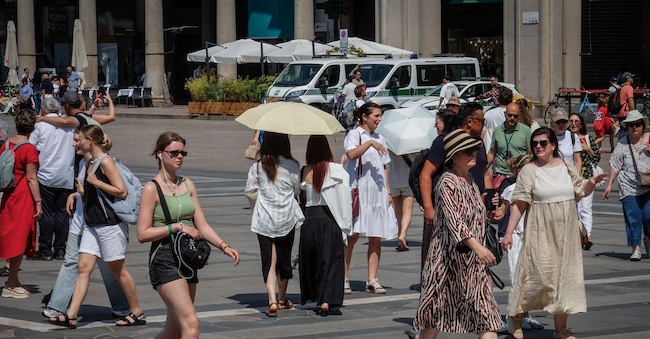
Cittadini e turisti cercano refrigerio dalle temperature record in piazza del Duomo, Milano, 23 Giugno 2026. ANSA / MATTEO CORNER ANSA

4' min read

Translated by AI
Versione italiana

4' min read

Translated by AI
Versione italiana

The heatwave continues, brought on by the African high-pressure system Caronte, characterised by extreme temperatures, sky-high humidity and ‘super-tropical’ nights, with minimum temperatures struggling to drop below 25°C. Tomorrow, Thursday 25 June, the number of Italian cities issued with the red alert by the Ministry of Health will rise to 17, with 41 degrees forecast for Florence, which meteorologists have awarded the dubious distinction of being the hottest urban centre on the peninsula: for six consecutive days, the Florence Peretola weather station has reached or exceeded 36°C – a record never before seen in over 70 years of continuous observations. The alert already in place for Ancona, Bologna, Bolzano, Brescia, Frosinone, Milan, Perugia, Pescara, Rieti, Rome, Turin, Venice, Verona and Viterbo – as well as Florence – will be joined by alerts for Latina (again today) and Bari.

Local authorities take action amid countermeasures and power cuts

Local authorities are trying to take remedial action. In Bologna, 46 public water dispensers and 16 new drinking fountains are to be installed: this will bring the total number of water supply points across the city to almost 250. Across the whole of Emilia-Romagna, a regional order prohibits workers from prolonged exposure to the sun between 12.30 and 16.00. In the A&E departments of the ‘Mazzoni’ hospital in Ascoli and the ‘Madonna del Soccorso’ hospital in San Benedetto del Tronto, the so-called ‘heat code’ is now in force. Meanwhile, the Department of Civil Protection has issued a severe weather warning forecasting thunderstorms from today in the inland and mountainous areas of Lazio, Campania, Basilicata, Calabria, Sicily and Sardinia. These conditions will be accompanied by heavy downpours, strong gusts of wind, localised hailstorms and frequent lightning.

Loading...

Yesterday, the rise in energy consumption due to record temperatures caused power cuts in several cities, including Naples, Milan and Turin, causing disruption for thousands of people. Palazzo Civico, the town hall of the Piedmontese capital, also lost power for twenty minutes. Mayor Stefano Lo Russo was furious: “What is happening right now,” he said, “is unacceptable. Following the emergency that had already hit the city last summer, we had asked Iren and Ireti to strengthen the electricity grid’s response capacity and to adapt their emergency plans to events that, unfortunately, can no longer be considered exceptional. But what is happening now shows that the measures taken are not sufficient.” The situation is no better abroad.

Francia nella morsa del caldo: Parigi registra temperature record

Health emergency across Europe

The extreme heat at the start of this summer is also taking its toll on other countries across Europe, where even higher temperatures are being recorded: a staggering 45 degrees has been recorded in Spain, which has been under heatwave alerts for several consecutive days due to the unusual heatwave affecting almost the entire country and which, according to the State Meteorological Agency (Aemet), is set to peak in the coming hours.

The special warning issued on Sunday remains in force overnight, with tropical minimum temperatures of 25 degrees and daytime maximum temperatures exceeding 45.

Dal ventaglio al ghiaccio, come i turisti sopravvivono al caldo a Roma

In France, 40 people have died after swimming in waters where bathing is prohibited, such as lakes, rivers and unsupervised canals. Around 1,800 schools have been closed due to the heat.

Today was the hottest day ever recorded in France, breaking the record set just 24 hours earlier, according to Météo-France. The national heat index, which is the average of day and night-time temperatures at 30 reference stations, reached 30 degrees, a level never before recorded.

In Germany too, the 40 degrees forecast for Friday 26th are expected to set a new heat record for June, whilst the United Kingdom came close to 40 degrees, approaching the record of 40.3 set in July 2022. A red alert is in place today for 300 schools, where an all-time temperature record cannot be ruled out. The heat is also being felt in the Netherlands, where Amsterdam is rolling out a network of ‘cooled’ zones across the city. Overall, according to the WHO, the temperatures being recorded across Europe at the moment constitute a public health emergency, following the heatwaves of the last four years which have caused over 200,000 deaths.

Thunderstorms that are just ‘hot showers’

The extreme heat gripping Italy at the moment is accompanied, in the afternoons, by thunderstorms that do little to cool things down. Lorenzo Tedici, head of media meteorology at iLMeteo.it, confirms that these thunderstorms bring no real relief. The reason is purely physical: they are not associated with the passage of an Atlantic disturbance accompanied by cool air at high altitude (which would flow down towards the ground during the rainfall), but are generated exclusively by excess heat and the rapid saturation of water vapour in the atmosphere. In practical terms, these are effectively ‘hot showers’. During these showers, temperatures drop only slightly (by just 1–2°C), whilst the humidity in the air rises even further. The effect on our bodies is negligible: the perceived temperature remains the same, leaving the feeling of oppression and physical discomfort unchanged.

Some relief only at the start of July

We can expect this afternoon’s unsettled weather to continue until tomorrow, 25 June. After that, the Caronte high-pressure system will strengthen further, preventing thunderstorms and making the atmosphere even more stable and sweltering. The peak of this very long and gruelling heatwave is expected between Sunday and Monday. The models confirm an extremely challenging biometeorological scenario, especially for central and northern Italy: actual peak temperatures of 41°C will be reached in Tuscany and Emilia, whilst along the Ligurian coast the combination of high temperatures and extreme humidity will cause the perceived temperature to soar to 45°C. To see the light at the end of this Saharan tunnel, we will have to wait until the start of next month. The first few days of July could, in fact, coincide with the Caronte high-pressure system shifting south-eastwards, a movement capable of unblocking the atmospheric circulation and finally allowing cooler, more unstable air currents from Northern Europe to move in. It seems paradoxical given the time of year, but in July, we will most likely be more comfortable than we are now.

Copyright reserved ©
Loading...

Brand connect

Loading...

Newsletter

Notizie e approfondimenti sugli avvenimenti politici, economici e finanziari.

Iscriviti