
Cutting-edge technology

Initial logistics trials. US firm Corridian aims to move unmanned underwater containers

A 38 million funding round with Point72 Venture to mitigate some of the risks associated with surface-based distribution and transport. Europe is taking a piecemeal approach and focusing on communication systems. Fincantieri has unveiled Deep for underwater infrastructure

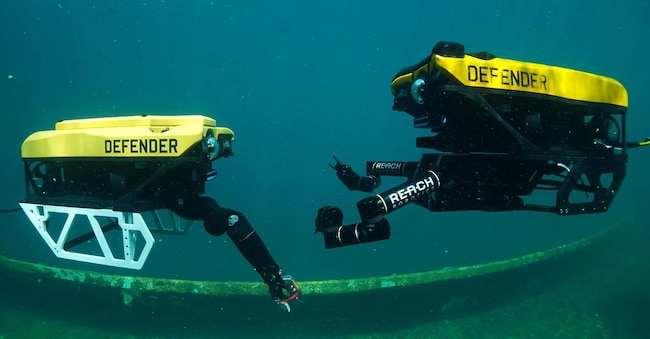
Droni sottomarini. (Imagoeconomica)

5' min read

Translated by AI
Versione italiana

5' min read

Translated by AI
Versione italiana

The ability to resupply a military force is becoming a decisive criterion for gauging its credibility. Corridian, a US company which on 3 November announced an initial funding round of $38 million led by Point72 Ventures, is bringing this issue into the underwater realm. The aim of the project is to transport containerised cargo using autonomous vehicles, thereby reducing the exposure of distribution operations to risks associated with the surface and airspace. If it were to operate as a continuous service, it would introduce a new and revolutionary capability into military logistics.

Corridian plans to unveil its flagship vehicle at the end of 2027. The company promises containerised cargo in accordance with ISO standards, ranges of thousands of nautical miles and a supply chain independent of the Submarine Industrial Base. The transport must result in usable material, delivered within the required timeframe and via an interface compatible with the recipient. The vessel must then be able to be returned to service with personnel, spare parts, energy and procedures readily available. It is this sequence of events that will determine the value of underwater logistics. The distance travelled, considered in isolation, therefore does not measure how long the sustained force can continue to operate.

Loading...

US Defence figures

The US defence budget for 2026 allocates nearly $5.7 billion to the submarine industrial base and productivity measures at nuclear shipyards. This figure includes over $2.6 billion for implementing the recommendations of the study on the industrial base and $2.5 billion for productivity measures. Of the 15 selected investments, only three files contain documentation of monthly updates and two of quarterly reporting. The sample is not statistically representative of all investments, but it illustrates how difficult it is to link committed resources to industrial outcomes. For Corridian, promising a distinct supply chain therefore means demonstrating where the real additional capacity originates: suppliers, manufacturing processes, skilled personnel, quality controls and acceptance of subsequent units.

Europe begins testing

Europe is entering this arena with a variety of tools and interests that cannot be reduced to a single technological ranking.

For Italia, the most tangible aspect is the integration of industrial capabilities and operational assessment. On 23 October 2025, Fincantieri presented the Deep system in La Spezia during a demonstration mission, the Deep system, a solution that combines underwater sensors, command and control, autonomous vehicles and data analysis for applications relating to infrastructure and port areas. The report by the NATO Centre for Maritime Research and Experimentation also describes the Chobin v1.1 prototype, developed for the Italian Navy’s Naval Support and Experimentation Centre with funding from the Ministry of Defence. Its function is to support the testing, verification and validation of heterogeneous autonomous underwater systems.

Deep and Chobin outline a process of oversight and acquisition: interface qualification, comparison of solutions, verification of operating conditions and integration with the military user. We shall see how the two processes will intersect.

Entry requirements for France

France is pursuing an approach centred on a national demonstrator. A press release from the Ministry of the Armed Forces dated 3 November 2026 announced the agreement between the Agence de l’innovation de défense and Naval Group for the Ucuv operational demonstrator, following the feasibility studies launched in 2023 with the Direction générale de l’armement. Sea trials are scheduled to begin in 2028. The objectives include controlled decision-making autonomy, mission duration, air transportability and deployment from a quay or a surface vessel. This approach provides Paris with a framework within which to link the vehicle’s architecture, its deployment and the national supply chain. However, it raises the issue of defining requirements: a multi-purpose demonstrator may generate transferable knowledge, but a reconnaissance test does not automatically qualify it for a cargo mission. The French decision should maintain separate acceptance criteria for each function, so as not to turn the breadth of ambitions into a fictitious measure of maturity.

Berlin is limited to observation and reconnaissance

Germany, on the other hand, has a procurement programme focused on reconnaissance. On 25 February 2026, the Bundeswehr announced the introduction of Blue Whale into the German Navy, as part of a collaboration between Tkms Atlas Elektronik and Iai Elta. The system is described as being designed for extended surveillance, the search for underwater targets and the reconnaissance of surface vessels; its stated dimensions are 10.9 metres in length, 1.12 metres in diameter and 5.5 tonnes in weight.

For Berlin, the knowledge-based benefit lies in the experience that the introduction of a system can yield: operator training, integration into naval operations, diagnostics, maintenance and relations with suppliers. Before extending these lessons to logistics, it would be necessary to ascertain which ones are actually transferable. The German-Israeli industrial cooperation also highlights the importance of the allocation of technical responsibilities: who updates the software, who certifies a modification and who provides support. The quality of the procurement will also be measured by the customer’s ability to maintain control and operational continuity throughout this distribution of responsibilities.

Great Britain: operational trials

The United Kingdom offers a different approach, based on experimental integration with a military partner. On 30 September 2026, the Royal Navy reported the launch and control, from XV Excalibur, of a heavy, inert and recoverable torpedo. The three-week experiment involved the US Navy, the British autonomous systems organisation MSubs and QinetiQ; according to the official report, the integration was completed within six months. The significance for London lies in the ability to bring together the platform, payload, management system, test range and responsible authorities to achieve a defined outcome. In terms of logistics, the next test should focus on the receipt of materials and the repeatability of the service. The Excalibur experience suggests a bilateral testing approach, but does not justify skipping the acceptance phase.

Loading...

The common ground between these approaches lies more in communications and assessment than in transport. The CMRE (Centre for Maritime Research and Experimentation) reports that during the Repmus and Dynamic Messenger 2025 exercises, over 200 nodes comprising platforms and sensors from different domains were connected, with thousands of messages processed every minute. Communicating with a system does not mean accepting its mission. For NATO, the most useful contribution would be to make national results comparable and to verify that technical interoperability corresponds to clear operational responsibilities. For the European Union, the Cable Security Toolbox published in February 2026 – with a corrected version of the report issued the following March – addresses infrastructure resilience. It can provide a framework for coordination on protection, incidents and dependencies, but it is not a mandate to purchase a military cargo fleet.

Finally, Article 20 of the United Nations Convention on the Law of the Sea requires, in the context of innocent passage through territorial waters, that submarines and other submersible vessels navigate on the surface whilst flying their flag. International straits to which the right of transit passage applies and archipelagic routes are subject to distinct regimes.

Italia, Germany and the United Kingdom would be well advised to use this period to align their respective qualifications with comparable requirements and assessments, whilst avoiding making initial training conditional on the establishment of a joint fleet.

Charlye Ghezzi is a geopolitical analyst and specialist in technology and government security

Copyright reserved ©

Brand connect

Loading...

Newsletter

Notizie e approfondimenti sugli avvenimenti politici, economici e finanziari.

Iscriviti