
Langosteria accelerates with Buonocore Hospitality Group and aims for 200 million turnover in 2030
Bhg will bring together active and new brands: towards openings in Italia and abroad with which to triple revenues and increase revenues more than proportionally

Key points
"We have a dream to become the world's leading luxury restaurant group". There is certainly no lack of enthusiasm and ambition in Enrico Buonocore as he announces the birth of Buonocore Hospitality Group (Bhg), 19 years after the opening of the first Langosteria in Milan, followed by the Bistrot, the pieds dans l'eau restaurant in Paraggi and those in Saint Moritz and on the seventh floor of the Cheval Blanc hotel in Paris, and with the next stages being finalised, after some 'technical' delays, in London and Porto Cervo.
From Langosteria to multibrand group
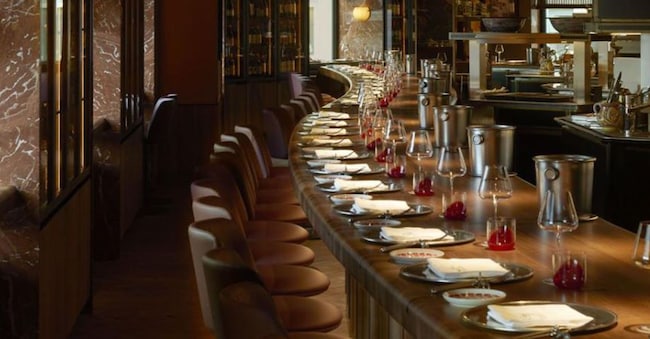
"The name has changed but not the objectives and underlying principles that have guided us in our continuous growth over these years," says the CEO, "but it was time to start working on the vertical developments of the other projects that flank the Langosteria brand. Two of them were recently inaugurated at Palazzo Fendi, together with Langosteria Montenapoleone. Pepe - Barra Italiana is a project I had in mind for some time, completely independent from Langosteria. It wants to celebrate the most authentic Italian tradition (interpreted by chef Luca Fantin, ed.) with an approach based on sharing, where guests are welcomed along the 'barra' (the bar, ed.) that runs all around the kitchen. The second format is the Ally's Bar with which we have opened a specific space for mixology. In Milan it can take advantage of two splendid terraces with 80 seats, but we would like to try to put it alongside all the new Langosteria projects, as will be the case for the next opening in Porto Cervo in the summer. Then the space where the Café used to stand (again in Milan in the San Babila area, ed.) will be used to test a further format on which I prefer not to reveal anything for now, but which we expect to see the light between the end of the year and the beginning of 2027. And not forgetting the Bagni Fiore (in Paraggi, ed) which could be a model for landing elsewhere'.
New York is also in the business plan
The plan to 2030 envisages reaching a turnover of between EUR 180 and 200 million, three times the current figure of EUR 68 million in 2025 between direct and indirect revenues (i.e. those generated in management agreement projects). The margin in terms of Ebitda is expected to grow more than proportionally to turnover: from 7 million in 2025 to 28-30 million in 2030.
On the one hand, the average size of the premises will be larger, on the other hand, investments are expected from real estate companies that have an interest in creating entrances to their facilities. "For example Paris has a turnover of 17 million and could reach 20 million with Ally's Bar. In New York we are evaluating important locations in Manhattan, with rents of three million a year but possible revenues of thirty. And on the other hand,' continues Buonocore, 'despite the fact that in 2026 it will still not be fully operational, for Montenapoleone, a unique case in Italia of an open club with three different experiences that is attracting 600 customers a day, we foresee takings of over 20 million that could become 25 in 2027'.
Over the next five years, the plan is to open three restaurants for each of the two new brands, and more Langosteria and Ally's Bar signs, in addition to those already in the pipeline (in the US, in a European capital - Madrid? - and in a mountain resort)


