NextMed Observatory Report

Manufacturing in the Mediterranean: Turkey is catching up with Milan

A ranking of the cities that best combine industrial output, sectoral diversification, added value and exports. Lombardy takes first place, closely followed by the Bursa industrial triangle near Istanbul. Barcelona and Emilia-Romagna also feature highly. Tangier, Tunis and Tirana are making their mark.

4' min read

Translated by AI
Versione italiana

4' min read

Translated by AI
Versione italiana

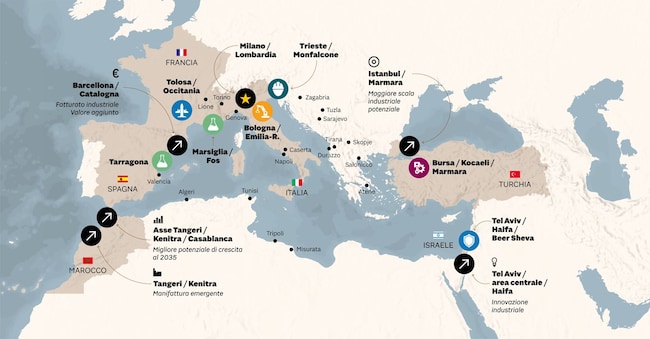
Milan (though in reality the whole of Lombardy) remains the manufacturing capital of the wider Mediterranean. But it faces stiff competition from a formidable rival: the polycentric system of the Marmara region (Istanbul-Kocaeli-Bursa), the ‘Turkish industrial triangle’, boasting a vast labour pool, competitive labour costs, a robust automotive sector (Europe’s fourth-largest manufacturer) and a rapidly expanding defence industry, particularly in the fields of drones and missiles. And watch out, because in the coming years, it cannot be ruled out that Turkey might overtake Italia’s economic powerhouse.

This is revealed in the study ‘The Manufacturing Capitals of the Mediterranean’, carried out by the NextMed Observatory of Il Sole 24 Ore. The term ‘wider Mediterranean’ refers here to a functional economic system, not merely a coastal strip: inland cities are therefore included when they have supply chains linked to Mediterranean ports, are integrated into logistics corridors and control industries along the coast, such as Milan or Lyon.

Loading...

According to the study, Lombardy combines production scale, sectoral diversification, added value and exports better than any other region. It also excels in terms of the presence of multinational companies, the depth of its component supply chain, financial capacity and access to European markets. The region therefore acts as a genuine global ‘transformation platform’, integrated into the trade corridors of Germany and China. The Achilles’ heels of the Lombardy industrial model (as well as that of Emilia-Romagna) are labour and energy costs.

The Turkish industrial triangle

With a large workforce and low labour costs, the Turkish triangle dominates an automotive sector concentrated in Bursa (which accounts for 30.2 per cent of the sector’s production sales value), Kocaeli (28.4 per cent), Sakarya (12.3 per cent) and İzmir (3.9 per cent).

However, it is important to bear in mind the structural limitations of Ankara. Despite having a larger critical mass than Lombardy, Turkey suffers from high currency volatility, hyperinflation, the cost of capital and a dependence on foreign semiconductors.

Barcelona and Bologna are hot on their heels

In third place is the Catalan polycentric system: Barcelona leads the way in management, pharmaceuticals, technology, design and R&D; Baix Llobregat stands out for the automotive sector, components and mechanical engineering; Vallès is the stronghold of electronics, machinery and life sciences; Tarragona is a hub for the chemical and petrochemical industries; Girona specialises in food, packaging and mechanical engineering; Lleida focuses on agribusiness.

Close behind is Bologna, with Emilia-Romagna proving to be by far the most efficient regional system in relation to its population. It therefore competes not on volume but on value: with packaging, excellence in mechatronics and the legendary Motor Valley, which create technological barriers and high profit margins.

Israel cannot compete with Lombardy, Catalonia or the Marmara region in terms of manufacturing output, but it leads the way in terms of R&D density: electronics, radar, missiles, air defence, sensor technology, semiconductors, avionics, medical devices and software.

Five scenarios for 2035

The in-depth report (which we summarise here, whilst referring you to the full-length version online) outlines five future scenarios.

The first is based on momentum: barring any major upheavals, the manufacturing hubs in 2035 will remain Milan-Lombardy, Marmara, Catalonia, Emilia-Romagna, Tangier-Kenitra and Tel Aviv-Haifa. Europe retains its qualitative leadership, Turkey and Morocco increase production, whilst Israel strengthens its defence and tech sectors.

Loading...

The second scenario envisages an acceleration of European industrial growth. The prerequisites? Pmore competitive energy prices, full implementation of the Chips Act and industrial policies, increased defence spending, reshoring, upgraded electricity grids and less bureaucracy. Italia would benefit from this, with Milan and Bologna taking the top two spots on the podium.

The third scenario, accelerated nearshoring, posits that European production will shift from Asia to the Mediterranean (through trade agreements and investment in ports and industrial estates). The main beneficiaries? Tangier-Kenitra, Tunis, Skopje, Tirana-Durrës, Sarajevo, Thessaloniki and Marmara. In this context, the risk for Europe is that it will lose ground in terms of production and skills.

Fourth scenario: energy and climate crisis. A worsening of climate change, combined with a spike in energy prices, would adversely affect Tarragona, Taranto, Oran-Arzew in Algeria, Sfax in Tunisia, industrial Morocco, Catalonia, Turkey and Sicily. Regions with better access to a stable electricity supply, interconnected grids, nuclear power or domestic gas would, by contrast, be relatively favoured. As well, of course, as industries with lower energy intensity.

The fifth scenario is that of geopolitical fragmentation. A clearer division between blocs would benefit the Israeli and Turkish defence sectors, the aerospace and semiconductor industries in Europe, local suppliers and secure ports. Conversely, systems reliant on Chinese components, volatile foreign capital, vulnerable shipping routes or imported energy would struggle.

Let’s take stock. The industrial capital of the Mediterranean in 2035 will need to be able to manage energy, technology, human capital, intellectual property, critical components, logistics and access to markets. This is a demanding goal to achieve, and the challenge remains very much open.

Brand connect

Loading...

Newsletter

Notizie e approfondimenti sugli avvenimenti politici, economici e finanziari.

Iscriviti