

NATO technology and energy: the rift between Turkey and Israel runs through Italy
Just a few months later, Rome suspended its military cooperation agreements with Tel Aviv and launched a drone partnership with Baykar. However, the growing tensions between the two countries will have an impact on the Imec mega-project. In contrast, a new convergence of views between Ankara and Italy is emerging on the issue of Libya

Key points
On 17 February 2026, speaking from the podium at a gathering of American Jewish organisations in Jerusalem, former Israeli Prime Minister Naftali Bennett described Turkey as ‘the new Iran’. In Rome, the Meloni government has taken a contrasting yet equally significant course of action: on 16 June 2026, the Council of Ministers exercised its ‘golden power’ to authorise a 50-50 joint venture between Leonardo and the Turkish firm Baykar Makina, aimed at producing next-generation remotely piloted aircraft systems, with political approval having already been granted on 29 April 2025 at Villa Pamphilj, when Giorgia Meloni received Recep Tayyip Erdoğan and the two countries signed eleven bilateral cooperation agreements. Italia thus finds itself – almost by geographical necessity rather than diplomatic one – right at the heart of the most dangerous rift in the eastern Mediterranean: a growing industrial and military partner of Ankara, and at the same time a historic ally of Jerusalem, whose defence cooperation is currently suspended precisely because of that very same regional instability.
Syria
The bond between Ankara and Jerusalem is as old as the Turkish Republic itself — Turkey was the first Muslim-majority country to recognise Israel, in 1949 — but it has been structurally severed since 7 October 2023, and the most recent and tangible breaking point is post-Assad Syria. In the weeks leading up to the end of March 2025, Turkish military teams inspected the T-4 and Palmyra airbases in Homs province, and the main airport in Hama province, assessing the runways and hangars with a view to a possible deployment; Israel struck five sites in thirty minutes, almost completely destroying the Hama base, and Defence Minister Israel Katz described the attack as a warning “not to allow the security of the State of Israel to be compromised”. In July, tensions flared up again directly over Damascus: Israeli fighter jets struck the headquarters of the Syrian Ministry of Defence and an area near the presidential palace, officially to protect the Druze minority. The Israeli government has formalised this assessment through a formal act: the Nagel Committee, established by Netanyahu in January 2025, has defined the Turkish threat as a danger potentially greater than that posed by Iran, warning of the real risk of a direct Turkish-Israeli clash.
This rift is compounded by a multi-tens-of-billions-of-dollars infrastructure race that also affects Italian energy interests. The IMEC (India-Middle East-Europe Economic Corridor), launched at the G20 summit in New Delhi in 2023, will link the Gulf to Israel, Cyprus and Greece, deliberately bypassing Turkish territory; Ankara has responded by reviving the Ottoman Hejaz Railway through Syria and Jordan to Oman, with the Turkish Minister for Trade, Omer Bolat, openly stating the aim of ‘reducing Israel’s influence in the region’. Israel, for its part, has strengthened its maritime axis through a trilateral Joint Action Plan between Greece, Cyprus and Israel, and a Greek-Israeli Military Cooperation Programme for 2026, explicitly designed to counter Turkey. It is within this geographical triangle — the Levant, Cyprus and the Italian coast — that the security of the gas fields on which Italy’s energy future partly depends is at stake: the Italian and Israeli navies are currently cooperating to protect the extraction platforms at the Leviathan and Tamar fields, but the Italian government has just announced the suspension of the automatic renewal of the defence cooperation memorandum with Israel for the 2026–2031 period, officially to review the agreement in light of the instability in Lebanon and Gaza. As the specialist website Energia Oltre notes, this suspension raises a political ‘question mark’ over the pace of certain joint energy projects that depend precisely on military stability in the region – including the corridors to Europe for which Italia is seeking to become a hub.
Armaments
On the Turkish front, bilateral trade with Italia reached around 28 billion euros in 2024, with Meloni setting a new target of 35–40 billion in total trade in the joint statement issued following the April 2025 summit. The most sensitive pillar of that agreement is the Leonardo-Baykar deal: Baykar — led by Selçuk Bayraktar, Erdoğan’s son-in-law — will set up a joint venture with Leonardo, based in Italia, for the development, production and maintenance of unmanned aerial systems, with facilities to be located in Ronchi dei Legionari. NATO Secretary-General Mark Rutte has outlined three priorities for Ankara: investment in defence, transatlantic industrial production and support for Ukraine, whilst the allies have pledged €70 billion in military aid to Ukraine for 2026–2027 at a summit hosted by the very country that Israel now regards as its emerging strategic threat. This is not a mere matter of protocol: it means that Italia, a founding member of the Alliance, is strengthening the Turkish defence industry — through Leonardo — at the very same time as it is suspending the framework for military cooperation with Israel, within the very same Atlantic framework that both countries share with Washington.
Diplomacy
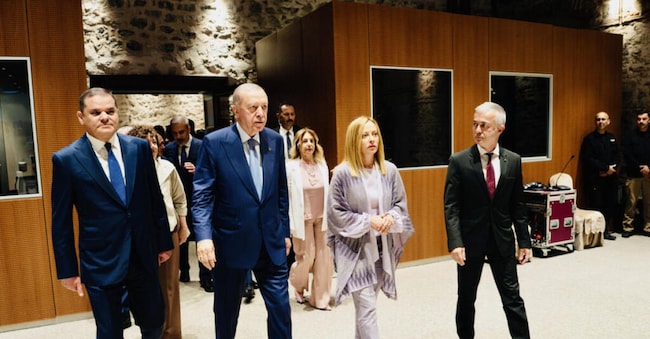
Italian diplomacy had, in any case, already experienced – even before the Turkey-Israel crisis in the strict sense – just how complex it is to navigate between Ankara and Rome’s Mediterranean interests regarding the Libyan issue, which now serves as a testing ground for relations with Turkey in the energy sector. The trilateral meeting in Istanbul in August 2025 between Erdoğan, the Libyan Prime Minister Abdulhamid Dbeibah and Meloni herself demonstrated Italy’s willingness to engage with Ankara on western Libya, whilst Rome simultaneously maintained channels of communication with eastern Cyrenaica through the Minister of the Interior, Matteo Piantedosi. ISPI notes that an institutionalised trilateral mechanism between Turkey, Italy and Libya, covering energy security and maritime jurisdiction – a scenario that would place Italy in a role of structural mediation precisely in the area where Turkey has used the 2019 maritime memorandum with Libya, registered with the United Nations, to legally challenge the route of the EastMed gas pipeline — the project around which the energy interests of Eni, the Israeli gas fields and Italy’s ambitions to become a supply hub for Europe most directly converge.

